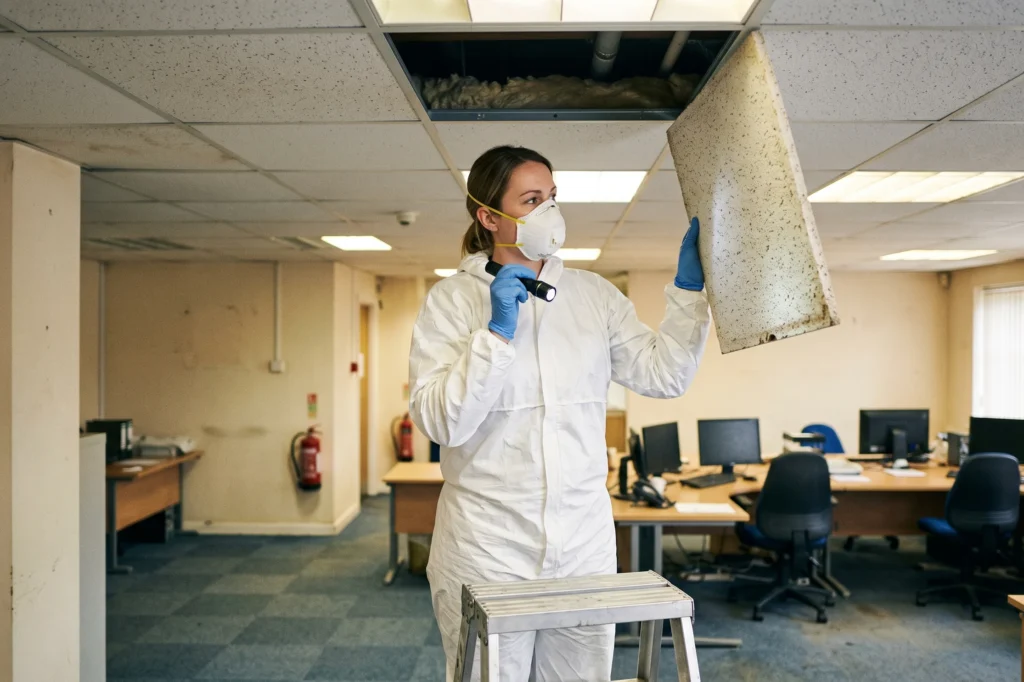
Commercial Building Asbestos Survey Under HSG264
Every non-domestic premises constructed before the year 2000 presents latent occupational liabilities that property managers must address systematically. Commissioning an authoritative commercial building asbestos survey provides the baseline technical data required to prevent accidental fibre exposure during routine business operations. Without accurate documentation, routine electrical, plumbing, or cabling work can breach concealed toxic materials. A comprehensive inspection protects visiting contractors, building tenants, and maintenance personnel. It also establishes compliance with the Control of Asbestos Regulations 2012.
British health regulations hold commercial landlords and facilities teams strictly accountable for the hazardous materials within their physical estates. Many dutyholders still struggle to determine whether their existing site paperwork satisfies current enforcement criteria or exposes them to serious legal penalties. How can your business build an inspection strategy that protects everyone on site and withstands HSE scrutiny?
Key Takeaways
- Regulation 4 of the Control of Asbestos Regulations 2012 requires dutyholders to find, assess and manage asbestos-containing materials in non-domestic premises.
- A standard management survey locates accessible asbestos during ordinary property operations without causing significant structural damage to the commercial fabric.
- HSE guidance recommends appointing surveying organisations accredited by UKAS to ISO/IEC 17020 to demonstrate competence and produce defensible registers.
- Bulk samples undergo analysis at laboratories accredited to ISO/IEC 17025 standards using polarised light microscopy to establish definitive fibre identification.
- Commercial building managers should re-inspect recorded materials and review the management plan regularly, typically every six to twelve months.
Commercial Inspection Standards and Survey Methodologies
UK regulations establish distinct survey strategies depending on whether a commercial building remains in normal daily occupation or faces major structural alteration. Choosing the correct methodology ensures that surveying teams target the appropriate building zones whilst minimising unnecessary operational disruption for commercial tenants across office complexes, retail premises, and industrial warehouses.
The Health and Safety Executive sets out inspection parameters in its guidance document HSG264 to help property managers align survey scopes with operational needs. The comparative table below outlines the core differences between standard management surveys and intrusive pre-construction inspections for non-domestic premises.
| Parameter | Management Survey | Refurbishment and Demolition Survey |
|---|---|---|
| Primary Objective | Maintain safe daily occupation | Identify ACMs prior to construction |
| Typical Scope | Accessible rooms and service voids | Intrusive inspection of entire fabric |
| Property Status | Occupied commercial space | Vacated work areas or isolated units |
| Structural Intrusion | Minimal non-destructive sampling | Destructive access to cavities and voids |
| Legislative Driver | CAR 2012 Regulation 4 | CAR 2012 Regulation 5 and CDM 2015 |
Statutory Obligations Under CAR 2012
Duty to Manage in Non-Domestic Premises
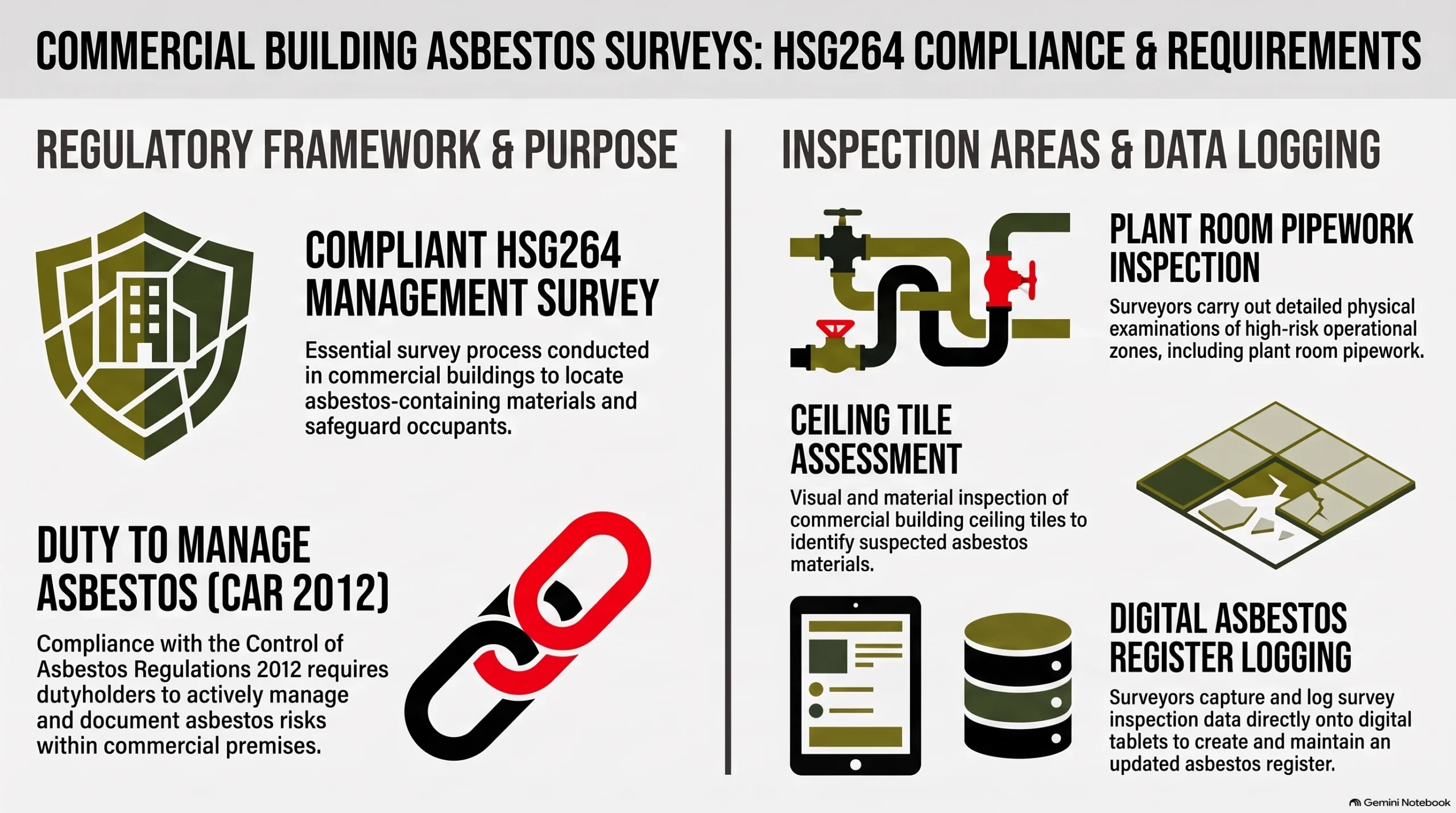
Regulation 4 of the Control of Asbestos Regulations 2012 assigns legal accountability directly to the commercial dutyholder. This designated individual or corporate entity must take reasonable steps to locate materials containing hazardous fibres. They must assess product conditions and establish a live register that informs all maintenance operatives before work commences.
Commercial leases often assign these duties across multiple parties. Landlords usually oversee common risers, plant rooms, and exterior roofs, whilst tenants manage internal demised office floors. Failure to establish clear maintenance boundaries leaves facilities vulnerable to enforcement notices. Both parties must collaborate to maintain an integrated building safety record.
Penalties and Regulatory Enforcement Actions
Health and Safety Executive inspectors can serve improvement notices or prohibition notices where dutyholders fail to manage asbestos. A prohibition notice stops the relevant activity until the risk is controlled. Serious breaches can lead to unlimited fines on conviction. Individual directors can also face prosecution where an offence involved their consent, connivance or neglect.
Local authorities also inspect commercial venues, retail spaces, and public buildings. Beyond direct regulatory intervention, civil courts hold non-compliant building owners liable for occupational illness claims brought by affected workers. Proactive survey records and risk management documentation provide the strongest evidence of compliance when defending enforcement action or civil claims.
HSG264 Management Survey Scope and Execution
Day-to-Day Operational Inspection Parameters
A standard HSG264 management survey evaluates all building areas accessed during ordinary occupancy, routine cleaning, and minor repairs. Surveyors inspect accessible ceiling voids, surface risers, basements, and mechanical plant rooms. The primary objective centres on ensuring occupants can use commercial facilities safely without inadvertently releasing respirable asbestos fibres.
Surveyors employ non-destructive techniques to preserve the integrity of decorated finishes during these inspections. If a specialist cannot access an unsealed duct or locked distribution cupboard, they record a formal presumption of asbestos. Presuming hazardous content ensures maintenance personnel treat uninspected spaces with stringent precautionary controls.
Non-Destructive Sampling and Presumption Protocols
Surveyors take discrete representative bulk samples of suspect materials using hand tools and water suppression techniques. Each sample is sealed within double polythene bags to prevent contamination during transit. Where sampling would cause excessive cosmetic damage, the surveyor records a reasoned presumption based on manufacturing dates and building typology.
A well-planned survey of commercial buildings balances thoroughness with business continuity. Surveyors label sample points discreetly and document precise architectural coordinates on building plans. This detailed spatial record eliminates confusion when external maintenance contractors arrive to service lighting fixtures, heating ducts, or pipe runs.
Did You Know?
The United Kingdom banned blue and brown asbestos in 1985. White asbestos (chrysotile) remained permitted until the full ban took effect on 24 November 1999. Any commercial building constructed or refurbished before 2000 may therefore contain asbestos.
Common Asbestos Materials in Commercial Estates
High-Risk Insulating Boards and Thermal Lagging
Asbestos insulating board and thermal pipe lagging represent severe inhalation hazards across older commercial properties. Contractors historically installed these materials around heating calorifiers, structural columns, and ceiling fire barriers. Due to their friable nature, these high-risk products release significant fibre clouds if subjected to minor impacts or mechanical vibration.
Plant rooms and service shafts frequently conceal degrading pipe insulation covered in canvas or painted calico wraps. Over decades of operation, thermal expansion and water leaks degrade the underlying binder matrix. Surveyors assign elevated material risk scores to these installations, recommending either licensed encapsulation or immediate removal.
Low-Friability Floor Tiles and Cement Cladding
Thermoplastic floor tiles, bitumen adhesive backings, and corrugated cement roof sheeting exhibit low friability under undisturbed conditions. Manufacturers bound chrysotile fibres tightly within cementitious or synthetic resin matrices to add strength and durability. These robust composite items rarely emit dangerous fibres unless operatives drill, saw, or crush the materials.
Industrial estates and suburban commercial parks built across post-war Britain feature extensive asbestos cement roofing. As these sheets weather over forty or fifty years, surface moss, freeze-thaw cycles, and acid rain embrittle the composite. Commercial building asbestos survey documentation flags external panel decay before water ingress damages interior stock.
Detailed ACM condition checks and regulatory compliance reports.
Technical Risk Assessment and Scoring Frameworks
Material Assessment Score Calculation
Surveyors calculate the material assessment score by evaluating four intrinsic parameters that govern potential fibre release. These factors include product type, extent of surface damage, surface treatment, and specific asbestos type. The cumulative score ranks items from low to high risk, providing an objective benchmark for ongoing facilities management.
A loose spray coating containing amosite or crocidolite scores substantially higher than a bonded vinyl floor tile containing chrysotile. The material assessment algorithm removes subjective guesswork from the survey document. It provides commercial property managers with a standardised metric to determine which materials demand immediate remediation or protective sealing.
Priority Assessment Scores for Active Workspaces
The priority assessment score evaluates the likelihood of occupant exposure based on specific workplace operational patterns. Dutyholders evaluate maintenance frequency, room occupancy levels, physical accessibility, and potential air movement across the item. Combining this operational rating with the surveyor’s material assessment produces a total risk score to govern actionable interventions.
A damaged ceiling board located within a high-traffic corridor requires urgent attention because hundreds of workers pass underneath daily. Conversely, an identical damaged board situated inside a secure, infrequently entered switch room presents lower overall exposure probability. Priority evaluations ensure commercial organisations allocate remedial budgets to genuine health threats.
Management, refurbishment, and demolition surveys for all property types.
Competence Standards and Quality Assurance
Surveyor Qualifications and UKAS ISO 17020 Accreditation
Technical surveying personnel must possess validated industry qualifications, such as the BOHS P402 certification, combined with practical site experience. The Health and Safety Executive strongly recommends appointing inspection bodies accredited to ISO/IEC 17020 by UKAS. This independent accreditation confirms that surveying firms operate rigorous technical quality systems.
UKAS accreditation requires organisations to demonstrate impartial judgement, calibrated inspection equipment, and ongoing surveyor audit trails. Employing non-accredited individuals introduces serious commercial liabilities if an unrecorded hazardous material causes accidental worker contamination. Professional property investors routinely insist upon ISO/IEC 17020 compliance during institutional property acquisitions.
Laboratory Analysis Standards Under ISO 17025
Laboratories processing bulk commercial samples must hold UKAS accreditation against the ISO/IEC 17025 testing standard. Qualified analysts examine material sub-samples using polarised light microscopy coupled with dispersion staining techniques. This rigorous scientific process identifies specific mineral types, including chrysotile, amosite and crocidolite.
Accredited testing facilities participate in regular proficiency testing programmes such as the Asbestos in Materials Scheme. Robust chain-of-custody protocols ensure that sample integrity remains intact from site extraction to final laboratory sign-off. Defensible laboratory certificates safeguard dutyholders against misidentification disputes with construction contractors or trade unions.
Asbestos Removal
Safe, certified removal of asbestos materials in line with HSE guidelines.
Asbestos Registers and Management Plan Reviews
Asbestos Registers and Digital Asset Mapping
The completed survey report must populate a dynamic asbestos register that records every confirmed or presumed hazardous material. Modern facilities managers integrate this data into digital asset software linked with annotated architectural drawings. Visual spatial mapping ensures in-house engineers and visiting contractors pinpoint hazardous installations before picking up tools.
Static paper binders stored in remote administrative offices fail to protect visiting trade contractors effectively. Cloud-based management systems allow facilities teams to share live registers instantly before issuing permits to work. Linking physical barcodes or warning labels to digital records ensures that external engineers verify material safety directly at the work face.
Periodic Re-Inspection and Review Protocols
Regulation 4 requires dutyholders to review and monitor the management plan at regular intervals. In practice, we find most commercial estates re-inspect every six to twelve months. Competent personnel must re-inspect every recorded material to evaluate whether physical wear, impact damage, or water leaks have degraded its condition. They update the register whenever an item deteriorates or is removed.
A neglected management plan creates severe legal exposure during Health and Safety Executive inspections. Re-inspection audits document subtle changes in material surface integrity, ensuring that minor deterioration does not escalate into catastrophic airborne contamination. Commercial property managers preserve these historical condition logs to demonstrate unbroken statutory diligence.
Refurbishment and Demolition Surveys for Project Works
Intrusive Inspection Requirements for Contractors
Standard management data is legally insufficient prior to structural alterations, electrical rewiring, or interior strip-out projects. Regulation 5 of CAR 2012 requires the presence of asbestos to be identified before disruptive work begins. HSG264 meets this through a refurbishment and demolition survey. This intrusive methodology breaks into structural cavities, sub-floor voids, and riser shafts to locate hidden materials.
Surveyors employ destructive techniques such as removing skirting boards, punching inspection holes in partitions, and lifting floorboards across the construction footprint. HSG264 expects the survey area to be vacated wherever possible to protect building occupants. The resulting report informs the pre-construction information pack required under the CDM Regulations 2015.
Four-Stage Clearance and Handover Verification
After licensed asbestos removal inside an enclosure, an independent analyst must complete the four-stage clearance procedure. Outlined in HSG248 guidance, this verification process combines visual structural inspections with air monitoring inside sealed enclosures. Analysts issue a formal Certificate of Reoccupation only when airborne fibre levels fall below clearance thresholds.
The four stages cover a preliminary check of site condition and job completeness, a thorough visual inspection inside the enclosure, and air monitoring with surface disturbance. A final assessment follows once the enclosure is dismantled. Analysts work for organisations accredited to ISO/IEC 17025 and remain independent of the removal contractor. This rigorous verification protects future tenants before general contractors re-enter renovated commercial spaces.
Final Thoughts
Securing a professional commercial building asbestos survey represents an indispensable operational obligation for modern facilities directors, corporate landlords, and estate managers. Systematically locating, assessing, and recording hazardous building elements eliminates the devastating health consequences of airborne fibre releases whilst shielding organisations from severe statutory penalties. Compliance demands an active commitment that begins with thorough baseline inspection and continues through disciplined re-inspection schedules.
As commercial property portfolios age across the United Kingdom, proactive hazardous material management underpins successful lease negotiations, safe fit-out projects, and asset value preservation. Property dutyholders who establish transparent registers, foster open contractor communication, and adhere strictly to technical standards build safer working environments for everyone occupying their commercial real estate.
Submit Enquiry
Frequently Asked Questions
Yes, Regulation 4 of the Control of Asbestos Regulations 2012 requires non-domestic property dutyholders to take reasonable steps to find asbestos-containing materials on their premises. This requirement applies to commercial offices, warehouses, retail spaces, and communal areas of multi-occupancy buildings built before 2000. Property owners and maintenance managers must conduct a formal survey to establish an up-to-date asbestos register. Operating without this technical baseline exposes organisations to HSE improvement notices, prohibition notices and criminal prosecution.
A management survey focuses on identifying materials that could be disturbed during routine building occupation, standard maintenance, and daily business operations. It relies on visual inspection and non-destructive bulk sampling of accessible surfaces. Conversely, a refurbishment and demolition survey is an intrusive, destructive investigation required before any structural remodelling or demolition occurs. This survey breaks through walls, lifts screeds, and opens concealed voids to locate all hidden hazardous materials within the specific project scope.
HSE guidance expects the asbestos register and management plan to be reviewed at regular intervals, and most commercial dutyholders re-inspect every six to twelve months. During these re-inspections, a competent individual must visually examine recorded materials to verify that paint coatings, sealants, and underlying surfaces remain undamaged. Furthermore, dutyholders must update the register immediately following any accidental damage, remedial encapsulation, or licensed abatement work. Keeping live digital records ensures external contractors always receive accurate safety information prior to commencing maintenance.
Commercial tenants can face direct prosecution if their formal lease agreement delegates repair and maintenance obligations for internal demised areas. The Control of Asbestos Regulations defines the dutyholder based on actual contractual maintenance responsibility. In full repairing and insuring leases, commercial tenants typically bear statutory accountability for inspecting and managing materials inside their tenancy. Landlords and tenants must carefully examine their lease terms to clarify legal boundaries and ensure neither party neglects mandatory surveying responsibilities.
Commercial asbestos surveyors should hold industry-recognised certifications, primarily the British Occupational Hygiene Society P402 qualification in surveying and sampling strategies, backed by extensive supervised practical experience. Additionally, dutyholders should appoint surveying organisations accredited to ISO/IEC 17020 by the United Kingdom Accreditation Service. This UKAS standard ensures the surveying organisation maintains robust quality management systems, calibrated technical equipment and strict procedural impartiality across all non-domestic property inspections.

Ora Asbestos Management Ltd
Unit A9, Seedbed Centre,
Shoeburyness, Southend-on-Sea SS3 9QY..
About the Author
Gordon Ringland is the founder, Director and principal asbestos surveyor at Ora. He holds the BOHS P402 qualification — the recognised industry standard for surveying and sampling strategies for asbestos in buildings — awarded by the British Occupational Hygiene Society (BOHS) Faculty of Occupational Hygiene (Certificate No. 20140911-32845-4254).
Gordon has over 12 years of hands-on experience in the asbestos industry, built on more than 20 years working in roofing. He carries out all three main survey types — management surveys, R&D surveys and re-inspections — and designs the sampling strategies used to find asbestos-containing materials (ACMs). He also leads non-licensed asbestos removal projects.
His work spans the full range of buildings, from residential garages and family homes to large commercial sites. Gordon has particular experience in heritage and museum environments, including listed buildings, where careful, fully compliant work matters most. He oversees Ora’s survey work and is the named author of our asbestos guides.