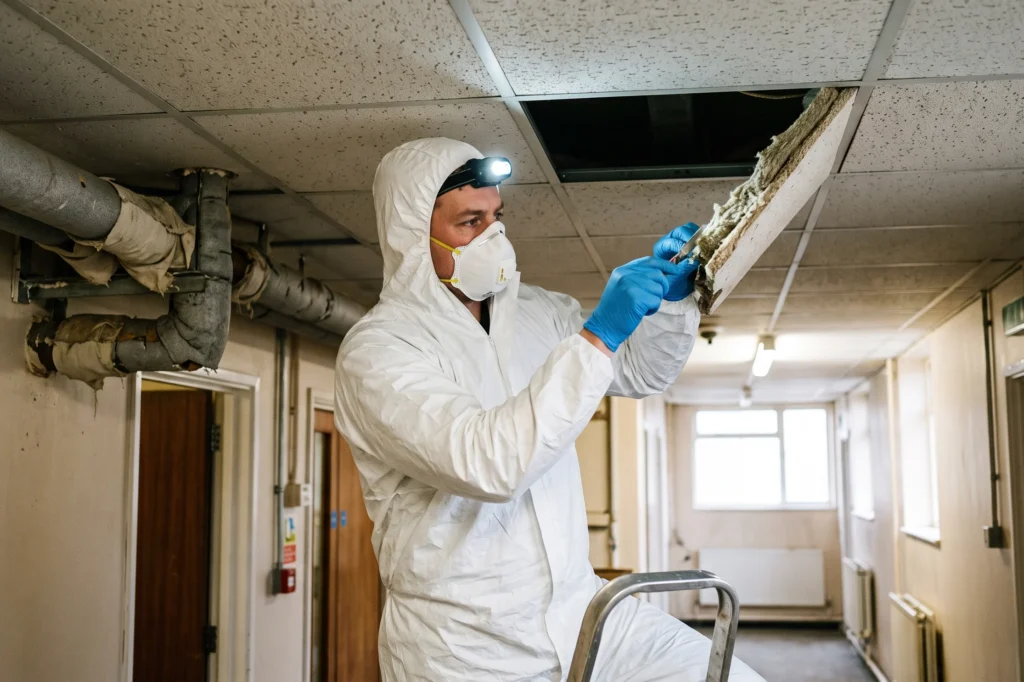
Facilities Management Asbestos Compliance Guide
Commercial estates across the UK carry a legacy of hazardous building materials. Facilities management asbestos duties sit at the centre of that risk. Any non-domestic building constructed before 2000 may contain asbestos insulating board, sprayed coatings or floor tiles. Estates teams must control that risk every day. Contractors, engineers and occupants all depend on it.
Poor control creates real legal exposure. A single drilled hole through asbestos insulating board can release fibres across an occupied floor. Enforcement action, project delays and civil claims follow quickly. Does your current estate framework identify, record and control every known or presumed material?
Key Takeaways
- Regulation 4 of CAR 2012 places a legal duty to manage asbestos on every non-domestic dutyholder.
- An FM asbestos programme needs an accurate register, scheduled re-inspections and permit-to-work control over every contractor.
- Management surveys cover normal occupancy, whereas refurbishment surveys are intrusive and mandatory before invasive works begin.
- Dutyholders must re-inspect material condition at risk-based intervals, and review the management plan at least every twelve months.
- Appoint surveyors accredited by UKAS to ISO/IEC 17020, and laboratories accredited to ISO/IEC 17025 for bulk analysis.
Statutory Operational Framework for Commercial Estates
The Control of Asbestos Regulations 2012 set explicit duties for anyone who controls non-domestic premises. Estates teams must find the materials, record them, and control the risk. Those duties apply to offices, warehouses, schools, retail units and industrial sites alike. The table below sets out the core components of a defensible programme.
In practice, these disciplines fail at the joins rather than the centre. Registers drift out of date. Contractors arrive without a briefing. Re-inspections slip past their due date. Each gap creates liability under British health and safety law. Build the components into daily routines, and the programme holds up under scrutiny.
| Operational Component | Statutory Driver | Estate Delivery Action |
|---|---|---|
| Register Verification | CAR 2012 Reg 4 | Catalogue all known or presumed ACMs across every zone. |
| Survey Commissioning | CAR 2012 Reg 5 | Commission HSG 264 compliant surveys prior to maintenance works. |
| Condition Assessment | ACoP L143 | Re-inspect material condition and surface integrity annually. |
| Contractor Control | CAR 2012 Reg 7 | Operate strict permit-to-work systems tied to the register. |
| Waste Consignment | Hazardous Waste Regulations | Retain full consignment documentation for at least three years. |

Duty to Manage Across Non-Domestic Portfolios
Core Dutyholder Responsibilities Under Regulation 4
Regulation 4 places a legal duty on whoever controls non-domestic premises. The dutyholder must find suspect materials, record their location and condition, and assess the risk. A written management plan must then set out the controls. The duty applies to every commercial asset built before the year 2000.
Lease structures decide who actually holds the duty. Estate leads must read the repairing covenants before assuming responsibility. In multi-tenanted buildings, common parts normally fall to the landlord or managing agent. Tenants usually hold the duty inside their demise. Write that split into the management plan. Ambiguity between landlord and tenant is where controls lapse.
Written Asbestos Management Plan Requirements
A compliant plan records the policies, processes and named roles that control fibre risk. It must cover inspection schedules, labelling, emergency procedures and contractor communication. The plan works as an operational manual, not a filing exercise. Site staff must reach it quickly, before any task that disturbs the fabric.
Review the plan at intervals no longer than twelve months. Update it immediately after any structural alteration. Changes in occupancy also trigger a review. From experience across the sector, plans fail because nobody owns them. Name a single accountable person. Give them the authority to stop work and the budget to act.
Survey Methodologies and Sampling Strategies
Management Surveys for Day-to-Day Building Occupation
A management survey records the location, type and condition of materials during normal occupancy. Surveyors inspect reasonably accessible areas without destructive opening-up. Where safe sampling is not possible, the material must be presumed to contain asbestos. The survey gives the estates team its working baseline for daily risk control.
Surveyors target what maintenance teams actually touch. That means pipe lagging, ceiling tiles, floor finishes, riser cupboards and plant rooms. The findings populate the register and drive the priority assessment. In practice, we find access is the weak point. Locked rooms and tenanted areas get logged as no access, then forgotten.
Refurbishment and Demolition Surveys for Project Delivery
A refurbishment and demolition survey is fully intrusive. Commission one before any structural alteration or invasive maintenance work. Surveyors open up cavities, sub-floor voids, risers and partition linings. The aim is to locate every asbestos-containing material inside the project envelope before contractors mobilise on site.
Scope the survey against the architect’s drawings and the engineering schematics. HSG 264 sets the technical standard for this work. A surface-level walk-round will not satisfy it. Proceeding without the survey breaches Regulation 5 of CAR 2012. It also invites the worst outcome on site: an unplanned discovery mid-strip-out, with the programme already running.
Did You Know?
The United Kingdom banned the import, supply and use of all asbestos in November 1999. The HSE estimates that around 1.5 million buildings in Great Britain still contain asbestos materials. Those materials remain lawful in place. The dutyholder must manage them under Regulation 4.
Live Register Maintenance and Condition Re-Inspections
Centralised Register Architecture and Accessibility
The asbestos register lists every identified or presumed material across the estate. Each entry records location, extent, product type, condition and risk score. Facilities teams must update the register the moment a material is encapsulated, removed or damaged. A register that lags behind reality offers no legal protection at all.
Digital platforms give contractors instant access from a phone or tablet. That removes the reliance on a printed folder in a remote FM office. Operatives can log damage during a walk-round and raise an action immediately. Across multi-site portfolios, this is the single biggest improvement most estates teams can make.
Mandatory Condition Monitoring and Risk Prioritisation
Materials degrade. Condition monitoring tracks that degradation, along with impact damage and general wear. The material assessment and the priority assessment combine into a single risk score. That score drives the maintenance plan and the capital budget. Re-inspection intervals follow the risk, capped at twelve months at the outside.
Not every item needs the same attention. Lagging in a busy plant room needs watching far more closely than sealed cement sheet in a roof void. Damaged pipe insulation, lifting floor tiles and deteriorating textured coating all demand prompt action. Record the condition score each time. A trend line across three inspections tells a facilities director when to budget for removal.
Detailed ACM condition checks and regulatory compliance reports.
Contractor Controls and Permit-to-Work Systems
Pre-Commencement Information Exchange
Every contractor must receive the relevant register information before work starts. Service partners then adjust their method statements to avoid disturbing recorded materials. A signed induction record proves the exchange happened. Without that record, the dutyholder has no evidence of compliance with Regulation 4 when an inspector asks.
A verbal warning at the gate is not information exchange. It leaves no audit trail and no proof of understanding. Issue the relevant register extract, not the whole document. Mark the specific rooms and services in scope. In practice, a one-page plan drawing with the materials marked works better than twenty pages of schedule.
Permit-to-Work Authorisation and Site Oversight
A permit-to-work system stops unauthorised drilling, cutting and abrasive work in areas with known or presumed materials. The permit fixes the work zone, the approved tools, the protective equipment and the precautions. Only a competent, authorised facilities manager may issue it. Nobody else signs, regardless of programme pressure on the day.
Spot checks matter more than the paperwork. Supervisors must verify that the contractor is working inside the permitted scope. Any deviation suspends the permit immediately. Review the site before work restarts. Structured permits prevent the accidental releases that trigger emergency shutdowns, decontamination costs and enforcement action.
Management, refurbishment, and demolition surveys for all property types.
Risk Scoring and Action Categorisation
Material Assessment Algorithms Under HSG 264
The material assessment scores how readily an item would release fibres if disturbed. Surveyors grade four factors: product type, extent of damage, surface treatment and asbestos type. Each factor carries its own points. Added together, they produce a material score between two and twelve. The surveyor owns this assessment.
Friable products score high. Sprayed coatings and unsealed insulating board sit at the top of the range. Firmly bound products score low. Thermoplastic floor tiles and sound asbestos cement sheet sit at the bottom. The score reflects fibre release potential, not urgency. A low-scoring material in a busy corridor can still demand action.
Priority Assessment Integration for Capital Planning
The priority assessment covers how the building is used. It weighs occupant activity, likelihood of disturbance, maintenance access and the number of people exposed. The dutyholder leads it, because the dutyholder knows the building. Combine it with the material score, and each item carries one overall risk rating.
Those ratings set the action categories. Some items go on the removal programme. Some need encapsulation or sealing. Most stay in place under planned monitoring. Transparent scoring lets an estates director defend the capital plan to the board. It also stops money going to low-risk material whilst a genuine hazard sits untouched.
Asbestos Removal
Safe, certified removal of asbestos materials in line with HSE guidelines.
Competence, Accreditation, and Quality Assurance
Surveyor Competence and ISO/IEC 17020 Accreditation
Check competence before appointing anyone. Surveyors need qualifications, current field experience and demonstrable technical knowledge. The HSE recommends inspection bodies holding UKAS accreditation to BS EN ISO/IEC 17020. That accreditation gives independent assurance of capability, impartiality and internal quality control. Price alone is a poor basis for appointment.
Individual surveyors should hold the BOHS P402 qualification or equivalent. Ask for the certificates, not the claim. Check that professional indemnity cover explicitly includes asbestos risk assessment. An unaccredited survey that misses a material transfers the whole liability back to the dutyholder. That liability does not disappear because a contractor quoted cheaply.
Laboratory Standards Under ISO/IEC 17025
Bulk samples belong in a laboratory accredited by UKAS to BS EN ISO/IEC 17025. Accredited laboratories follow HSG 248 and identify fibres using polarised light microscopy. Accreditation protects against cross-contamination and inconsistent results. It also produces a certificate of analysis that stands up as evidence.
Ask whether the laboratory takes part in a recognised proficiency testing scheme such as AIMS. Keep the original analysis certificates with the survey report. Traceability matters when a material is challenged years later. Sound laboratory data also prevents needless removal. Presumed asbestos that tests negative saves an estate significant expenditure.
Incident Response, Enclosure Management, and Clearance
Emergency Response Procedures for Accidental Fibre Release
Damage to an asbestos-containing material triggers the emergency procedure straight away. Clear the area. Seal the entrances. Shut down local ventilation and isolate mechanical services feeding the space. Put warning notices on every access point. Nobody re-enters the compartment until a competent analyst has established the extent of contamination.
Engage an asbestos consultancy immediately. Analysts use static air monitoring and settled dust sampling to map the contaminated boundary. Clean-up of friable material requires a licensed removal contractor. That work runs under a Plan of Work prepared to Regulation 7. Record the whole incident. The HSE will ask for the chronology if it investigates.
Four-Stage Clearance and Re-Occupation Verification
Licensed removal work ends with a four-stage clearance before anyone returns to the space. An independent UKAS-accredited analyst runs the procedure set out in HSG 248. Independence from the removal contractor is the point. The clearance confirms visual cleanliness and air quality before the enclosure comes down.
Stage one checks the site condition and job readiness; stage two is a thorough visual inspection of the cleaned surfaces. Stage three involves air testing inside the enclosure, with fibre levels required below 0.01 f/ml and finally stage four is a final visual check after the enclosure comes down. Only then does the analyst issue the Certificate of Reoccupation.
Final Thoughts
Facilities management asbestos control is not an annual paperwork exercise. It runs on three things: an accurate register, re-inspections that actually happen, and permits that contractors respect. Embed those into procurement, maintenance and project workflows. The statutory duty under CAR 2012 then takes care of itself. Treat it as a bolt-on, and it will fail at the first drilled hole.
Estates are changing. Adaptive reuse, fit-out churn and plant replacement disturb building fabric more often than a decade ago. Cloud-based registers and mobile condition reporting make live data realistic across a multi-site portfolio. The direction of travel is clear. Programmes built on current, accessible data will hold up. Those built on filed reports will not.
Submit Enquiry
Frequently Asked Questions
A:
Regulation 4 of the Control of Asbestos Regulations 2012 is the principal duty. It applies to anyone who controls non-domestic premises. The dutyholder must find suspect materials, record their location and condition, and assess the risk. A written management plan must then set out the controls. That plan needs regular review, and it must be available to anyone working on site. The duty exists to protect maintenance staff, contractors and building occupants from accidental exposure.
A:
Update the register immediately after any removal, encapsulation, remediation or accidental damage. There is no waiting period. Separately, condition re-inspections should run at intervals set by risk, and no longer than twelve months. Higher-risk materials in busy areas warrant more frequent checks. The recorded condition must reflect the actual state of the material at all times. Digital registers make this far easier across multiple sites, because operatives can log changes during a walk-round.
A:
A management survey covers normal occupancy. It identifies accessible materials that routine maintenance or cleaning could disturb, without destructive opening-up. A refurbishment and demolition survey is intrusive. Surveyors open cavities, voids, risers and linings to find every material inside the project area. You need a management survey to run the building safely. You need a refurbishment survey before any invasive work begins. Skipping the second one risks unplanned discoveries, project delays and exposure incidents.
A:
The dutyholder is whoever holds responsibility for maintenance and repair of the premises. That responsibility usually comes from a contract or a tenancy agreement. In commercial property, it typically rests with the freeholder, the tenant or a managing agent. The repairing covenants in the lease decide it. Where no contract exists, the duty falls to whoever controls the premises. In multi-tenanted buildings, the landlord or managing agent normally holds the duty for corridors, stairwells and shared plant rooms.
A:
Four-stage clearance follows licensed removal work and is governed by HSG 248. An independent UKAS-accredited analyst carries it out. Stage one is a preliminary check of the site and the enclosure; stage two is a detailed visual inspection of the cleaned area. Stage three is air testing inside the enclosure, requiring fibre levels below 0.01 fibres per millilitre, and finally stage four is a final visual check after the enclosure is removed. The analyst then issues a Certificate of Reoccupation.

Ora Asbestos Management Ltd
Unit A9, Seedbed Centre,
Shoeburyness, Southend-on-Sea SS3 9QY..
About the Author
Gordon Ringland is the founder, Director and principal asbestos surveyor at Ora. He holds the BOHS P402 qualification — the recognised industry standard for surveying and sampling strategies for asbestos in buildings — awarded by the British Occupational Hygiene Society (BOHS) Faculty of Occupational Hygiene (Certificate No. 20140911-32845-4254).
Gordon has over 12 years of hands-on experience in the asbestos industry, built on more than 20 years working in roofing. He carries out all three main survey types — management surveys, R&D surveys and re-inspections — and designs the sampling strategies used to find asbestos-containing materials (ACMs). He also leads non-licensed asbestos removal projects.
His work spans the full range of buildings, from residential garages and family homes to large commercial sites. Gordon has particular experience in heritage and museum environments, including listed buildings, where careful, fully compliant work matters most. He oversees Ora’s survey work and is the named author of our asbestos guides.