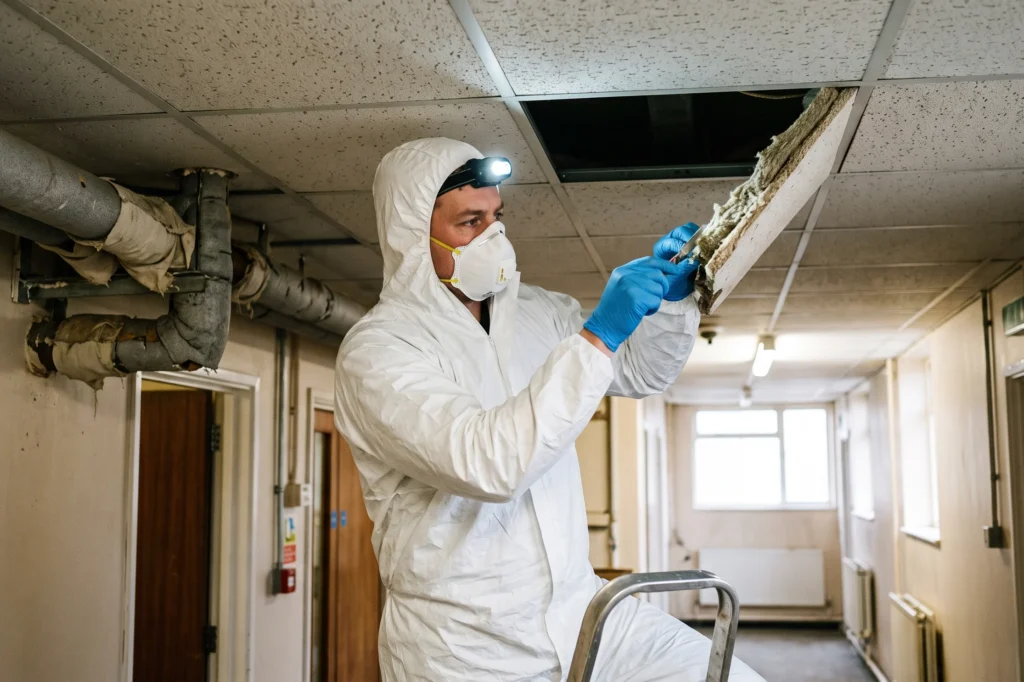
Public Sector Asbestos Duties for Estates Teams
Estates managers in local authorities, NHS trusts and government departments carry legal accountability for building safety. Public sector asbestos duties sit with the organisation that controls repair and maintenance. Thousands of civic properties built before 2000 still contain legacy materials. Continuous compliance demands proactive surveys, accurate records and prompt risk assessment. Without them, routine maintenance can release fibres into occupied space.
Uncontrolled fibre release exposes an organisation to unlimited fines, project delays and long-tail health liabilities. Estates teams must balance routine repairs against strict statutory duties across large, mixed portfolios. In practice, the weak point is rarely the register itself. It is the moment a contractor picks up a drill. Do your current procedures guarantee compliance whilst protecting occupants during everyday maintenance and capital works?
Key Takeaways
- Regulation 4 of the Control of Asbestos Regulations 2012 places a direct statutory duty to manage asbestos on public sector dutyholders.
- Dutyholders must keep an accurate register recording the location, condition and risk rating of every known or presumed asbestos-containing material.
- Estates teams must commission an intrusive refurbishment survey before any destructive maintenance, structural alteration or demolition work begins on site.
- Contractors and in-house trades must read the register and receive a site induction before they start any invasive task.
- Health records under Regulation 22 must be retained for forty years, supporting future claims defence and occupational health review.
Statutory Duties Across a Public Sector Estate
Public sector estates teams carry several distinct duties under the Control of Asbestos Regulations 2012. Every non-domestic building constructed before 2000 needs active oversight, a verified register and planned re-inspection. The table below sets out the main obligations, their legislative driver, the required action and the expected frequency.
Clear accountability prevents the two failures we see most often: an out-of-date register and an uninformed contractor. HSE inspectors routinely audit schools, hospitals and civic buildings. They check whether the management plan reflects actual site conditions. Structured protocols let dutyholders meet their legal standards whilst reducing exposure risk across a complex estate.
| Statutory Obligation | Legislative Driver | Required Action | Operational Frequency |
|---|---|---|---|
| Duty to manage asbestos | CAR 2012 Regulation 4 | Maintain a written management plan and register | Continuous review, annual re-inspection |
| Identification before work | CAR 2012 Regulation 5 | Commission an intrusive refurbishment and demolition survey | Before any refurbishment or demolition |
| Contractor work planning | CAR 2012 Regulation 7 | Approve a written plan of work | Pre-start review for every invasive task |
| Air monitoring and clearance | CAR 2012 Regulations 19 to 21 | Commission four-stage clearance by a UKAS-accredited analyst | After removal, before reoccupation |
| Health and exposure records | CAR 2012 Regulations 19 and 22 | Retain health records and personal exposure data | 40 years; 5 years for general air monitoring |

Core Statutory Duties Under Regulation 4
Portfolio Surveys for Presumed Hazardous Materials
Estates teams must inspect all non-domestic buildings constructed before the year 2000 to identify potential hazardous materials. Where access is restricted or testing is delayed, dutyholders must presume materials contain asbestos until proven otherwise. This presumption ensures that facility managers protect building occupants and trade workers during regular property operations.
Regulation 4 defines the explicit duty to manage asbestos in non-domestic premises. Public sector bodies often control mixed portfolios: offices, libraries, depots, health centres and primary schools. Teams should review historical architectural records, original construction drawings and past refurbishment contracts. From experience across the sector, the gaps sit in ceiling voids, pipe ducts and service shafts. Presuming presence in those areas prevents inadvertent disturbance.
Operational Asbestos Registers for Facility Records
A compliant asbestos register records the location, quantity, material type and surface condition of every identified or presumed hazard. Dutyholders must keep this document on site and update entries immediately following any material repairs or abatement projects. The register underpins day-to-day safety management across public buildings and civic properties.
Digital registers suit multidisciplinary teams managing dispersed public estates. Facilities managers, safety representatives and visiting trades all need access to it. Centralised software lets site staff log condition changes in real time across multiple buildings. When an external contractor signs in, the site lead must issue the relevant register entries first. A register locked in an office filing cabinet protects nobody.
Survey Protocols for Public Property
Baseline Management Surveys for Active Facilities
Management surveys locate and evaluate asbestos-containing materials that occupant activities or routine maintenance could disturb during daily operations. Surveyors conduct systematic visual inspections of all accessible rooms, service corridors and exterior elevations without damaging the structural fabric. The resulting data enables estates teams to formulate practical maintenance plans and control measures.
HSG 264 sets out standard procedure for management surveys across estates public buildings. Surveyors take representative bulk samples of suspected textured coatings, vinyl tiles and insulation for laboratory analysis. Where sampling would compromise building fabric or occupant safety, the surveyor records a reasoned presumption instead. Estates directors rely on these baseline reports to hold a defensible compliance position.
Intrusive Refurbishment Surveys Before Capital Works
Refurbishment and demolition surveys locate all concealed hazardous materials before invasive construction, structural alterations or demolition projects commence. These intrusive inspections require destructive access methods to examine wall cavities, underfloor voids and enclosed structural risers. Estates teams must commission these targeted surveys to prevent catastrophic fibre release during planned upgrades.
A management survey does not provide enough depth for invasive capital work. Under the Construction (Design and Management) Regulations 2015, the client must supply adequate pre-construction information. That information goes to designers and the principal contractor before work starts. A refurbishment survey defines the precise boundary of the works. Specialist teams can then remove hazardous materials before structural trades arrive on site.
Did You Know?
The Health and Safety Executive attributes around 5,000 deaths each year in Great Britain to past asbestos exposure. The UK banned all remaining forms of asbestos in 1999. The deaths occurring now stem from exposure decades earlier, which is why buildings completed before 2000 are treated as suspect.
Risk Prioritisation and Assessment Scoring
Material Risk Scoring for Fibre Release Potential
The material assessment algorithm evaluates the intrinsic potential of an asbestos product to release dangerous fibres when disturbed. Surveyors assess four critical parameters: product type, degree of damage or deterioration, surface treatment, and specific asbestos fibre type. This calculation yields an objective numerical score that establishes basic material vulnerability.
HSG 264 details the scoring parameters for material assessment. Friable products score highest: sprayed coatings and thermal pipe insulation release fibres readily. Well-bound composites score lower under the same physical conditions, including thermoplastic floor tiles and asbestos cement sheets. Estates officers use the material score to flag items needing encapsulation, sealing or planned removal.
Priority Assessment for Building Occupant Exposure
The priority assessment measures operational factors that influence human exposure to hazardous materials during routine occupancy. Estates teams evaluate occupant activity levels, maintenance frequency, material accessibility, and the average number of daily visitors. Combining priority scores with material ratings establishes a clear hierarchy for proactive management and remedial capital expenditure.
A surveyor cannot complete the priority assessment alone. Operational estate staff know how each space actually functions. They understand pupil flows in a school corridor or access frequency in a plant room. A high priority score signals a real chance of accidental disturbance. In practice, we find remedial budgets should go to high-traffic communal areas before locked basement plant rooms.
Detailed ACM condition checks and regulatory compliance reports.
Control Measures for External Contractors
Pre-Work Information Sharing and Site Inductions
Dutyholders must share the building asbestos register with all external contractors and trade personnel prior to any site work. Facilities managers must conduct comprehensive safety inductions that verify contractors understand the location of known hazardous materials. This mandatory step prevents tradespeople from drilling into unrecorded panels or disturbing concealed thermal lagging.
Accidental disturbance by trades remains the main cause of modern exposure incidents. Estates teams should run a formal permit-to-work system for electrical, plumbing and fabric maintenance. Contractors sign to confirm they have read the relevant register entries. Site leads must challenge anyone working without a verified permit or induction. The administrative burden is small compared with a prohibition notice.
Written Plans of Work for Maintenance Staff
Regulation 7 requires a formal written Plan of Work before any contractor or operative undertakes tasks likely to disturb asbestos. The document must define task scope, containment methods, required respiratory protective equipment, waste management procedures, and site emergency arrangements. Estates teams must scrutinise these detailed plans before approving contractor attendance.
Approved Code of Practice L143 sets out what a compliant method statement contains. For non-licensed work, operatives follow the HSE Asbestos Essentials task sheets to control dust. Licensed work demands more: diagrams of the negative-pressure enclosure, decontamination unit and transit routes. Managing asbestos public sector estates depends on this administrative check happening before anyone lifts a tool.
Management, refurbishment, and demolition surveys for all property types.
Air Monitoring Protocols and Enclosures
Static Testing and Statutory Exposure Limits
Independent air monitoring verifies that dust suppression and containment systems successfully restrict airborne fibres below statutory thresholds. UK regulations establish an occupational control limit of 0.1 fibres per cubic centimetre over a four-hour reference period. Dutyholders use static area sampling around work enclosures to ensure adjacent occupied areas remain entirely uncontaminated.
Regulations 19 to 21 govern air monitoring, analysis and analyst competence. Competent analysts draw a calibrated air volume through a membrane filter. They then count fibres using phase contrast optical microscopy. If reassurance sampling outside an enclosure exceeds 0.01 fibres per millilitre, work stops. Estates teams must then check seals, pressure differentials and airlock integrity before anyone restarts.
Four-Stage Clearance for Area Handover
Before reoccupying an area after licensed asbestos removal, dutyholders must obtain a formal Certificate of Reoccupation following a four-stage clearance. An independent UKAS-accredited analyst inspects cleanliness, verifies drying, performs disturbance air testing, and conducts a final post-enclosure audit. This statutory process guarantees that spaces are safe for public re-entry.
HSG 248 governs the four-stage clearance procedure. Stage one is a preliminary check of site condition and job completeness, stage two is a thorough visual inspection of the enclosure and its surfaces. Following this stage three measures airborne fibre concentration under disturbed conditions, requiring a result below 0.01 fibres per millilitre. Stage four confirms the site is clean after the enclosure comes down.
Asbestos Removal
Safe, certified removal of asbestos materials in line with HSE guidelines.
Quality Standards for Appointed Contractors
UKAS Accreditation and Technical Competence
Estates teams should appoint asbestos surveying organisations holding UKAS accreditation to ISO/IEC 17020 to ensure technical competence and impartiality. Individual surveyors must hold formal professional qualifications such as the BOHS P402 certification alongside demonstrable field experience. Choosing accredited suppliers protects public authorities from inadequate surveys and subsequent regulatory enforcement.
The Health and Safety Executive treats UKAS accreditation as the benchmark for surveying and analytical bodies. Accredited organisations face third-party audit, desktop review and in-progress field assessment. Bulk sampling laboratories need accreditation to ISO/IEC 17025 and must join external proficiency testing schemes. These standards deliver analytical precision and documentation that stands up under scrutiny.
Licensed Contractors for High-Risk Removals
Work involving friable materials like sprayed asbestos coatings, thermal lagging or asbestos insulating board requires an HSE-licensed removal contractor. These higher-risk products release dangerous respirable fibres rapidly upon disturbance, requiring sophisticated containment engineering and medical surveillance. Public sector organisations must verify licence validity and contractor performance records before awarding removal contracts.
An HSE licence confirms that a contractor holds competent personnel, specialist plant and tested procedures. Unlicensed operatives may only carry out short-duration, lower-risk work on firmly bound materials. That covers asbestos cement sheeting and vinyl floor tiles, not sprayed coatings. Estates managers should review training matrices, equipment maintenance logs and health surveillance files before award.
Long-Term Record Retention and Annual Audits
Mandatory Annual Re-Inspections of Known Materials
Dutyholders must review the asbestos management plan at regular intervals. HSE guidance sets the practical benchmark at a formal re-inspection every twelve months. Re-inspection tracks degradation, surface wear and accidental damage across operational buildings. Regular monitoring lets estates teams update condition ratings and order repairs before fibres reach occupied space.
Building use changes over time, and previously sound materials start to suffer. High footfall in a school corridor can scuff an encapsulated board. Storage changes in a hospital plant room can damage lagging. A qualified surveyor judges whether protective coatings remain intact and updates the register score. Any deteriorated material needs attention before normal operations continue.
Forty-Year Retention for Exposure Files
Regulation 22 requires employers to keep health surveillance records for at least forty years. Regulation 19 sets a five-year retention period for air monitoring records. That rises to forty years where the record represents the personal exposure of an identifiable employee. Public sector bodies must store these archives securely and retrievably.
Asbestos-related disease appears decades after first exposure. Exposure logs and clearance certificates therefore hold evidential value long after a project closes. Estates teams should hold electronic copies in a backed-up document management system. Accessible archives let a public authority demonstrate compliance when an inspector or claimant solicitor asks. Paper records in a decommissioned depot are worthless.
Final Thoughts
Managing public sector asbestos comes down to three things: an accurate register, disciplined re-inspection and tight contractor control. Estates teams run portfolios used daily by staff, pupils, patients and the public. Regulation 4 compliance protects those people and shields the organisation from enforcement. The register only works if the people holding drills actually read it.
Public estates are moving towards digitised asset data and live condition records. Linking the register into wider facilities management software shortens audit time and speeds up risk mitigation. Competence, structured oversight and transparent documentation remain the foundation. Build those now, and the estate stays safe and compliant for decades.
Submit Enquiry
Frequently Asked Questions
A:
The dutyholder is whoever has clear contractual responsibility for maintaining and repairing the premises. In the public sector that is usually the local authority, the NHS trust, the academy trust or the governing body. Where no contract exists, the duty falls on whoever controls the premises. The dutyholder must find or presume asbestos, record it and assess the risk. They must also write a management plan and tell anyone likely to disturb the material.
A:
Review the management plan at regular intervals and re-inspect recorded materials at least once a year. That is the HSE benchmark rather than a fixed figure in the regulations. Update the register immediately whenever a material is damaged, altered, encapsulated or removed. Also update it after any building alteration. Re-inspection confirms whether boards, coatings and lagging have degraded under operational wear. Live records protect contractors and building users from unexpected disturbance.
A:
Estates teams must commission a refurbishment and demolition survey before any work that disturbs the building fabric. A management survey only covers surfaces reachable during normal occupation. The refurbishment version is destructive. Surveyors open up wall cavities, floor ducts, risers and ceiling voids inside the project boundary. Public sector bodies must complete the survey before contractors start, not alongside them. Doing it late is the most common cause of a stopped site.
A:
Licensed work covers higher-risk friable materials. That includes sprayed coatings, loose fill, thermal lagging and most work on asbestos insulating board. These products release large quantities of respirable fibre the moment someone disturbs them. Licensed contractors use negative-pressure enclosures, decontamination units and controlled transit routes. Some minor, short-duration work on asbestos insulating board is notifiable but non-licensed. Check the HSE decision flowchart rather than assuming either way.
A:
Asbestos-related conditions such as mesothelioma and asbestosis have very long latency periods. Symptoms often appear thirty or forty years after the exposure that caused them. Regulation 22 therefore requires employers to keep health records for at least forty years. Air monitoring records under Regulation 19 run for five years. That extends to forty years where the record shows the personal exposure of an identifiable worker. Long archives support medical evidence and defend the organisation against historical claims.

Ora Asbestos Management Ltd
Unit A9, Seedbed Centre,
Shoeburyness, Southend-on-Sea SS3 9QY..
About the Author
Gordon Ringland is the founder, Director and principal asbestos surveyor at Ora. He holds the BOHS P402 qualification — the recognised industry standard for surveying and sampling strategies for asbestos in buildings — awarded by the British Occupational Hygiene Society (BOHS) Faculty of Occupational Hygiene (Certificate No. 20140911-32845-4254).
Gordon has over 12 years of hands-on experience in the asbestos industry, built on more than 20 years working in roofing. He carries out all three main survey types — management surveys, R&D surveys and re-inspections — and designs the sampling strategies used to find asbestos-containing materials (ACMs). He also leads non-licensed asbestos removal projects.
His work spans the full range of buildings, from residential garages and family homes to large commercial sites. Gordon has particular experience in heritage and museum environments, including listed buildings, where careful, fully compliant work matters most. He oversees Ora’s survey work and is the named author of our asbestos guides.