Refurbishment Asbestos Survey: R&D Construction Guide
Every major construction, refit, or structural alteration project carries significant operational risks when disturbing older property fabric. Commissioning a refurbishment asbestos survey before works commence protects site contractors and shields commercial developers from costly project delays. Under United Kingdom safety regulations, standard visual audits do not provide adequate protection prior to structural works. Principal contractors must locate all hazardous fibres concealed within walls, risers, and voids to maintain compliance and keep active sites safe.
Failing to identify concealed hazardous materials creates immediate health hazards and exposes commercial developers to heavy statutory penalties. When unexpected contamination suddenly halts site progress, emergency containment inflates budgets and severely disrupts handover programmes. Are your construction teams and external contractors fully protected against the hidden commercial and legal risks embedded within pre-2000 building assets across the region?
Key Takeaways
- A refurbishment survey provides a fully intrusive, destructive inspection designed to uncover all hidden asbestos-containing materials prior to structural alterations.
- Dutyholders must commission targeted surveys under Regulation 5 of the Control of Asbestos Regulations 2012 before undertaking major invasive building projects.
- Management surveys inspect only accessible surfaces, whereas refurbishment and demolition protocols actively breach partitions, floor slabs, and sealed ceiling voids.
- Survey data informs the pre-construction information pack required by the Construction Design and Management Regulations to safeguard contractors from accidental exposure.
- Failure to identify hazardous materials before site strip-out frequently triggers HSE prohibition notices, unexpected project delays, and severe financial consequences.
Survey Specifications for Commercial Building Projects
Selecting the appropriate survey type ensures dutyholders comply with United Kingdom asbestos regulations. Standard management inspections assess only visible and surface materials during normal building occupation. In contrast, intrusive project surveys break into the building fabric to find concealed products before demolition or structural refits begin on site.
The comparative data below outlines the primary boundaries, access methodologies, and project triggers across core asbestos survey classes. Specifying the correct inspection scope prevents costly project stoppages, eliminates contractual disputes, and safeguards all construction operatives during invasive works across commercial properties.
| Survey Type | Inspection Scope | Destructive Access Required | Primary Purpose |
|---|---|---|---|
| Management Survey | Surface and readily accessible materials | No destructive methods used | Day-to-day occupancy and routine maintenance |
| Refurbishment Survey | Targeted areas undergoing structural changes | Yes, within defined project boundary | Pre-construction planning and safe contractor strip-out |
| Demolition Survey | Entire structure across all internal voids | Yes, comprehensive destructive entry | Full structural clearance prior to building removal |
Statutory Duties and the Regulatory Framework
Control of Asbestos Regulations 2012 Requirements
Regulation 5 requires employers and dutyholders to identify all asbestos-containing materials before initiating invasive work. This statutory requirement prevents inadvertent fibre release during structural interventions. Failure to commission an adequate inspection breaches safety legislation, leading to substantial fines or site prohibition notices from the Health and Safety Executive.
The Approved Code of Practice L143 provides practical guidance on executing these duties. Property owners must never assume an uninspected area is free of asbestos. If historical records lack definitive laboratory analysis, dutyholders must presume high-risk materials exist until fully intrusive sampling proves otherwise.
Construction Design and Management Coordination
The Construction Design and Management Regulations 2015 require commercial clients to share pre-construction information. Delivering an intrusive survey report ensures principal designers and contractors account for hazardous substrates within method statements. This shared intelligence allows contractors to design appropriate engineering controls before deploying trades to the workface.
Integrating survey findings into early procurement documents eliminates unexpected contract variations. When demolition teams know exact material locations, they schedule licensed remediation contractors efficiently. Clear communication across the supply chain protects overall project timelines whilst safeguarding workers against airborne hazards.
Destructive Methodology in Refurbishment Surveys
Targeted Destructive Inspection Techniques
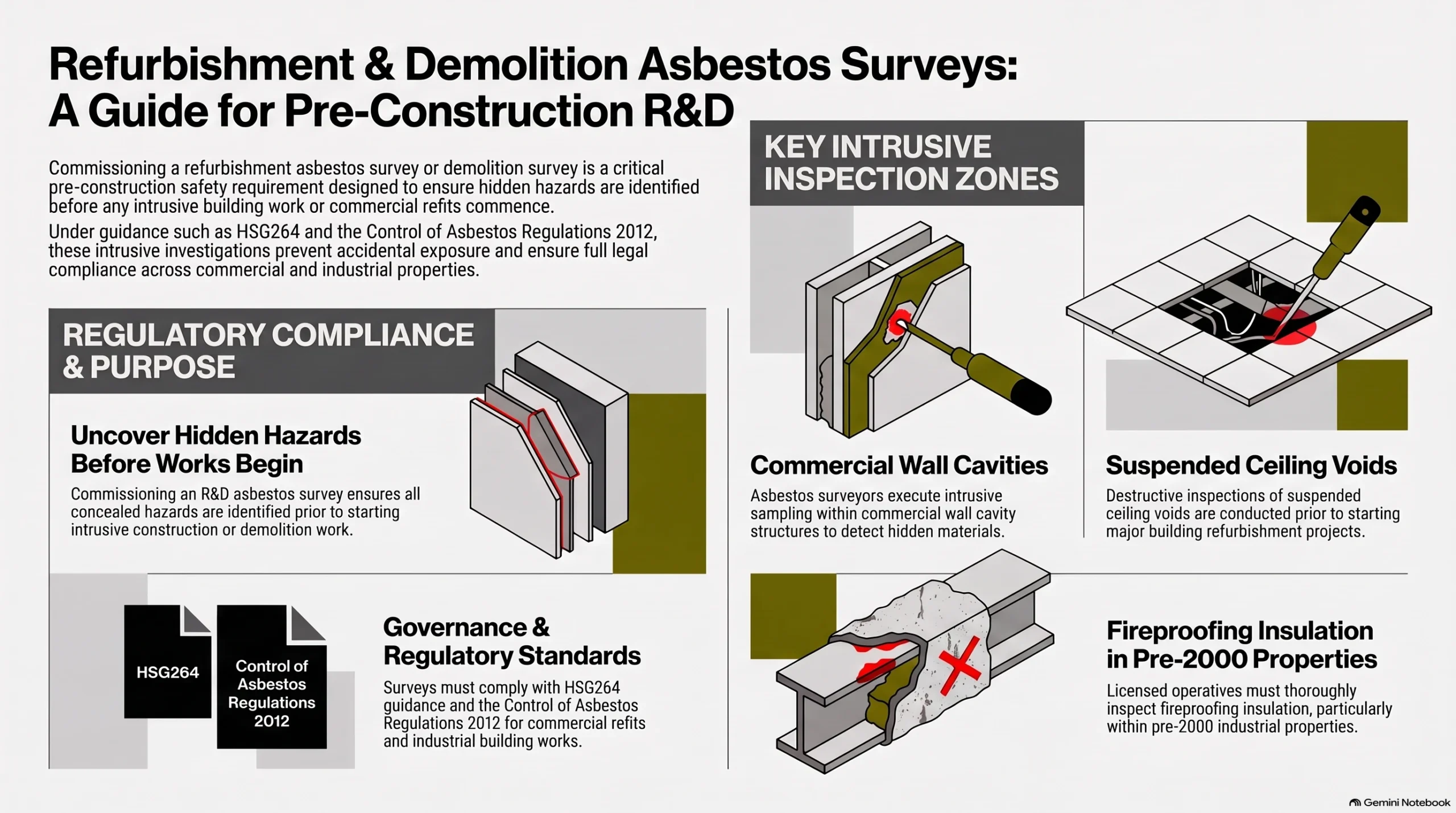
Destructive inspection requires surveyors to break through structural surfaces to expose concealed cavities and chases. Survey teams deliberately cut inspection hatches, core through masonry, and lift fixed flooring to examine hidden areas. This aggressive approach ensures no hidden insulation boards or pipe lagging escape documentation.
Surveyors adapt their destructive methods to the planned architectural alterations. If a developer intends to remove an internal partition, the surveyor inspects the interior stud framing, head track, and floor junctions. By focusing damage strictly on areas designated for demolition, the survey team protects building elements scheduled for preservation.
High-Risk Structural Voids and Service Risers
Service risers, lift shafts, and ceiling plenums represent prime locations for high-risk thermal insulation products. Surveyors inspect enclosed risers where past contractors routed heating pipes lagged with amphibole asbestos. These confined spaces frequently contain debris from historic maintenance activities carried out before current containment standards existed.
Gaining safe access to service voids often demands specialist isolation procedures. Surveyors coordinate with facility managers to lock out live electrical feeds and mechanical plant before entering risers. Thorough investigation of these hidden conduits prevents trades from severing live asbestos insulation during subsequent refurbishment operations.
Did You Know?
The Control of Asbestos Regulations 2012 set a single control limit of 0.1 asbestos fibres per cubic centimetre of air, averaged over a continuous four-hour period. Employers must ensure no employee is exposed above this limit, whatever the asbestos type.
Project Surveys Compared with Management Audits
Core Boundaries of Refurbishment Scope
A refurbishment asbestos survey differs from a management survey by focusing strictly on areas affected by construction. Whilst management surveys ensure daily occupant safety, refurbishment assessments facilitate intrusive work. The surveyor establishes clear spatial limits aligned precisely with the proposed scope of works provided by the project architect.
Confining the survey to specific work zones prevents unnecessary property damage in occupied areas. If an office fit-out affects only the second floor, the surveyor limits intrusive access to that single level. Dutyholders must supply accurate architectural drawings so the survey team defines appropriate inspection perimeters.
Full Demolition Survey Requirements
A demolition survey requires complete destructive access across every element of a structure prior to teardown. Unlike targeted refurbishments, demolition protocols leave no structural fabric unbreached, including foundations, sub-floor voids, and external claddings. The objective involves locating all hazardous materials to clear the site safely before heavy machinery arrives.
Planning a complete teardown requires unoccupied premises and isolated utility services. Surveyors dismantle structural framing, smash through solid masonry walls, and excavate below floor slabs to verify sub-surface conditions. The resulting report provides the demolition contractor with a definitive schedule of materials requiring licensed abatement.
Detailed ACM condition checks and regulatory compliance reports.
Regional Considerations and Industrial Building Assets
Post-War Expansions Along Regional Corridors
Commercial estates constructed between 1950 and 1980 present exceptionally high volumes of manufactured asbestos building components. Along transport arteries like the A12 and A127, light industrial units rely heavily on corrugated asbestos cement roof sheeting and cladding. These fragile components deteriorate over time, creating significant friability risks during overhaul projects.
An R&D survey Essex developers can rely on identifies brittle composite panels and gutter systems accurately. Post-war business parks in Basildon, Harlow, and Southend frequently contain system-built structures where panels hide asbestos insulating board fire breaks. Identifying these components early protects logistics operations and industrial redevelopment schemes from unexpected downtime.
Rural Transformations and Agricultural Conversions
Converting agricultural barns and storage facilities into residential dwellings requires rigorous intrusive inspection protocols. Farmers and rural developers frequently encounter weathered asbestos cement sheets, subterranean drainage flues, and redundant grain drying equipment lined with insulation boards. Surveyors must inspect every timber frame junction and unmapped earth floor for buried hazardous debris.
Historic farm buildings often contain haphazard modifications executed without documented records. Agricultural outbuildings modified throughout the 1960s and 1970s often hide composite panels beneath corrugated iron skins. A detailed pre-construction survey reveals these hidden installations, ensuring conversion projects proceed without endangering carpentry trades or masonry contractors.
Management, refurbishment, and demolition surveys for all property types.
Survey Preparation, Quality Assurance and Sampling
Pre-Survey Desktop Reviews and Site Strategy
Every reliable survey begins with a comprehensive desktop analysis of available architectural drawings and health records. The surveyor examines the age of the structure, historical maintenance logs, and previous asbestos registers to map probable risks. This preparation informs a site-specific inspection plan that targets high-risk construction zones efficiently.
Effective survey planning coordinates access permits, personal protective equipment, and necessary plant isolations. Dutyholders must detail the precise scope of planned works to avoid scope gaps. When surveyors understand structural engineering plans beforehand, they tailor destructive sampling directly to the physical zones contractors will strip out.
Bulk Sampling Strategy and Laboratory Analysis
Surveyors collect representative bulk samples using targeted wet-sampling tools to suppress any airborne fibre release. Each specimen is sealed immediately inside two individual labelled polythene bags to prevent cross-contamination on site. The surveyor documents the precise location, component depth, and material condition on digital register logs before dispatch.
Independent laboratories accredited to ISO/IEC 17025 test all collected samples using polarised light microscopy. This optical analysis confirms the specific asbestos fibre types, such as chrysotile, amosite, or crocidolite. Independent validation ensures the dutyholder receives legally defensible data to direct subsequent waste disposal and licensed abatement tenders.
Asbestos Removal
Safe, certified removal of asbestos materials in line with HSE guidelines.
Unforeseen Asbestos Discoveries and Project Risk
Emergency Procedures for Unplanned Disturbances
Discovering suspect unrecorded materials during active refurbishment requires immediate site evacuation and area isolation. Site managers must seal the affected zone, shut down mechanical ventilation systems, and post clear warning notices. Management must immediately consult the project survey to determine whether the substrate represents an omitted area.
A competent surveyor must attend site promptly to sample and evaluate the newly exposed material. Operatives must not re-enter the workface until accredited laboratory results confirm the material is safe or licensed contractors execute containment. Establishing rapid-response protocols prevents widespread contamination across active construction zones.
Financial Impacts of Construction Work Stoppages
Discovering unexpected hazardous insulation during construction halts trade programmes and triggers severe commercial consequences. Subcontractors submit standing-time claims, machinery leases incur unnecessary costs, and missed completion deadlines activate liquidated damages clauses. Resolving unforeseen contamination during main contract works costs substantially more than executing thorough pre-construction surveys.
Emergency remediation contracts command premium rates due to tight timelines and urgent mobilisations. In contrast, uncovering all materials during early design stages allows developers to tender abatement packages competitively. Rigorous survey work eliminates project uncertainty, protects planned profit margins, and ensures handovers meet contractual completion dates.
Removal Operations and Re-Occupation Standards
Licensed Versus Non-Licensed Remediation Protocols
Remediation procedures depend entirely on the friability and matrix composition of the discovered materials. Highly friable items like sprayed limpet insulation, pipe lagging, and asbestos insulating board demand a licensed contractor working within negative-pressure enclosures. These complex projects require formal notification to the Health and Safety Executive before mobilisation.
Lower-risk composites, including external cement sheets, vinyl floor tiles, and textured decorative coatings, usually fall under non-licensed parameters. Trained operatives remove these materials using controlled wet-stripping techniques, shadow vacuuming, and polythene drop-sheets. Regardless of licensing status, contractors must package and transport all hazardous waste to designated licensed disposal facilities.
Four-Stage Clearance and Re-Occupation Testing
Following licensed remediation, an independent environmental analyst must conduct a rigorous four-stage clearance inspection. The analyst inspects site cleanliness, checks thorough enclosure hygiene, executes aggressive air monitoring, and performs a final visual sign-off. The work enclosure must yield airborne fibre concentrations below 0.01 fibres per millilitre.
Only passing all four clearance stages allows the analyst to issue a formal Certificate of Reoccupation. The certificate confirms that the area is clean and safe for unprotected trades to resume construction works. Developers must retain all clearance certificates within the permanent building safety file for future auditing.
Final Thoughts
Executing an intrusive refurbishment asbestos survey represents an essential operational baseline for any commercial construction or renovation scheme. Skimping on pre-construction inspections exposes dutyholders to legal liability, site shutdowns, and substantial financial losses. By commissioning qualified professionals to execute thorough destructive investigations, developers secure compliance with safety legislation and protect trade contractors from avoidable health hazards.
As the construction industry modernises ageing infrastructure, rigorous risk management remains vital to safeguarding workers and commercial assets. Investing in comprehensive intrusive surveys ensures developers, contractors, and building managers identify legacy hazards well before site tools break ground. Clear data, independent testing, and systematic planning form the true foundation of safe, profitable, and uninterrupted property development.
Submit Enquiry
Frequently Asked Questions
A management survey assesses accessible surfaces to manage asbestos safely during standard occupancy and routine maintenance. It avoids causing material damage to the premises. In contrast, an intrusive project survey is fully destructive. Surveyors deliberately penetrate walls, risers, floor slabs, and sealed ceiling voids. This aggressive approach exposes all concealed hazardous materials before construction or demolition trades arrive on site.
Regulation 5 of the Control of Asbestos Regulations 2012 places a strict legal duty on dutyholders and employers. They must identify all asbestos before carrying out work liable to disturb building fabric. Commissioning an intrusive survey report also satisfies mandatory duties under the Construction Design and Management Regulations 2015. It incorporates definitive hazard information directly into the pre-construction documentation pack provided to principal contractors.
Surveyors should hold industry-recognised qualifications such as the British Occupational Hygiene Society P402 certificate. They should also demonstrate documented practical field experience gained under supervision. The Health and Safety Executive strongly recommends employing surveying organisations accredited to ISO/IEC 17020 by the United Kingdom Accreditation Service. This formal accreditation demonstrates organisational competence, strict quality assurance protocols, third-party independence, and full procedural impartiality across all inspections.
Occupants must vacate all immediate inspection zones whilst destructive sampling takes place across the property. Because surveyors deliberately break through building fabric, unsealed cavities can release dust and disturbed fibres into the air. Surveyors always employ respiratory protection, protective suits, and shadow vacuuming. However, completely isolating work areas prevents unmonitored occupants and members of the public from being exposed to airborne asbestos during invasive investigations.
Dutyholders should keep survey reports and asbestos registers for the operational life of the building. The duty to manage requires an up-to-date record of asbestos locations and condition. Clearance certificates belong in the building safety file to inform future works. Employers must keep air-monitoring records for at least five years under Regulation 19. Where employees require health records under Regulation 22, employers must keep those records and related monitoring data for at least 40 years.

Ora Asbestos Management Ltd
Unit A9, Seedbed Centre,
Shoeburyness, Southend-on-Sea SS3 9QY..
About the Author
Gordon Ringland is the founder, Director and principal asbestos surveyor at Ora. He holds the BOHS P402 qualification — the recognised industry standard for surveying and sampling strategies for asbestos in buildings — awarded by the British Occupational Hygiene Society (BOHS) Faculty of Occupational Hygiene (Certificate No. 20140911-32845-4254).
Gordon has over 12 years of hands-on experience in the asbestos industry, built on more than 20 years working in roofing. He carries out all three main survey types — management surveys, R&D surveys and re-inspections — and designs the sampling strategies used to find asbestos-containing materials (ACMs). He also leads non-licensed asbestos removal projects.
His work spans the full range of buildings, from residential garages and family homes to large commercial sites. Gordon has particular experience in heritage and museum environments, including listed buildings, where careful, fully compliant work matters most. He oversees Ora’s survey work and is the named author of our asbestos guides.