Refurbishment Asbestos Surveys in Hospitals and Schools
Executing a refurbishment survey within an active public facility demands rigorous control and meticulous planning. When facilities managers commission a hospital asbestos survey before capital improvements, intrusive sampling must take place without exposing vulnerable patients or pausing clinical workflows. Similar demands arise during maintenance across educational campuses constructed prior to the year 2000. Dutyholders must maintain statutory compliance under the Control of Asbestos Regulations 2012 whilst actively safeguarding students, healthcare workers, and clinical environments from microscopic hazardous fibre releases during destructive investigations.
Standard non-destructive survey methodologies cannot satisfy the intrusive legal mandates required prior to structural renovations. Refurbishment projects require destructive access into wall cavities, service risers, and structural voids. How can estates teams conduct destructive sampling across operational wards, lecture theatres, and classrooms without releasing toxic fibres, breaching statutory compliance, or interrupting critical day-to-day public operations?
Key Takeaways
- Refurbishment and demolition surveys require fully intrusive investigations that break through building fabric to expose concealed asbestos materials before any construction work begins.
- Live healthcare and education settings necessitate phased isolation techniques, including localised negative pressure enclosures, to prevent airborne fibre contamination in occupied zones.
- Scheduling intrusive works during scheduled school holidays or night shifts eliminates accidental public exposure and minimises operational disruption for sensitive hospital departments.
- The Control of Asbestos Regulations 2012 mandates clear dutyholder responsibilities, requiring thorough pre-construction risk management to protect employees, contractors, and building occupants.
- Independent air reassurance monitoring and four-stage clearance testing verify that surveyed zones are completely safe before medical staff or pupils re-enter the facility.
Operational Comparison: Management Versus Refurbishment Surveys
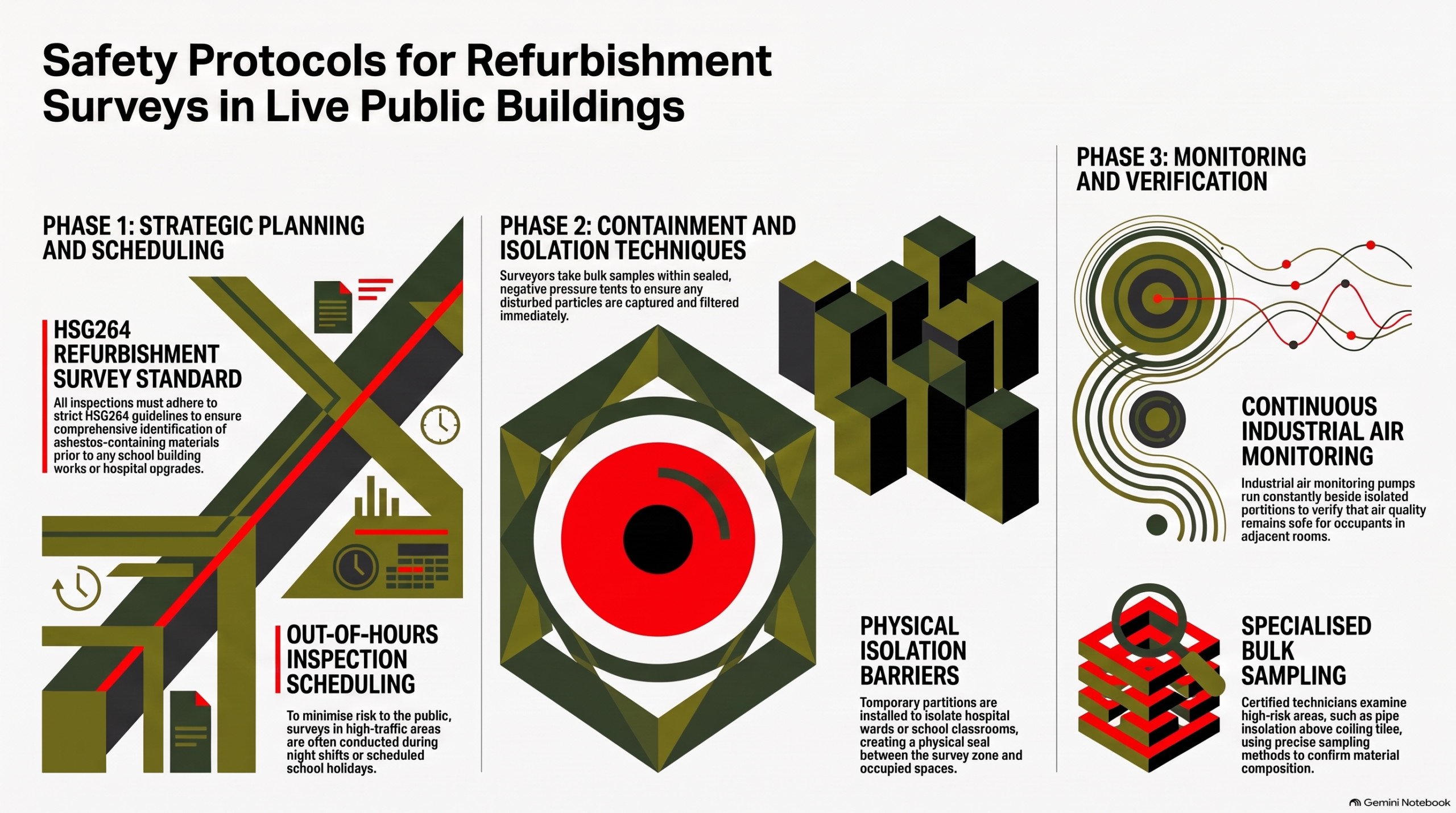
Refurbishment surveys fundamentally differ from standard management inspections because they require destructive methods to uncover hidden hazards. Management surveys assess surface condition during normal building occupation. In contrast, refurbishment audits access structural cavities, sub-floor voids, and internal ductwork. Knowing the technical distinction ensures public estates teams commission the correct level of inspection before structural changes begin.
Destructive testing inside live environments creates immediate containment challenges that require stringent engineering controls. Survey teams must adapt their containment levels, access protocols, and operational timings to suit each facility type. The table below outlines how operational protocols shift between standard management routines and targeted refurbishment investigations within healthcare and educational premises.
| Survey Dimension | Management Survey | Refurbishment Survey (R&D) |
|---|---|---|
| Core Objective | Document surface ACMs for day-to-day estate safety | Locate all hidden ACMs prior to upgrade works |
| Intrusiveness Level | Non-destructive; superficial sampling only | Fully destructive; breaks into walls, floors, and risers |
| Building Status | Carried out during normal operational hours | Requires isolated zones, decanted wards, or out-of-hours shifts |
| Containment Controls | Shadow vacuuming and localised cleaning wipes | Mini-enclosures, negative pressure units, and airlocks |
| Regulatory Mandate | CAR 2012 Regulation 4 (Duty to Manage) | CAR 2012 Regulation 5 & CDM 2015 Pre-construction Info |
Public Sector Asbestos Compliance Under UK Law
Control of Asbestos Regulations 2012 Requirements
Regulation 4 of the Control of Asbestos Regulations 2012 places a statutory duty to manage on public property operators. Dutyholders must identify all asbestos-containing materials across their estate. When structural alterations occur, Regulation 5 mandates comprehensive identification before any work begins. These legal duties prevent catastrophic exposure across public sector asbestos estates.
Approved Code of Practice L143 enforces these statutory requirements across the public estate. Estates directors cannot rely on standard management records when commissioning substantial upgrades. Refurbishment surveys must access every concealed structural void. Failure to identify hidden materials exposes staff and the public to uncontrolled fibre releases. Furthermore, breaches incur severe enforcement penalties from the Health and Safety Executive, including prohibition notices and unlimited fines.
Construction Design and Management Regulations Alignment
Under the Construction Design and Management Regulations 2015, clients must provide pre-construction information to all appointed contractors. A targeted refurbishment survey forms a vital component of this compliance package. Providing complete hazardous material data ensures principal designers construct safe scopes of work. This technical collaboration eliminates project stoppages and unexpected toxic findings.
Design teams require comprehensive data before publishing tender documentation. When structural surveys lack intrusive sampling data, principal contractors encounter unexpected asbestos during strip-out works. These events trigger automatic site shutdowns and substantial financial claims. Coordinated planning between surveyors, project managers, and designers keeps construction schedules intact. It ensures everyone meets their legal obligations under both CDM 2015 and CAR 2012.
Destructive Sampling Hazards in Operational Hospitals
Airborne Contamination Risks in Clinical Settings
Destructive sampling releases fine respirable fibres that can bypass basic visual dust controls. Within clinical environments, airborne contaminants threaten immunocompromised patients and sensitive medical machinery. Conducting a hospital asbestos survey requires strict aerosol containment to isolate invasive sampling points. Every physical penetration through walls or service ducts demands immediate localised dust capture.
In practice, we find ventilation networks are the main contamination route. Hospitals operate continuous systems that circulate air across multiple wards. A single unsealed core drill through an asbestos insulating board panel can distribute microscopic particles through heating ducts. Survey teams must deploy Class H HEPA extraction vacuums directly at the point of intrusive tool contact. Shadow vacuuming suppresses dust before it migrates into adjacent treatment rooms. Clear physical demarcations prevent staff and patients from entering active inspection zones.
Vibration and Noise Disturbance in Patient Wards
Heavy mechanical drilling and structural breaking generate significant acoustic energy through building frames. In acute medical wards or neonatal care units, sudden noise and vibration distress vulnerable patients. Surveyors must select low-vibration hand tools and quiet extraction machinery. Controlled sampling techniques ensure structural fabric investigations proceed without disturbing critical patient care.
Acoustic impact requires careful consultation with ward managers before work begins. Where intrusive sampling requires masonry chiselling or floorboard lifting, teams must coordinate exact time windows. Clinicians need advance notice to relocate sensitive monitoring devices or reschedule delicate procedures. Surveyors should utilise diamond-tipped core drills with water injection where possible. These tools operate quietly and capture dust slurry simultaneously, mitigating acoustic and environmental risks.
Did You Know?
Under the Control of Asbestos Regulations 2012, the statutory clearance indicator for reoccupation is 0.01 fibres per millilitre of air. However, personal exposure records for licensed asbestos operatives must be retained for at least 40 years alongside their statutory health surveillance files.
Isolation Techniques and Physical Containment Systems
Modular Containment and Negative Pressure Units
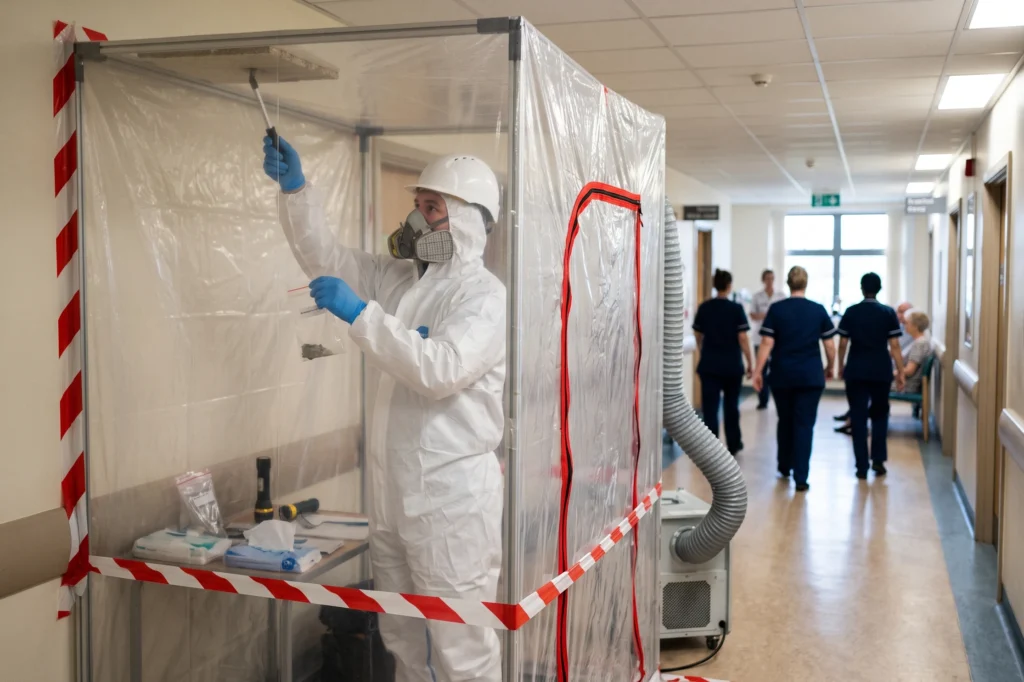
Modular polythene enclosures provide dependable physical barriers when surveying active public buildings. Survey teams construct airtight timber or metal frames lined with heavy polythene sheeting. Integrated negative pressure units extract internal air through high-efficiency particulate filters. This engineered pressure differential guarantees that airborne dust cannot escape into adjoining public corridors.
Negative pressure units must deliver sufficient extract capacity to achieve at least eight air changes per hour in larger setups. For small sampling points, portable units provide at least 1,000 cubic metres per hour of extract volume. Surveyors test these temporary structures using smoke tubes to verify seam integrity before opening up structural finishes. Airlocks with overlapping weighted flaps maintain internal pressure whilst operatives enter and exit with sampling gear.
Air Handling Isolation and Return Air Sealing
Central heating and ventilation systems present substantial contamination risks during invasive surveying. Return air grilles draw surrounding air into centralised distribution networks. Estates teams must mechanically isolate localised ventilation zones before surveyors cut into ceiling spaces. Sealing supply diffusers and ductwork with impervious sheeting prevents particulate dispersal through the building.
Coordination with facilities management engineers ensures that building management systems do not automatically trigger fans during intrusive works. Surveyors fix magnetic covers or adhesive barriers over all ventilation louvres adjacent to inspection locations. Once the sampling concludes and the local enclosure passes cleaning checks, engineers can safely reinstate ventilation dampers. This systematic protocol safeguards downstream occupants from inhaling dislodged particles.
Detailed ACM condition checks and regulatory compliance reports.
Out-of-Hours and Phased Survey Scheduling
Night Shift Logistics in Healthcare Environments
Performing intrusive sampling overnight avoids daytime congestion across outpatient departments and communal hospital circulation corridors. Surveyors mobilise specialised equipment during designated low-occupancy windows between ten at night and six in the morning. Each inspection zone must be fully sealed, sampled, cleaned, and cleared before normal medical services recommence each morning.
Night shifts require meticulous timekeeping to guarantee that wards reopen punctually. Surveyors agree specific handback times with clinical ward leads well before unpacking tools. The survey plan must schedule buffer time for high-efficiency vacuum cleaning and visual checks prior to releasing space. Clear sign-off documentation confirms that sampling areas are spotless and ready for staff. This disciplined structure protects hospital routines from unexpected logistical delays.
Holiday Windows for School Building Works
Major refurbishment programmes across educational estates typically align with half-term and summer closures. Carrying out intrusive surveys during school building works prevents pupil contact with destructive sampling operations. Empty school grounds provide unrestricted access to ceiling voids, boiler rooms, and structural framing. Surveyors can complete aggressive destructive testing quickly without safety risks.
When operating in occupied schools, access is the limiting factor. Early holiday planning allows project managers to establish thorough sampling densities across entire classroom blocks. When surveys run during term time, access restrictions force surveyors to make assumptions or omit hazardous spaces. Unrestricted holiday access enables complete destructive testing behind radiator panels, below floorboards, and within roof timbers. Contractors receive comprehensive pre-construction data before building tenders go live, safeguarding subsequent construction teams.
Management, refurbishment, and demolition surveys for all property types.
Air Monitoring and Environmental Reassurance Protocols
Baseline and Leak-Check Air Testing Procedures
Environmental air sampling verifies the physical integrity of survey enclosures throughout destructive operations. Analysts run background sampling before sampling tools touch structural fabric to establish baseline ambient fibre concentrations. Continuous operational monitoring positions sampling pumps directly outside enclosure seals. These pumps actively capture ambient air to verify that containment barriers remain completely effective.
Air monitoring procedures follow the strict analytical guidance in HSE publication HSG 248. Technicians use calibrated sampling pumps drawing measured air volumes across 25-millimetre membrane filters. On-site laboratories analyse the exposed filter graticules using phase-contrast optical microscopy. If external fibre counts approach the 0.01 fibres per millilitre action threshold, work ceases instantly. Surveyors immediately inspect the polythene envelope to locate and remedy potential pressure leaks.
Four-Stage Clearance for Unrestricted Reoccupation
Reoccupying survey enclosures in sensitive public sites demands rigorous verification. Independent analysts conduct formal four-stage clearance testing in accordance with HSG 248 before dismantlement occurs. This statutory process includes visual inspections, thorough cleaning assessments, air disturbance tests, and post-enclosure examinations. Every stage must pass before hospital patients or pupils can safely re-enter.
Clearance procedures begin with an exhaustive visual inspection of every surface within the isolated enclosure. Operatives then use HEPA vacuums and damp cloths to remove minute dust residues before the air test. Analysts use mechanical leaf blowers or brushes to agitate air during sampling, testing whether loose fibres linger in suspension. When laboratory counts fall below 0.01 fibres per millilitre, the analyst issues a formal Certificate of Reoccupation.
Asbestos Removal
Safe, certified removal of asbestos materials in line with HSE guidelines.
High-Risk Asbestos Profiles in Educational and Medical Stock
Asbestos Insulating Board and Structural Fireproofing
Post-war civic architecture heavily utilised asbestos insulating board for structural fire protection. Hospitals and schools built between 1950 and 1980 contain these friable boards within ceiling grids, partitions, and fire doors. Refurbishment surveys must sample these fragile panels with extreme caution. Mechanical disturbance releases high volumes of dangerous amosite and chrysotile fibres.
Asbestos insulating board presents a substantial risk profile because its matrix breaks down under minimal stress. When surveying classroom partitions or corridor ceilings, surveyors inject wetting agents into target points before cutting coupons. Wet injection binds the mineral matrix, curbing immediate airborne release. Surveyors immediately encapsulate the sampling wound with PVA sealant and apply warning tape. This careful protocol leaves the remaining material stable until licensable removal work begins.
Thermal Pipe Lagging and Service Risers
Extensive heating circuits in educational campuses and hospital complexes contain thick thermal pipe lagging. These materials often feature high concentrations of amphibole asbestos wrapped in protective outer coatings. Surveyors must access vertical service risers and underfloor pipe ducts to locate damaged insulation. Intrusive sampling requires powered respiratory protection and thorough local encapsulation controls.
Thermal insulation represents one of the most hazardous materials found across historical public facilities. Decades of vibration and minor maintenance often leave pipe insulation friable and poorly bonded to underlying steelwork. Surveyors inspect enclosed ceiling voids and basement crawlways using remote cameras before entering. Where physical sampling is necessary, surveyors use core samplers fitted with rubber suction sleeves. This prevents loose lagging chunks from dropping onto surrounding surfaces.
Quality Assurance and Surveyor Competence Standards
ISO 17020 Accreditation and Technical Governance
Estates managers must commission surveying organisations accredited to ISO 17020 by the United Kingdom Accreditation Service. This technical standard demonstrates rigorous operational impartiality, surveyor competence, and continuous quality audits. Choosing accredited surveying partners ensures that bulk sampling follows HSG 264 methodology. These verified standards provide legal defensibility across sensitive public estate renovation projects.
From experience across the sector, accreditation is the clearest marker of competence. The Health and Safety Executive strongly advises dutyholders to engage UKAS-accredited inspection bodies for all pre-construction asbestos surveys. Individual surveyors must hold formal BOHS P402 certifications combined with demonstrable experience in complex operational buildings. Accredited firms enforce internal quality audits, re-inspecting at least five percent of completed surveys. This strict oversight ensures that reports provide complete, accurate data without generic exclusions or ambiguous caveats.
Digital Asset Registers and Pre-Construction Data
Accurate survey data must feed directly into the dutyholder’s statutory management register. Modern digital asset registers track identified materials, precise room locations, and material risk assessments across estates. Updating digital records prior to construction enables principal contractors to plan work methods safely. Clear digital mapping prevents accidental disturbance during complex multi-phase building upgrades.
Pre-construction information must convey actionable hazard profiles to all parties involved in structural works. Cloud-based asbestos registers enable project managers, building surveyors, and trade subcontractors to access live floor plans before disturbing building fabric. When contractors understand exact material locations and asbestos types, they can coordinate licensed removals without delaying broader refurbishment timetables. Transparent data management preserves safety and legal compliance throughout the project lifecycle.
Final Thoughts
Executing intrusive refurbishment surveys within live public institutions requires an uncompromising commitment to environmental containment and methodical scheduling. Successfully completing a hospital asbestos survey or educational audit demands robust isolation barriers, negative pressure extraction, and accredited analysis. Public sector dutyholders must balance statutory compliance under the Control of Asbestos Regulations 2012 against daily operational needs. They must safeguard patients, medical personnel, educators, and pupils during intrusive audits.
Forward-planning remains the most effective tool for mitigating contamination hazards and project delays across civic infrastructure. Estates managers who plan ahead, schedule out-of-hours shifts, and commission UKAS-accredited surveyors ensure seamless compliance. Investing in thorough pre-construction investigation protects construction workers, shields building occupants, and maintains long-term structural safety across the public estate.
Submit Enquiry
Frequently Asked Questions
A management survey only locates and records asbestos-containing materials that are accessible during standard occupancy and daily maintenance. In contrast, construction and structural refurbishments break into building fabric, disturbing concealed spaces such as wall cavities, floor voids, and service risers. Conducting an intrusive refurbishment survey is a statutory requirement under Regulation 5 of the Control of Asbestos Regulations 2012. It ensures all hidden hazardous materials are identified and safely managed before any structural alteration commences.
Surveyors use modular polythene enclosures and portable negative pressure units to form airtight physical barriers around destructive sampling points. High-efficiency particulate air vacuums capture dust at the exact point of tool contact via shadow vacuuming techniques. In addition, technicians mechanically seal adjacent ventilation grilles to prevent fibres from entering central air ducts. Independent analysts run continuous air monitoring alongside sampling locations, verifying that containment seals remain effective and that airborne fibre levels remain safely below statutory action thresholds.
Intrusive refurbishment surveys should not take place in areas occupied by pupils due to the risk of accidental exposure during destructive work. In educational settings, surveying teams schedule invasive investigations during school holiday periods, weekends, or scheduled evening closures. If specific surveys must occur during term time, estates teams must completely isolate, lock, and seal the designated work area from pupil access. The isolated zone must pass rigorous four-stage clearance testing before any students are permitted to return.
Four-stage clearance testing provides formal, independent scientific evidence that an isolated area is clean and safe for unprotected human reoccupation. Governed by HSE guidance HSG 248, the process requires an initial structural inspection, a thorough visual cleanliness check, deliberate air disturbance testing, and a post-dismantlement examination. A qualified analytical tester must confirm that airborne fibre levels fall below 0.01 fibres per millilitre of air before issuing a formal Certificate of Reoccupation that allows building occupants to re-enter.
Under Regulation 4 of the Control of Asbestos Regulations 2012, legal responsibility sits with the designated dutyholder. This is typically the individual or organisation in control of maintenance and repair for the non-domestic premises, such as an NHS trust board, local education authority, or academy trust. Dutyholders must maintain an up-to-date asbestos register, implement a written management plan, assess exposure risks, and provide comprehensive hazard data to anyone planning work liable to disturb the fabric of the property.

Ora Asbestos Management Ltd
Unit A9, Seedbed Centre,
Shoeburyness, Southend-on-Sea SS3 9QY..
About the Author
Gordon Ringland is the founder, Director and principal asbestos surveyor at Ora. He holds the BOHS P402 qualification — the recognised industry standard for surveying and sampling strategies for asbestos in buildings — awarded by the British Occupational Hygiene Society (BOHS) Faculty of Occupational Hygiene (Certificate No. 20140911-32845-4254).
Gordon has over 12 years of hands-on experience in the asbestos industry, built on more than 20 years working in roofing. He carries out all three main survey types — management surveys, R&D surveys and re-inspections — and designs the sampling strategies used to find asbestos-containing materials (ACMs). He also leads non-licensed asbestos removal projects.
His work spans the full range of buildings, from residential garages and family homes to large commercial sites. Gordon has particular experience in heritage and museum environments, including listed buildings, where careful, fully compliant work matters most. He oversees Ora’s survey work and is the named author of our asbestos guides.