Warehouse Building Asbestos for Industrial Landlords
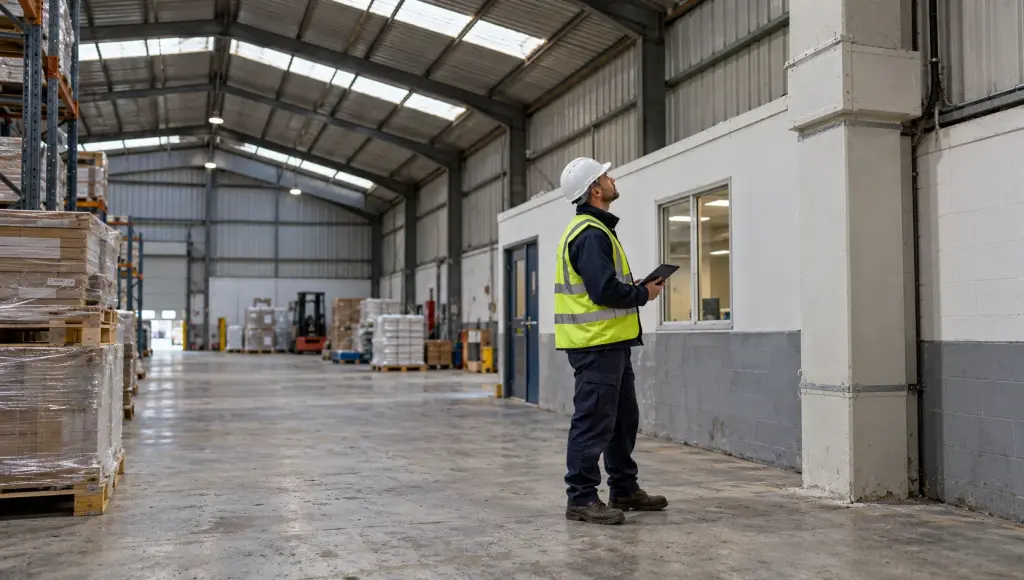
Managing warehouse building asbestos requires commercial property owners to enforce strict compliance protocols under UK health and safety legislation. Older logistics hubs, storage depots, and light manufacturing units built before 2000 frequently contain hazardous materials within their primary envelopes. Commercial landlords must proactively assess these hidden risks to prevent serious exposure and avoid severe liabilities. Managing these hazards also preserves asset value across operational portfolios. Robust oversight ensures workplace safety remains paramount across every site.
Commercial lease agreements frequently blur operational boundaries between property freeholders and occupying tenants during routine tenancy periods. Conflicting maintenance clauses often create dangerous compliance blind spots and legal friction across shared industrial estates. Who carries statutory liability when fragile roofing sheets degrade, or when tenants alter office annexes without checking historical survey records?
Key Takeaways
- Regulation 4 of the Control of Asbestos Regulations 2012 establishes legal liability for commercial warehouse owners, requiring written management plans and risk reviews.
- Commercial leases allocate daily statutory obligations across shared units, but landlords retain baseline responsibilities for common structures, shared roof coverings, and main external envelopes.
- Management surveys establish baseline registers that dutyholders must review at least every twelve months to capture ongoing material degradation, weathering, or accidental physical damage.
- Refurbishment and demolition surveys remain legally mandatory before undertaking intrusive building alterations, fit-outs, structural modifications, or tenant dilapidation remediation works across industrial units.
- Accredited UKAS inspection bodies provide the technical competence, independent oversight, and laboratory accuracy needed to create fully defensible site safety registers for commercial portfolios.
Industrial Property Compliance Summary
Non-domestic property portfolios demand systematic oversight to prevent uncontrolled fibre disturbance during regular occupancy. Landlords and managing agents must evaluate the physical condition of every suspect installation across their industrial assets. Establishing clear baseline inspections helps dutyholders protect visiting contractors, operational staff, and adjacent commercial tenants from hazardous dust releases.
The matrix below outlines key hazardous materials typically identified within pre-2000 distribution units across the UK. It details their primary structural locations, regulatory categories, and corresponding management protocols mandated under CAR 2012. These measures ensure continuous operational compliance across industrial assets.
| Material Type | Typical Warehouse Location | Regulatory Category | Mandatory Action |
|---|---|---|---|
| Asbestos Cement Sheets | Roof coverings, external wall cladding, rainwater gutters | Non-licensed | Condition monitoring and annual re-inspection |
| Asbestos Insulating Board (AIB) | Office partitions, ceiling tiles, firebreak linings | Licensed or notifiable non-licensed | Register recording, sealing, or licensed removal |
| Thermal Pipe Lagging | Boiler rooms, heating distribution runs, service trenches | Licensed | Strict containment, regular air testing, licensed stripping |
| Thermoplastic Floor Tiles | Administrative suites, staff canteens, reception spaces | Non-licensed | Safe encapsulation, register logging, wet stripping |
| Bitumen Mastic and Felts | Flat roof annexes, structural damp-proof membranes | Non-licensed | Intrusive sampling prior to refurbishment or repair |

Statutory Obligations Under CAR 2012
Regulation 4 Duty to Manage Provisions
Regulation 4 of the Control of Asbestos Regulations 2012 applies to all non-domestic premises. It requires dutyholders to identify and manage every asbestos-containing material on site. This legal obligation requires commercial owners and occupiers to maintain an accurate register. They must implement a written plan that prevents hazardous fibre releases.
Commercial property owners must make reasonable enquiries to locate suspect materials. Casual observation or assumption is never sufficient. Where access cannot safely confirm a material type, dutyholders must presume asbestos. Laboratory analysis can then confirm or refute that presumption. The statute demands clear documentation outlining inspection intervals, emergency procedures, and operational controls for all identified items.
Landlord and Tenant Allocation of Responsibilities
Commercial lease agreements dictate the operational split of health and safety duties between the building proprietor and the occupying tenant. Full Repairing and Insuring leases typically shift daily industrial warehouse duty requirements onto tenants. However, landlords retain statutory obligations if common structural envelopes remain under their control.
Ambiguities frequently arise within multi-let logistics sites with shared roof trusses or common corridors. If a lease leaves maintenance responsibilities unallocated, enforcement falls upon the party holding active control. The Health and Safety Executive targets whoever manages day-to-day access.
High-Risk Materials Across Logistics Hubs
Corrugated Cement Roofs and Cladding Sheets
Corrugated asbestos cement sheets represent the most common hazardous envelope material found on post-war industrial estates. These exterior profiled panels combine chrysotile fibres within a compressed cement matrix. They provide weatherproofing, thermal resistance, and structural fire protection across large building spans. Dutyholders must monitor these external surfaces continuously.
Decades of weathering and moss growth degrade the outer surface of these cement panels. Damaged panels become brittle over time. They present severe fall hazards alongside fibre release risks during routine roof work. Dutyholders must avoid dry scraping or power-washing. They should deploy wet methods and specialised coatings to encapsulate deteriorating profiles safely.
Office Annexes and Fireproofing Installations
Administrative offices attached to industrial depots frequently incorporate high-risk asbestos insulating board within partition walls and enclosures. Builders routinely used this board to construct fire doors, internal duct linings, and ceiling tiles. These installations were standard practice across commercial warehouse buildings erected before 1980.
These lower-density materials contain amosite or chrysotile fibres. They crumble far more readily than exterior cement sheets. High-traffic warehouse offices present elevated risks. Forklift vibrations, door impacts, and internal alterations can disturb decorative boxing. Dutyholders must inspect these interior assemblies regularly to ensure surface sealants remain intact.
Did You Know?
The Health and Safety Executive estimates that around 5,000 workers die each year in Great Britain from past asbestos exposure. Industrial buildings constructed before 2000 represent the largest ongoing repository of these historic materials.
Survey Methodologies for Industrial Buildings
Management Surveys for Operational Warehouses
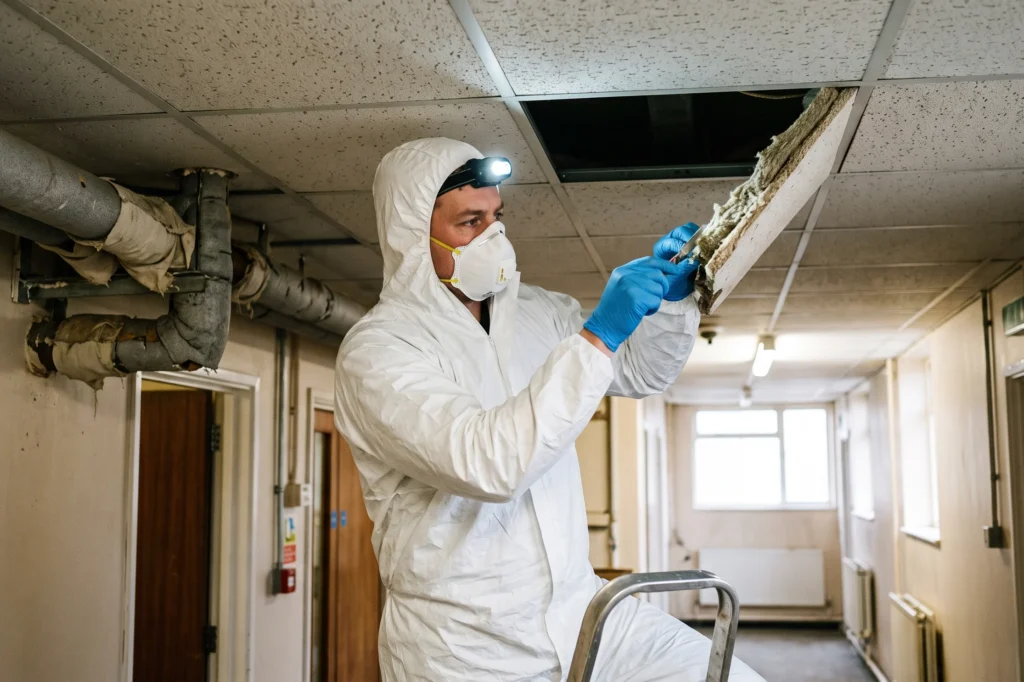
Management surveys establish the foundational baseline for daily risk management across active industrial facilities. Surveyors locate and record suspect materials that personnel or contractors might disturb during normal business operations. These inspections cause no structural damage to the primary building fabric.
The survey methodology detailed within HSG 264 uses systematic zone inspections across all accessible spaces. Qualified surveyors document material condition ratings and photograph suspect items. They collect representative bulk samples for laboratory analysis. Uninspected voids remain formally documented as presumed hazards until intrusive checks occur.
Refurbishment and Demolition Surveys Prior to Fit-Outs
Refurbishment and demolition surveys are legally required before an industrial unit undergoes structural alteration or tenant modifications. These intrusive inspections locate all concealed hazardous materials within structural framing, floor slabs, and wall cavities. They ensure construction teams remain safe before breaking into the building fabric.
Surveyors conduct destructive inspections to uncover hidden service risers, internal cavity firestops, and buried roof membranes. The affected warehouse area must remain fully vacated during intrusive sampling. Site teams must isolate services to protect personnel. The final report delivers pre-construction information under CDM 2015 to guide remediation.
Detailed ACM condition checks and regulatory compliance reports.
Risk Assessment and Management Plans
Material and Priority Assessment Score Calculation
Dutyholders calculate overall risk scores by combining a material assessment with an operational priority assessment. The material score evaluates product density, surface damage, and asbestos fibre type under HSG 264 guidelines. This establishes the intrinsic risk of airborne fibre release from any identified installation.
The priority assessment considers operational factors, including human footfall, maintenance likelihood, accessibility, and occupant numbers. A robust asbestos warehouse building management programme combines both values to establish an actionable hazard priority ranking. This metric ensures facility teams address damaged pipe insulation in busy corridors before sound roof sheets.
Live Asbestos Register Requirements
The asbestos register must function as a live working document rather than a static compliance binder. It must capture the exact location, material type, physical condition, and risk score for every identified item. Dutyholders must keep these entries accessible to site teams at all times.
Under CAR 2012 Regulation 4, dutyholders must review their written management plan at least every twelve months. Any maintenance work, accidental physical damage, or licensed abatement must trigger an immediate register update. Integrating digital registers with building management software enables commercial owners to review site conditions rapidly.
Management, refurbishment, and demolition surveys for all property types.
Contractor Controls and Dilapidations Oversight
Permit to Work Protocols for Maintenance Teams
Facility managers must control external maintenance personnel by operating a permit to work system across every commercial facility. Visiting trades must review the property register before starting works. They must sign a formal briefing acknowledgement before drilling, cutting, or installing equipment on site.
Uncontrolled intrusive work represents the leading cause of accidental fibre exposure across light industrial units. Maintenance personnel installing cabling or lighting frequently drill through hidden AIB partition headers or scrape cement flashings. Clear permits ensure contractors review documented hazard zones, follow explicit method statements, and halt work if suspect materials appear.
Dilapidations Claims and Tenancy Transitions
Tenancy terminations frequently provoke legal disputes when departing tenants leave behind damaged building fabric or unapproved alterations. Dilapidations claims often focus on cracked wall linings, damaged ceiling panels, or penetrated external cladding sheets. These compromised installations require costly hazardous remediation before landlords can re-let units.
Landlords must execute thorough baseline management surveys prior to lease commencement. This establishes unequivocal evidence regarding pre-existing material conditions. If a departing tenant leaves unsealed wall penetrations or damaged floor tiles, the landlord can substantiate reinstatement costs. Comprehensive survey records protect property owners against unexpected clearance liabilities.
Asbestos Removal
Safe, certified removal of asbestos materials in line with HSE guidelines.
Air Monitoring and Enclosure Standards
Enclosure Pressurisation and Negative Pressure Units
Licensed asbestos removal inside commercial units requires fully sealed enclosures built from heavy polythene sheeting. Operatives secure all joints with airtight taped seams to prevent fibre escape. These containment zones keep surrounding industrial spaces safe for normal operational activities during remediation programmes.
Negative Pressure Units extract air continuously to establish an inward pressure differential. This pressure remains between 0.05 and 0.15 millibars across the containment boundary. For large industrial volumes, extraction equipment must deliver at least eight air changes per hour. Technicians monitor magnehelic pressure gauges and conduct regular smoke testing to verify airlock integrity.
Four-Stage Clearance and Reoccupation Testing
Re-occupying an enclosed working area requires passing a rigorous four-stage clearance process under HSG 248. An independent UKAS-accredited laboratory must conduct this testing. This statutory procedure guarantees that workers can safely enter the vacated warehouse space without respiratory protection. It confirms complete decontamination of the work area.
Stage one verifies site cleanliness and enclosure integrity, stage two entails a visual inspection of all treated surfaces. The third stage involves air monitoring within the enclosure, where ambient fibre concentrations must register strictly below 0.01 fibres per millilitre. Once air testing passes. Stage four authorises enclosure dismantling, leading to the Certificate of Reoccupation.
Control Limits and Respiratory Protection
Respiratory Protective Equipment Selection Standards
Selecting appropriate respiratory protective equipment requires a formal assessment of airborne fibre concentrations and task durations. Powered air-purifying respirators fitted with P3 particulate filters provide suitable protection for prolonged industrial strip-out operations. Dutyholders must verify that contractors select equipment meeting strict British and European safety benchmarks.
Operatives must undergo face-fit testing to ensure masks achieve an airtight perimeter seal. Facial hair compromises this critical seal. Therefore, operatives must remain clean-shaven to maintain required protection factors. Contractor method statements must detail daily cleaning routines, regular inspection schedules, and secure storage for all deployed masks.
Air Sampling Protocols and Operational Thresholds
Statutory air monitoring protocols verify the ongoing effectiveness of engineering controls during industrial asbestos removal projects. Phase-contrast optical microscopy quantifies respirable airborne fibres collected on membrane filter cassettes. This analytical method provides rapid clearance data to site safety supervisors. Sampling ensures airborne fibres remain controlled throughout active remediation phases.
The occupational control limit stands at 0.1 fibres per cubic centimetre calculated across a four-hour reference period. When operational monitoring reveals concentrations approaching this threshold, supervisors must immediately pause works. They must re-examine engineering controls and air extraction systems. Maintaining thorough monitoring logs provides defensible evidence that removal works complied with statutory exposure limits.
Final Thoughts
Industrial property owners must recognise that managing warehouse building asbestos demands persistent vigilance and clear contractual boundaries. Aged cement cladding, hidden office fireproofing, and bitumen coatings require strategic oversight under CAR 2012. Treating compliance as a dynamic programme safeguards building occupants. It shields landlords from regulatory prosecution and protects capital investments across the industrial property sector.
Commercial logistics hubs face evolving tenant requirements, modern fit-outs, and frequent structural changes. These activities can disturb ageing building envelopes. Developing partnerships with accredited inspection bodies ensures property operators address hidden hazards before refurbishment occurs. Systematic condition reviews, automated digital registers, and disciplined contractor controls form the foundations of defensible property stewardship.
Submit Enquiry
Frequently Asked Questions
A:
Regulation 4 of the Control of Asbestos Regulations 2012 sets the principal duty to manage asbestos. It applies across all non-domestic premises. The regulation requires commercial dutyholders to determine whether asbestos-containing materials exist within their buildings. They must assess current material conditions, maintain a centralised register, and implement a written management plan. This plan protects maintenance personnel, tenants, and visitors from airborne exposure risks during daily warehouse operations.
A:
Under a typical Full Repairing and Insuring lease, the tenant usually assumes operational dutyholder responsibilities. This covers the internal leased areas that the tenant maintains. However, landlords frequently retain statutory liability for external building envelopes, structural frameworks, and common estate infrastructure. If lease terms remain ambiguous regarding maintenance boundaries, statutory authorities evaluate active control over the physical premises. They use this assessment to determine which party bears legal liability.
A:
Dutyholders must review their asbestos register and management plan at least every twelve months under CAR 2012. Building managers must also update the register immediately following any accidental damage, degradation, or licensed abatement works. Re-inspecting materials annually ensures that weathering or operational impacts are caught early. Keeping records current guarantees a fully defensible account of on-site conditions across the property portfolio.
A:
A management survey is insufficient for intrusive works because it only evaluates accessible areas during normal building use. Dutyholders must commission a refurbishment and demolition survey before starting any strip-out or structural fit-out project. This intrusive inspection locates hidden asbestos materials concealed behind partition cavities, beneath floor finishes, or within riser boxing. Completing this survey ensures full contractor safety prior to starting demolition or refurbishment tasks.
A:
Minor surface cracking can sometimes be sealed using approved elastomeric coatings if the underlying cement matrix remains structurally sound. However, severely degraded or fractured sheets become dangerously brittle and resist safe repair. Property owners should replace damaged sheets using qualified non-licensed operatives working under controlled conditions. This approach permanently eliminates the ongoing risk of structural failure, roof leaks, and airborne fibre release across the facility.

Ora Asbestos Management Ltd
Unit A9, Seedbed Centre,
Shoeburyness, Southend-on-Sea SS3 9QY..
About the Author
Gordon Ringland is the founder, Director and principal asbestos surveyor at Ora. He holds the BOHS P402 qualification — the recognised industry standard for surveying and sampling strategies for asbestos in buildings — awarded by the British Occupational Hygiene Society (BOHS) Faculty of Occupational Hygiene (Certificate No. 20140911-32845-4254).
Gordon has over 12 years of hands-on experience in the asbestos industry, built on more than 20 years working in roofing. He carries out all three main survey types — management surveys, R&D surveys and re-inspections — and designs the sampling strategies used to find asbestos-containing materials (ACMs). He also leads non-licensed asbestos removal projects.
His work spans the full range of buildings, from residential garages and family homes to large commercial sites. Gordon has particular experience in heritage and museum environments, including listed buildings, where careful, fully compliant work matters most. He oversees Ora’s survey work and is the named author of our asbestos guides.