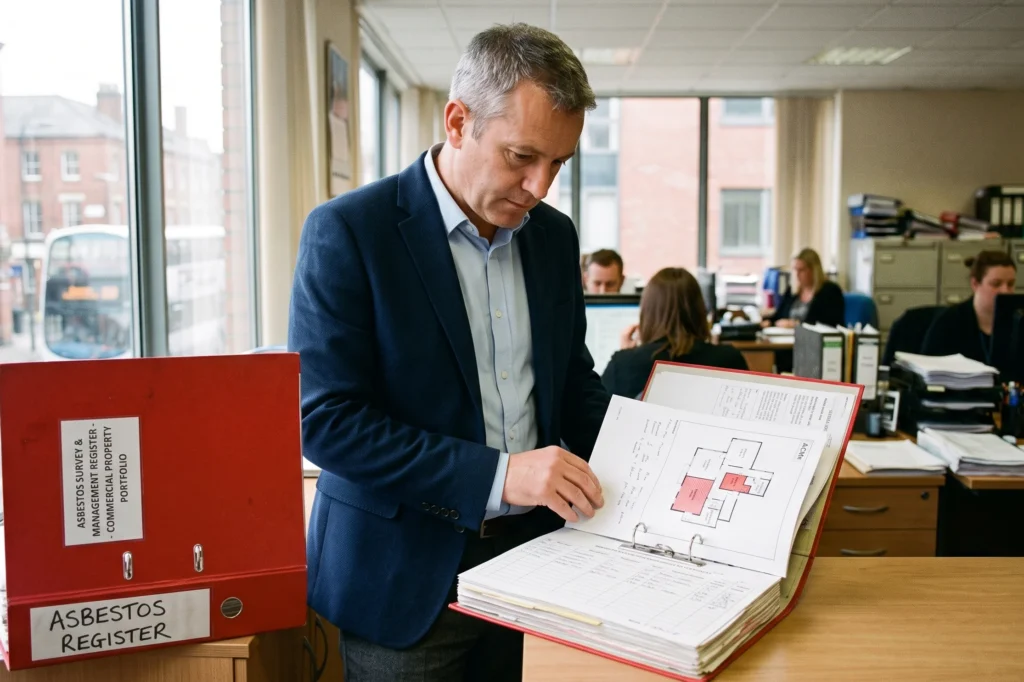
Asbestos Management in London.
Property owners and managers across the capital face critical responsibilities when dealing with materials that may contain harmful fibres. Professional asbestos management in London provides comprehensive solutions to identify, assess and control potentially hazardous building materials whilst ensuring full regulatory compliance. Furthermore, specialist asbestos surveys in London deliver detailed inspections that locate and document asbestos-containing materials (ACMs) throughout residential and commercial properties, enabling informed decision-making for safe building maintenance and modification projects. Additionally, a comprehensive refurbishment survey report documents intrusive inspections necessary before structural alterations commence, ensuring contractor safety and providing essential data for safe work planning.
Engaging qualified professionals for asbestos management in London ensures dutyholders meet their legal obligations under the Control of Asbestos Regulations 2012. Moreover, thorough asbestos surveys in London establish accurate registers of ACM locations, whilst each refurbishment survey report details all concealed materials discovered through destructive inspection techniques. How can property stakeholders ensure their premises remain safe, compliant and ready for future development whilst protecting occupants from asbestos-related health risks?
Key Takeaways
- Professional asbestos management in London helps dutyholders fulfil legal duties by identifying, recording and controlling ACMs through systematic risk assessment and written management plans
- Specialist asbestos surveys in London encompass both management surveys for day-to-day property oversight and intrusive refurbishment and demolition surveys for pre-construction planning
- A detailed refurbishment survey report provides essential documentation of all concealed ACMs before structural work begins, ensuring contractor safety and regulatory compliance
- Accredited surveyors maintain UKAS certification to ISO/IEC 17020 and hold BOHS P402 qualifications, guaranteeing technical competence and reliable survey outcomes
- Systematic inspection methodologies employ zone-by-zone approaches with representative bulk sampling, followed by UKAS-accredited laboratory analysis for precise material identification
- Accurate asbestos registers integrate survey findings with annotated building plans, enabling ongoing management and informing safe work practices across commercial and domestic properties
- Air monitoring during removal operations verifies control measures and confirms safe re-occupation, with results recorded and retained for 40 years as required by legislation
- Continuous professional development and quality assurance audits ensure survey teams deliver consistent, high-integrity reports that support effective long-term asbestos management strategies
An Overview of Asbestos Management Responsibilities
Legal Duties Under the Control of Asbestos Regulations 2012
The Control of Asbestos Regulations 2012 impose clear obligations on dutyholders—owners, occupiers or anyone responsible for maintenance of non-domestic premises. Consequently, these individuals must identify asbestos-containing materials by reviewing historical records, commissioning management surveys and presuming asbestos presence where uncertainty exists. Moreover, asbestos management in London requires maintaining an up-to-date asbestos register that records the location, extent, type and condition of every identified ACM. Dutyholders must also assess the risk of fibre release by considering factors such as material friability, likelihood of disturbance and frequency of access to affected areas.
In addition, a written management plan must detail roles, responsibilities, control measures and review intervals, typically conducted annually or whenever building use changes. Effective asbestos management in London ensures communication strategies inform contractors and employees about ACM locations before any maintenance or refurbishment work commences. Therefore, implementing and regularly reviewing the management plan protects building occupants whilst demonstrating legal compliance and reducing the risk of enforcement action by the Health and Safety Executive.
Establishing Comprehensive Asbestos Registers
Creating and maintaining accurate asbestos registers forms the cornerstone of effective asbestos management in London. Accordingly, the register must document precise locations using room numbers, floor levels and equipment identifiers, alongside photographic evidence tagged to each entry. Each ACM entry should include material type, surface area or linear metreage, sample identification numbers and corresponding laboratory analysis results. Furthermore, condition assessments rate surface integrity as good, fair or poor, whilst risk ratings evaluate the potential for fibre release as low, medium or high based on accessibility and disturbance likelihood.
Professional asbestos surveys in London generate the foundational data for these registers through systematic inspection and representative bulk sampling. Subsequently, surveyors integrate findings with annotated building plans that clearly mark ACM positions and sample points. Additionally, the register must highlight any areas not inspected due to access limitations, noting that hidden ACMs may exist in sealed voids or beneath floor coverings. Regular updates following re-inspections, material removals or property modifications ensure the register remains a reliable reference tool for ongoing asbestos management in London.
The Role of Survey Types in Property Management
Management Surveys for Day-to-Day Operations
Management surveys provide the essential foundation for routine asbestos management in London by locating and assessing ACMs in all reasonably accessible areas. These non-intrusive inspections examine rooms, service risers, plant spaces and visible voids without causing damage to building fabric. Accordingly, surveyors presume materials contain asbestos where definitive identification would require destructive investigation, thereby maintaining property integrity whilst ensuring occupant safety. Each suspect material receives a condition assessment and risk rating, enabling prioritisation of control measures and re-inspection schedules.
Professional asbestos surveys in London for management purposes include representative bulk sampling of accessible materials, with samples sealed in dual polythene bags and submitted to UKAS-accredited laboratories for polarised light microscopy (PLM) analysis. Moreover, the resulting management survey report documents all findings in a detailed register format, accompanied by annotated floor plans and high-resolution photographs. These reports clearly state limitations where areas could not be inspected, such as behind fixed panels or within sealed ducts. Consequently, dutyholders can implement effective asbestos management in London by establishing safe-work procedures, arranging periodic re-inspections and briefing contractors on ACM locations before maintenance activities commence.
Refurbishment and Demolition Surveys for Construction Planning
Before any structural alteration or demolition, intrusive asbestos surveys in London become mandatory to locate all concealed ACMs within work zones. These surveys employ destructive inspection techniques, including removing sections of wall linings, lifting floorboards and accessing ceiling voids to examine hidden materials. Furthermore, the refurbishment survey report defines the precise extent of investigation based on architectural drawings and planned works, ensuring comprehensive coverage of affected areas. Surveyors increase sampling density in high-risk locations such as sprayed coatings on steelwork, thermal insulation around pipework and asbestos insulation board (AIB) used in partition walls or fire-protection systems.
Detailed refurbishment survey reports provide contractors with essential information for safe work planning, including Plans of Work that outline removal methodologies, enclosure specifications and air-management requirements. Additionally, these reports must state that, subject to the defined scope, no further ACMs were observed or presumed within the survey area. Accurate asbestos surveys in London for refurbishment projects protect construction workers from unexpected fibre exposure and enable project managers to schedule licensed asbestos removal before structural works begin. Therefore, engaging qualified surveyors for refurbishment survey report preparation ensures regulatory compliance, minimises project delays and supports effective asbestos management in London throughout the building lifecycle.
Management, refurbishment, and demolition surveys for all property types.
Surveyor Competence and Quality Assurance
Professional Qualifications and Accreditation Standards
Reliable asbestos surveys in London depend on surveyors holding recognised qualifications and demonstrable technical expertise. Therefore, all surveyors must complete the British Occupational Hygiene Society (BOHS) P402 “Surveying and Sampling Strategies” course, which covers construction materials, ACM identification, sampling techniques and health and safety legislation. Additionally, surveyors require at least six months of supervised field experience under a competent mentor to develop practical skills in material recognition, condition assessment and risk rating. Organisations delivering asbestos surveys in London should ideally maintain UKAS accreditation to ISO/IEC 17020 as Type A inspection bodies, validating their technical competence and impartiality through regular external audits.
Continuous professional development (CPD) ensures surveyors remain current with legislative updates, emerging techniques and case-study insights. Moreover, effective asbestos management in London relies on surveyors demonstrating intimate knowledge of typical ACM applications, such as sprayed coatings on steelwork, pipe insulation, AIB in fire doors and textured ceiling coatings. Consequently, qualified surveyors can accurately distinguish asbestos-containing materials from modern substitutes, reducing the risk of false-positive presumptions whilst ensuring genuine ACMs are not overlooked during inspections.
Internal Quality Management Systems
Robust quality assurance underpins the integrity of asbestos surveys in London and ensures consistency across survey teams. Accordingly, survey organisations must maintain documented standard operating procedures (SOPs) for every survey type, sampling method and report generation process, all held under strict version control. In-progress inspections by independent senior surveyors on at least 5% of active surveys verify adherence to SOPs and correct identification of suspect materials. Furthermore, desktop audits involve peer review of every final refurbishment survey report by a second qualified surveyor, checking completeness of register entries, accuracy of condition and risk ratings, and correct labelling of annotated plans and photographs.
Document control systems maintain central logs for all survey documents, recording issue dates, revision histories and distribution records to support traceability and audit trails. Additionally, asbestos management in London benefits from electronic asset-management platforms that enable real-time tracking of ACM locations, condition changes and re-inspection schedules. Therefore, implementing rigorous quality management systems ensures asbestos surveys in London deliver high-integrity, defensible registers and reports that support long-term property safety and regulatory compliance.
Survey Methodology and Inspection Procedures
Desk-Based Studies and Pre-Survey Planning
Effective asbestos surveys in London commence with comprehensive desk-based studies that review historical building records, maintenance logs, previous survey reports and any demolition or refurbishment documentation. This preliminary research identifies areas of likely ACM use, such as boiler rooms, pipework lagging, sprayed coatings on structural steelwork and textured ceiling finishes. Consequently, surveyors can tailor their inspection strategies to target high-risk zones whilst ensuring thorough coverage of all accessible spaces. Additionally, pre-survey planning involves defining the survey scope, agreeing precise boundaries with the client and coordinating with site managers to arrange safe access, including lock-out and tag-out of live services where necessary.
Permit-to-work systems and risk assessments address hazards such as confined spaces, working at height and proximity to electrical installations. Moreover, surveyors prepare method statements covering sampling techniques, waste-packaging procedures, decontamination protocols and emergency arrangements. Personal protective equipment typically includes disposable overalls with hoods, gloves, P3-rated respiratory protection and boot covers. Therefore, thorough pre-survey planning enhances the safety and efficiency of asbestos surveys in London whilst ensuring comprehensive identification of ACMs for effective asbestos management in London.
Systematic Inspection and Bulk Sampling
Surveyors conducting asbestos surveys in London employ a zone-by-zone approach, dividing buildings into logical sections such as floors, wings or plant rooms. Within each zone, inspectors use detailed checklists to systematically examine potential ACM locations, including ceilings, walls, floors, ducts and pipe insulation. Visual recording captures high-resolution photographs of each suspect area before and after sampling, with images tagged to register entries for clarity. Furthermore, data logging utilises digital forms or tablet devices to record material type, condition, sample identification numbers, GPS location tags and assessor initials, ensuring traceability and completeness.
Bulk sampling selects representative areas of each material type, covering both damaged and intact sections to provide accurate laboratory identification. Surveyors seal each sample in two labelled polythene bags, changing gloves between samples to prevent cross-contamination. Completed chain-of-custody forms accompany samples to UKAS-accredited laboratories, which perform fibre identification using PLM and, where necessary, scanning or transmission electron microscopy (SEM/TEM). Therefore, systematic inspection methodologies and rigorous bulk-sampling protocols ensure asbestos surveys in London generate reliable data for accurate asbestos registers and effective asbestos management in London.
Laboratory Analysis and Reporting
UKAS-Accredited Fibre Identification
Accurate material identification relies on UKAS-accredited laboratories holding ISO/IEC 17025 accreditation for asbestos bulk analysis. These laboratories employ polarised light microscopy (PLM) to identify asbestos fibre types—chrysotile, amosite, crocidolite—within bulk samples, reporting results with high precision and sensitivity. Additionally, laboratories participate in the Asbestos In-House Proficiency Testing Scheme (AIMS) or equivalent external quality-assurance programmes, demonstrating ongoing accuracy and inter-laboratory comparability. Consequently, asbestos surveys in London benefit from validated analytical methods that support defensible conclusions and regulatory compliance.
Chain-of-custody controls ensure rigid sample tracking from collection through analysis, with duplicate or retained sub-samples held for at least six months in case of dispute or re-analysis requests. Moreover, laboratory reports state fibre types, percentage composition and detection limits, enabling surveyors to complete register entries with confidence. Therefore, UKAS-accredited fibre identification underpins reliable asbestos management in London by ensuring ACMs are correctly classified and appropriate control measures can be implemented based on material type and condition.
Comprehensive Survey Reports and Register Integration
Professional asbestos surveys in London generate comprehensive reports that integrate executive summaries, survey methodologies, detailed register entries and annotated building plans. The executive summary highlights key findings and identifies highest-risk ACMs requiring immediate attention, whilst the methodology section describes survey type, scope and any limitations such as inaccessible areas. Detailed register tables list each ACM’s location, material type, sample identification numbers, condition assessments, risk ratings and specific recommendations for management or removal. Furthermore, annotated plans clearly mark all ACM positions and sample points using colour-coded symbols and reference keys.
The refurbishment survey report includes additional sections outlining recommended Plans of Work for licensed asbestos removal, specifying enclosure designs, air-management requirements and disposal routes. Additionally, reports provide re-inspection frequencies based on material condition and risk ratings, typically ranging from six months for high-risk items to two years for low-risk, well-maintained ACMs. Dutyholders conducting asbestos management in London integrate these reports into existing asbestos registers and management plans, ensuring all stakeholders have access to current, accurate information. Therefore, comprehensive survey reports support informed decision-making, contractor briefings and ongoing compliance with the Control of Asbestos Regulations 2012.
Air Monitoring and Control Verification
Objectives and Types of Air Monitoring
Air monitoring serves multiple critical functions within asbestos management in London, including verifying that engineering controls and work methods effectively contain fibre release during removal operations. Background monitoring establishes ambient asbestos levels before work commences, providing a baseline for comparison. Operational or leak-check monitoring involves continuous or spot checks around enclosures and airlocks during removal activities to detect any breaches in containment. Additionally, personal occupational monitoring uses lightweight pumps and cyclones worn by operatives, collecting respirable fibres within their breathing zones over full or representative task periods.
Static area monitoring positions fixed samplers at key locations, such as the clean end of decontamination units or the perimeter of work areas, to verify overall containment effectiveness. Furthermore, re-occupation monitoring employs four-stage clearance procedures to demonstrate that areas have been cleaned to below action levels before lifting enclosure controls. Therefore, comprehensive air monitoring during asbestos management in London protects personnel, ensures regulatory compliance and provides documentary evidence of safe working practices throughout asbestos surveys in London and subsequent removal projects.
Sampling Equipment and Laboratory Protocols
Air-monitoring programmes utilise calibrated, battery-powered sampling pumps capable of maintaining flow rates between one and three litres per minute, with calibration performed immediately before and after each sampling session against primary standards to ensure accuracy within ±5%. Samples are collected on 25-millimetre diameter membrane filters with 0.8-micrometre pores, housed in sealed cassettes. Personal samples employ respirable dust cyclones to isolate the respirable fraction relevant to health risk assessments. Moreover, field protocols require recording sampler identification numbers, exact locations, flow rates, start and stop times and ambient conditions, alongside field blanks to check for contamination during handling.
UKAS-accredited laboratories analyse samples using phase-contrast optical microscopy (PCOM) following MDHS 39/4 and MDHS 100 methodologies, counting fibres greater than five micrometres in length with aspect ratios of at least 3:1. Results are reported as fibres per millilitre (f/ml), with limits of detection typically around 0.01 f/ml. Additionally, electron microscopy (SEM or TEM) provides fibre discrimination when PCOM results approach the Control of Asbestos Regulations 2012 control limit of 0.1 f/ml averaged over a four-hour period. Therefore, rigorous sampling equipment and laboratory protocols ensure asbestos management in London delivers reliable exposure assessments and clearance confirmations for safe re-occupation following refurbishment survey report recommendations.
Asbestos Management London
Ora Asbestos Management Has Response Teams Located Throughout Greater London
Plans of Work and Removal Methodologies
Developing Comprehensive Plans of Work
Before commencing any asbestos removal, whether licensed or non-licensed, a detailed Plan of Work (PoW) must outline the scope, methodologies, control measures, personnel and emergency procedures. Effective asbestos management in London requires PoWs to specify enclosure layouts, negative-pressure unit capacities, airlock dimensions, decontamination-unit configurations and waste-disposal routes. Additionally, PoWs identify all operatives by name or role, document their training records and qualifications, and list all equipment and consumables including respiratory protective equipment (RPE) types, disposable overalls and HEPA-filter specifications. Site drawings and diagrams mark work zones, airlock locations and waste-transfer paths, ensuring clarity for all personnel.
Emergency procedures within the PoW address scenarios such as unexpected ACM discovery, enclosure breaches or equipment failures, detailing immediate actions, communication protocols and escalation routes. Moreover, asbestos surveys in London and the resulting refurbishment survey report provide the foundational data for PoW preparation, specifying ACM quantities, conditions and recommended removal sequences. Dutyholders must review and approve the PoW before mobilisation, and the document remains available on-site at all times during removal operations. Therefore, comprehensive Plans of Work underpin safe, compliant asbestos management in London by ensuring all stakeholders understand their responsibilities and follow standardised procedures throughout removal projects.
Licensed and Non-Licensed Removal Techniques
Non-licensed asbestos work involves minor, short-duration tasks such as removing small quantities of asbestos cement, gaskets or textured coatings covering less than ten square metres, provided operatives follow “asbestos essentials” methods including encapsulation or wet techniques to minimise fibre release. Conversely, licensed asbestos removal applies to friable materials—sprayed coatings, loose insulation and AIB—requiring fully sealed enclosures, negative-pressure units maintaining at least eight air changes per hour, and three-stage decontamination units with showers. Furthermore, licensed contractors must hold current HSE licences demonstrating competency, insurance coverage and adherence to strict operational standards.
Enclosures constructed from 1,000-gram-per-square-metre polythene or proprietary panel systems feature welded seams and 150-millimetre flanges taped onto existing surfaces to ensure airtight integrity. Negative-pressure units fitted with pre-filters and final-stage HEPA H13 filters maintain differential pressures between 0.05 and 0.15 millibars, verified by magnehelic gauges and equipped with audible alarms for filter blockage or power loss. Therefore, selecting appropriate removal methodologies based on material type and friability supports effective asbestos management in London, protects operatives and occupants, and ensures full compliance with the requirements detailed in asbestos surveys in London and refurbishment survey reports.
Asbestos Removal
Safe, certified removal of asbestos materials in line with HSE guidelines.
Four-Stage Clearance and Re-Occupation
Pre-Cleaning and Thorough Cleaning Procedures
The four-stage clearance process begins with Stage 1, a pre-cleaning inspection where supervisors visually verify that all ACMs have been removed and surfaces are ready for cleaning. Subsequently, Stage 2 involves thorough cleaning using HEPA-vacuum equipment and wet-wiping of all horizontal and vertical surfaces, including walls, floors, ceilings and equipment within the enclosure. Cleaning consumables such as cloths and mop heads must be changed as soon as visible soiling occurs to prevent fibre redistribution. Moreover, operatives work methodically from top to bottom and from clean to dirty areas, ensuring systematic coverage and preventing cross-contamination.
During asbestos management in London, cleaning operatives wear full RPE and disposable overalls, disposing of used cleaning materials as asbestos waste by double-bagging in labelled polythene. Additionally, any equipment or tools removed from the enclosure pass through the decontamination unit, undergoing HEPA vacuuming and wet-wiping before transfer to clean areas. Therefore, rigorous pre-cleaning and thorough cleaning procedures prepare enclosures for air-monitoring tests, supporting safe re-occupation and ensuring compliance with the clearance standards specified in asbestos surveys in London and refurbishment survey reports.
Air Monitoring and Final Visual Inspection
Stage 3 of the clearance process involves air monitoring at four defined points within the enclosure and at the clean end of the decontamination unit, with results required to fall below 0.01 fibres per millilitre before proceeding. Background monitoring in adjacent spaces establishes baseline fibre levels for comparison, whilst enclosure samples verify the effectiveness of cleaning and containment measures. Accredited analysts perform PCOM analysis following MDHS 39/4, reporting results within 24 to 48 hours. Furthermore, if any sample exceeds the action level, additional cleaning cycles and re-sampling must occur until clearance criteria are met.
Stage 4 comprises a final visual inspection by a competent inspector who confirms that all surfaces are visibly clean, free from dust, debris or residual ACM fragments. The inspector photographs and date-stamps all cleaned areas, documenting findings on a clearance certificate that formally authorises barrier removal and unprotected access. Consequently, effective asbestos management in London depends on successful completion of all four clearance stages before enclosures are decommissioned and areas returned to normal use. Therefore, rigorous air monitoring and final visual inspection procedures protect building occupants, satisfy regulatory requirements and provide documentary evidence of safe re-occupation following the recommendations in asbestos surveys in London and refurbishment survey reports.

Ongoing Management and Continuous Improvement
Dutyholder Training and Contractor Communication
All maintenance staff and contractors working within properties subject to asbestos management in London must complete asbestos awareness training, refreshed at least every two years, to recognise ACMs and understand safe-work procedures. Additionally, dutyholders should share up-to-date asbestos registers and Plans of Work with contractors prior to site entry, logging inductions and toolbox talks to ensure everyone understands ACM locations and control measures. Effective communication strategies involve displaying asbestos warning signs at plant rooms and high-risk areas, alongside providing laminated register summaries for on-site reference. Moreover, contractors must notify dutyholders immediately if unexpected ACMs are discovered during works, halting activities until competent advice is obtained.
Professional asbestos surveys in London generate the foundational data for these communication systems, whilst refurbishment survey reports inform pre-construction briefings for design teams and principal contractors. Furthermore, dutyholders should maintain contractor liaison logs recording all asbestos-related communications, site visits and incident reports to support audit trails and continuous improvement initiatives. Therefore, comprehensive dutyholder training and proactive contractor communication underpin effective asbestos management in London by ensuring all stakeholders act knowledgeably and safely when working near or with ACMs.
Digital Management Systems and Record Retention
Electronic asbestos registers and cloud-based asset-management platforms enable real-time tracking of ACM locations, condition changes, survey dates and action plans, facilitating prompt updates and automated alerts for re-inspection schedules. These systems integrate annotated building plans, photographic evidence and laboratory reports into centralised databases accessible to authorised personnel across multiple sites. Additionally, digital management systems support regulatory compliance by retaining all survey reports, Plans of Work, air-monitoring logs and health surveillance records for the mandatory minimum of 40 years as required by the Control of Asbestos Regulations 2012.
Implementing digital solutions for asbestos management in London enhances efficiency, reduces the risk of data loss and supports audit readiness by providing comprehensive audit trails and version-controlled documentation. Moreover, electronic platforms enable dutyholders to generate compliance reports, track contractor activities and monitor re-inspection progress through intuitive dashboards and reporting tools. Therefore, adopting digital management systems and rigorous record-retention practices strengthens asbestos management in London, ensuring long-term property safety, regulatory compliance and effective use of data generated by asbestos surveys in London and refurbishment survey reports.
Conclusion
Effective asbestos management in London requires dutyholders to fulfil legal obligations by commissioning comprehensive asbestos surveys in London that identify, document and assess ACMs throughout residential and commercial properties. Professional surveyors deliver detailed refurbishment survey reports before structural works commence, ensuring all concealed materials are located and appropriate control measures implemented. Furthermore, ongoing management relies on accurate registers, systematic re-inspections and robust communication with contractors to protect occupants and workers from asbestos-related health risks.
Rigorous air monitoring, four-stage clearance procedures and comprehensive Plans of Work underpin safe removal operations within asbestos management in London, whilst UKAS-accredited laboratories and qualified surveyors ensure reliable survey outcomes. Additionally, digital management systems and continuous professional development support long-term compliance with the Control of Asbestos Regulations 2012. Therefore, engaging experienced professionals for asbestos surveys in London and implementing detailed refurbishment survey reports safeguards property stakeholders, maintains regulatory compliance and enables confident, informed decision-making throughout building lifecycles across the capital.
Request Consultation
asbestos management in London
Ora asbestos management in London
asbestos management in London
Ora asbestos management in London
Frequently Asked Questions
What legal responsibilities do property owners have regarding asbestos management in London?
Property owners and dutyholders of non-domestic premises in London must comply with the Control of Asbestos Regulations 2012, which requires them to identify asbestos-containing materials through commissioning professional asbestos surveys in London. They must maintain an up-to-date asbestos register documenting the location, type and condition of all ACMs, and prepare a written management plan detailing control measures, roles and responsibilities.
Additionally, dutyholders must assess the risk of fibre release, implement safe-work procedures and review the management plan annually or whenever building use changes. Furthermore, professional asbestos management in London ensures dutyholders communicate ACM locations to contractors before maintenance or refurbishment activities, protecting workers and occupants whilst demonstrating regulatory compliance and avoiding enforcement action.
How do management surveys differ from refurbishment and demolition surveys?
Management surveys provide non-intrusive inspections of all reasonably accessible areas to support day-to-day asbestos management in London, locating and assessing ACMs without causing damage to building fabric. These surveys presume materials contain asbestos where definitive identification would require destructive investigation, generating registers that inform routine maintenance and contractor briefings. Conversely, refurbishment and demolition surveys employ intrusive, destructive inspection techniques to locate all concealed ACMs before structural alterations or demolition commence.
Consequently, a comprehensive refurbishment survey report details findings from destructive sampling in hidden voids, wall cavities and plant equipment, providing essential information for safe construction planning. Therefore, management surveys support ongoing property oversight, whilst refurbishment and demolition surveys ensure contractor safety and regulatory compliance during major building projects across London.
What qualifications should professional asbestos surveyors hold?
Reliable asbestos surveys in London depend on surveyors holding the British Occupational Hygiene Society (BOHS) P402 “Surveying and Sampling Strategies” qualification, which covers construction materials, ACM identification, sampling techniques and health and safety legislation. Additionally, surveyors require at least six months of supervised field experience under a competent mentor to develop practical skills in material recognition, condition assessment and risk rating.
Organisations delivering asbestos management in London should ideally maintain UKAS accreditation to ISO/IEC 17020 as Type A inspection bodies, validating their technical competence and impartiality through regular external audits. Furthermore, surveyors must engage in continuous professional development (CPD) to remain current with legislative updates, emerging techniques and industry best practices. Therefore, engaging qualified, accredited professionals ensures asbestos surveys in London generate accurate, defensible refurbishment survey reports that support effective property management and regulatory compliance.
How does air monitoring support safe asbestos removal operations?
Air monitoring verifies that engineering controls and work methods effectively contain fibre release during asbestos management in London by measuring airborne fibre concentrations at multiple locations around enclosures and decontamination units. Background monitoring establishes baseline levels before work starts, whilst operational leak-check monitoring detects breaches in containment during removal activities. Personal occupational monitoring collects respirable fibres within operatives’ breathing zones to assess individual exposure against the Control of Asbestos Regulations 2012 control limit of 0.1 fibres per millilitre.
Additionally, four-stage clearance monitoring demonstrates that cleaned areas meet safe re-occupation standards before barriers are removed. Consequently, comprehensive air-monitoring programmes during asbestos surveys in London and removal projects protect personnel, ensure regulatory compliance and provide documentary evidence of safe working practices. Therefore, rigorous air monitoring underpins effective asbestos management in London and supports confident, informed decision-making following refurbishment survey report recommendations.
Why is ongoing asbestos management important after initial surveys are completed?
Initial asbestos surveys in London establish foundational registers and management plans, but ongoing asbestos management in London requires regular re-inspections to monitor ACM condition changes, document new findings and update registers following material removals or property modifications. Additionally, annual reviews of management plans ensure control measures remain effective and communication strategies inform all contractors and employees about current ACM locations.
Dutyholder training and contractor liaison prevent inadvertent disturbance of ACMs during routine maintenance, whilst digital management systems enable real-time tracking of condition assessments and re-inspection schedules. Furthermore, regulatory compliance under the Control of Asbestos Regulations 2012 mandates that dutyholders continuously manage asbestos risks, demonstrating due diligence and protecting occupants from health hazards. Therefore, ongoing asbestos management in London, supported by periodic asbestos surveys in London and updated refurbishment survey reports, safeguards property stakeholders, maintains compliance and enables confident, safe building operations throughout property lifecycles across the capital.
asbestos management in London
Ora asbestos management in London
asbestos management in London
Ora asbestos management in London
asbestos management in London

Ora Asbestos Management Ltd
Unit A9, Seedbed Centre,
Shoeburyness, Southend-on-Sea SS3 9QY..