
Property Asbestos Survey for Commercial Premises
Commercial landlords, tenants, and property agents face strict statutory obligations to protect building occupants from the hazardous fibres found in legacy building materials. Commissioning a property asbestos survey represents the foundational step toward achieving regulatory compliance and preventing catastrophic health consequences. Because asbestos was widely integrated into British construction until late 1999, commercial facilities often conceal hazardous materials behind pristine finishes. Understanding the location and condition of these materials guarantees operational continuity whilst keeping workers safe from exposure.
Dutyholders routinely struggle to determine which inspection standard applies to their premises and how to manage the resulting technical data effectively. Fulfilling the legal duty to manage requires clear procedures for identification, risk scoring, and ongoing monitoring across active operational environments. How can commercial operators satisfy statutory requirements, prevent costly project delays, and systematically control asbestos risks across their property portfolios?
Key Takeaways
- Regulation 4 of the Control of Asbestos Regulations 2012 places a statutory duty on commercial property dutyholders to identify and manage all asbestos materials.
- Management surveys inspect accessible operational areas during normal building occupancy, whereas refurbishment and demolition surveys require intrusive, destructive inspection within planned work boundaries.
- The complete survey assessment combines material risk scores regarding fibre release with priority assessment scores regarding occupant vulnerability and maintenance disturbance likelihood.
- Commercial dutyholders must establish a written asbestos management plan, review it every twelve months, and immediately update records following any structural work or condition changes.
- Employing UKAS-accredited inspection bodies operating under ISO 17020 ensures technical competence, independent sampling methods, and legally defensible reporting that protects building owners from liability.
Commercial Asbestos Survey Types and Core Specifications
Commercial property surveys fall into two distinct statutory categories defined by Health and Safety Executive guidance document HSG264. Selecting the appropriate survey depends directly on whether the premises will remain in standard daily occupation or undergo structural intervention. Dutyholders must commission the correct inspection model to maintain statutory compliance and avoid unsafe fibre disturbance.
The following matrix outlines the fundamental differences between standard management surveys and intrusive refurbishment or demolition inspections. Dutyholders should examine the operational scope, inspection depth, and occupancy requirements of each survey type before commissioning specialist attendance. Selecting the incorrect survey type risks substantial project delays, regulatory enforcement, and unbudgeted remediation expenditure.
| Survey Type | Operational Objective | Intrusiveness Level | Recommended Application |
|---|---|---|---|
| Management Survey | Locate and assess accessible ACMs during normal building use | Non-destructive, visual, representative bulk sampling | Standard tenancy occupation, routine maintenance, lease renewals |
| Refurbishment Survey | Locate all ACMs within specific structural renovation zones | Fully intrusive, targeted destructive access, void penetration | Layout alterations, HVAC replacements, shop refits |
| Demolition Survey | Identify all ACMs across the entire building fabric prior to razing | Aggressive destructive access, total fabric penetration | Full facility teardown, structural clearing, redevelopment |
| Re-inspection Survey | Monitor condition changes of known or presumed ACMs | Visual verification, non-intrusive reassessment | Statutory annual management plan reviews |
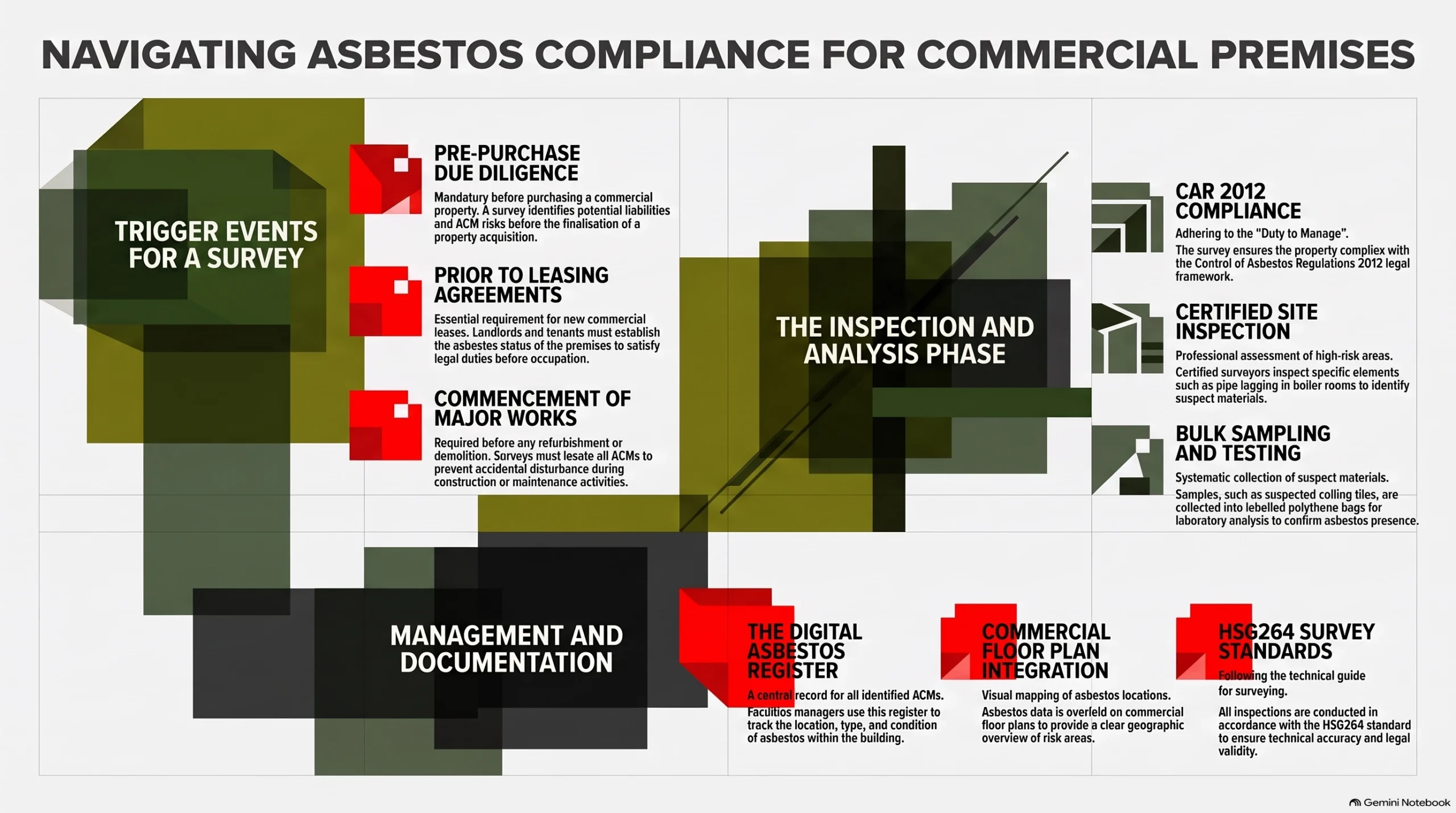
Statutory Framework for Commercial Asbestos Management
Regulation 4 Duty to Manage Responsibilities
Regulation 4 of the Control of Asbestos Regulations 2012 establishes the statutory duty to manage asbestos in non-domestic premises. The regulation places legal responsibility onto owners, landlords, or managing agents with maintenance obligations. Dutyholders must identify all asbestos-containing materials, assess their physical condition, and maintain an active written management plan.
The Health and Safety at Work etc. Act 1974 reinforces these responsibilities across all UK commercial property. A comprehensive property asbestos survey serves as the primary mechanism to discover where hazardous materials reside. Dutyholders who fail to locate asbestos or ignore condition assessments risk immediate enforcement action from the Health and Safety Executive. Penalties include formal improvement notices, prohibition notices, and uncapped financial liabilities. Furthermore, commercial leases often dictate how landlords and tenants share these maintenance burdens.
Regulation 5 Identification Before Planned Works
Regulation 5 mandates the positive identification of asbestos before any building alterations or refurbishment tasks commence. Employers and dutyholders cannot assume a building is free from hazardous materials without documented evidence. Undertaking an asbestos commercial property survey ensures that contractors do not disturb hidden fibres during routine or intrusive maintenance work.
Under Approved Code of Practice L143, dutyholders must supply asbestos data to contractors before works begin. Relying on presumptions alone is rarely sufficient when structural elements face physical disruption. Failure to provide accurate pre-construction information breaches both the Construction (Design and Management) Regulations 2015 and CAR 2012. Contractors who encounter unexpected suspect materials must halt operations immediately. This unplanned stoppage causes project delays, generates emergency containment costs, and creates substantial legal exposure for building operators.
Distinctions Between Commercial Survey Methodologies
Operational Scope of Management Surveys
Management surveys locate asbestos-containing materials that occupants or maintenance staff could disturb during daily operations. Surveyors conduct systematic visual inspections across accessible internal and external areas without inflicting structural damage. When suspect materials appear, the surveyor takes representative bulk samples or records a reasoned presumption that asbestos is present.
These surveys cover typical operational zones including entrance lobbies, office floors, boiler rooms, and ceiling spaces. Surveyors evaluate whether routine cleaning, IT cabling, or minor electrical work could release airborne fibres. The methodology follows guidance outlined in HSG264. Surveyors document clear access limitations if locked risers or live electrical infrastructure prevent inspection. Dutyholders must treat uninspected spaces as containing asbestos until proven otherwise. Management surveys require annual reviews to ensure that material conditions remain stable over time.
Intrusive Protocols of Refurbishment and Demolition Surveys
Refurbishment and demolition surveys locate every commercial property ACM within an area scheduled for structural alteration or complete clearing. These surveys are destructive by design and demand intrusive access through walls, floors, and service risers. The building zone must be unoccupied and fully isolated to safeguard workers during aggressive material sampling.
Unlike standard management inspections, refurbishment surveys break through the decorative fabric of the property. Surveyors lift floorboards, penetrate partition walls, and open sealed ceiling cavities. They target structural fireproofing, internal pipe chases, and concealed expansion joints. The final survey report establishes a baseline for contractor tenders and licensable removal work. All identified materials must be removed or properly encapsulated before construction trades enter the site. Destructive surveys prevent catastrophic discoveries during active building programmes.
Did You Know?
Although the UK banned the import and use of blue and brown asbestos in 1985 and chrysotile (white asbestos) in 1999, asbestos-related diseases still cause approximately 5,000 deaths annually in Great Britain.
Typical Asbestos-Containing Materials in Commercial Premises
High-Risk Insulation and Fireproofing Applications
High-risk asbestos materials include sprayed limpet coatings, thermal pipe lagging, and asbestos insulating board installed for structural fireproofing. These friable products release hazardous respirable fibres rapidly when subjected to minor impact or deterioration. Surveyors treat these applications with acute caution due to their significant potential for catastrophic personal exposure.
Commercial buildings erected between 1950 and 1980 frequently incorporate sprayed asbestos on structural steel columns. Plant rooms, boiler houses, and basement ducts often feature hand-applied thermal insulation around calorifiers and high-pressure steam distribution pipes. Asbestos insulating board (AIB) appears ubiquitously in ceiling tiles, firebreak partitions, and service riser casings. Due to its high friability, remedial work on AIB or pipe lagging requires a licensed contractor. These specialists operate inside sealed, negative-pressure enclosures.
Low-Risk Bonded Products and Surface Treatments
Bonded asbestos materials feature fibres tightly bound within cement, bitumen, or synthetic vinyl matrices. Common examples include corrugated roof sheets, rainwater goods, thermoplastic floor tiles, and textured Artex coatings. These products present minimal exposure risk during standard occupation as long as the matrix remains intact and completely undamaged.
Industrial estates and logistics corridors frequently utilise corrugated asbestos cement panels for external roofing and vertical cladding. Internally, thermoplastic floor tiles and their associated bituminous adhesives remain hidden beneath modern laminate or carpeting. Textured coatings cover plasterboard ceilings across thousands of commercial offices and communal lobbies. Non-friable materials release fibres less readily. However, abrasive maintenance like drilling, sanding, or high-pressure washing can liberate dangerous airborne particulates. Such tasks require strict non-licensed control measures and appropriate respiratory equipment.
Detailed ACM condition checks and regulatory compliance reports.
Survey Planning and On-Site Inspection Methodology
Desktop Research and Scope Formulation
Thorough survey planning begins with an exhaustive desktop assessment of the target property before attending the site. Surveyors review historical architectural plans, operation manuals, lease agreements, and previous inspection reports. This essential pre-survey study determines the precise physical boundaries, establishes safety access requirements, and identifies probable asbestos applications.
The planning phase ensures that client expectations align with Health and Safety Executive standards. Surveyors work with facility managers to identify operational constraints, live electrical services, and restricted zones. In multi-tenanted properties, surveyors schedule out-of-hours access to inspect plant spaces without disrupting daily commercial operations. Establishing clear parameters avoids ambiguous reporting and generic caveats. An agreed method statement defines specific sampling densities, required personal protective equipment, and necessary permits to work.
Systematic Zoned Sampling and Field Documentation
Field surveyors execute a systematic, zone-by-zone inspection across every floor, room, and service void of the building. Competent technicians log each suspect item, record visible deterioration, and collect representative bulk samples using safe wet-sampling techniques. Every physical sample is double-bagged, labelled, and tracked through formal chain-of-custody protocols.
Surveyors photograph suspect materials prior to and following sample extraction. They mark sampling points unobtrusively to assist future contractor location. Disposable polythene drop-sheets capture any stray debris, and technicians wipe sample points with wet rags before applying encapsulant paint. Bulk samples travel to an accredited analytical testing facility. The laboratory analyses the specimens using polarised light microscopy in accordance with HSG248 guidelines. If access to a space is unsafe, the surveyor marks the location as presumed asbestos.
Management, refurbishment, and demolition surveys for all property types.
Risk Evaluation and Asbestos Register Production
Material Assessment and Fibre Release Potential
The material assessment evaluates the intrinsic potential of an identified material to release airborne fibres if disturbed. Surveyors assign numerical values between zero and three across four parameters. These include product type, damage extent, surface treatment, and asbestos type. Combining these values yields an overall material score ranging from two to twelve.
A low score between two and five denotes a low potential for fibre release, typical of sealed vinyl floor tiles. Scores between six and eight indicate medium potential, commonly assigned to unsealed asbestos cement or slightly damaged board. High scores between nine and twelve highlight friable materials such as loose lagging or damaged pipe insulation. This objective numerical framework eliminates guesswork. It establishes an empirical baseline for the physical condition of every confirmed or presumed item within the commercial facility.
Priority Assessment and Action Plan Formulation
Priority assessments establish how building occupancy patterns and maintenance frequencies affect overall exposure risk for occupants. The dutyholder evaluates material location, occupant numbers, disturbance likelihood, and task frequency across the operational setting. Adding the priority score to the material score creates the final risk ranking that dictates required remedial actions.
Surveyors provide the material score, but dutyholders must supply occupancy data to calculate the priority score. A high-risk material situated inside a locked void presents lower danger than a damaged panel in a busy corridor. The combined total guides the management plan. Action categories range from simple routine monitoring and labelling to urgent encapsulation or licensed removal. Dutyholders transfer these action points directly into a centralised, living asbestos register.
Asbestos Removal
Safe, certified removal of asbestos materials in line with HSE guidelines.
Surveyor Competence and Technical Quality Assurance
Accreditation Standards and ISO 17020 Compliance
The Health and Safety Executive recommends engaging survey bodies holding formal UKAS accreditation to ISO/IEC 17020 standards. This international standard verifies that the inspection organisation operates with verified technical competence, strict impartiality, and documented quality assurance systems. Accredited survey providers deliver legally defensible survey reports that withstand scrutiny during property transactions.
Accreditation bodies evaluate inspection organisations against UKAS publication RG 8. This guidance document requires rigorous calibration of sampling tools, blind report auditing, and continuous technical training. Non-accredited surveyors often lack formal peer review processes, leading to generic caveats and missed materials. Missing an asbestos-containing material exposes maintenance contractors to life-threatening airborne fibres. For institutional landlords and commercial investors, employing accredited surveyors provides essential risk mitigation. This standard protects dutyholders from statutory liability.
Laboratory Testing and HSG248 Protocols
Accurate material identification relies entirely upon accredited laboratory testing adhering to ISO/IEC 17025 standards and HSG248 analytical guidance. Qualified analysts examine extracted bulk samples using polarised light microscopy and dispersion staining techniques. These microscopic evaluations positively differentiate chrysotile, amosite, and crocidolite fibres from non-hazardous natural or synthetic composite fibres.
Laboratories participate in proficiency testing schemes such as the Asbestos in Materials Scheme (AIMS). This scheme is administered by the Health and Safety Laboratory (HSL) and confirms analytical accuracy across difficult material matrices like textured plaster coatings or vinyl adhesives. The laboratory retains sample splits for six months to facilitate independent re-analysis in the event of legal disputes. The analytical certificate forms an integral annex to the final survey report. Without UKAS-accredited laboratory certification, an asbestos survey report cannot provide definitive statutory proof of compliance.
Commercial Property Transactions and Leasehold Responsibilities
Due Diligence During Acquisitions and Disposals
Acquiring commercial real estate without an up-to-date property asbestos survey introduces severe operational and financial liabilities for buyers. Buyers must verify that sellers maintain a compliant asbestos register and valid management plan before executing contracts. Undiscovered asbestos can derail post-purchase refurbishment budgets and depress the ultimate valuation of commercial assets.
Institutional investors and corporate purchasers include asbestos reviews within standard pre-acquisition environmental due diligence. If an existing register appears incomplete or outdated, prospective buyers should commission an updated inspection. Uncovering extensive asbestos insulating board or sprayed thermal coatings allows purchasers to negotiate price reductions. Alternatively, buyers can demand seller remediation prior to transaction completion. Commercial lenders routinely withhold development finance until borrowers supply accredited asbestos surveys. Clear documentation prevents unexpected project shutdowns during planned post-acquisition capital improvements.
Leasehold Obligations and Dilapidations Management
Commercial lease agreements determine whether landlords or tenants hold the statutory duty to manage asbestos within demised spaces. Full repairing and insuring leases typically shift compliance obligations onto tenants, requiring them to commission surveys and maintain records. Landlords generally retain direct statutory oversight for shared structural zones and common areas.
Dilapidations claims at the conclusion of commercial leases frequently involve damaged asbestos installations. Tenants who install partition walls, run data cabling, or alter flooring without reviewing the asbestos register can disturb protected materials. Damaging asbestos insulating board or floor tiles creates substantial reinstatement liabilities under lease covenants. Landlords can charge departing tenants for professional decontamination, licensed removal, and analytical air clearance testing. Maintaining transparent survey documentation protects both parties from contentious dilapidation disputes.
Final Thoughts
Maintaining compliance with UK asbestos regulations requires active oversight rather than passive documentation. Commissioning a professional property asbestos survey establishes the foundational baseline necessary to protect building occupants, facility staff, and external contractors from hazardous fibre exposure. Commercial dutyholders who systematically identify suspect materials and maintain an accurate asbestos register insulate their organisations from legal liabilities and avoid unexpected operational shutdowns.
Managing commercial real estate demands continuous vigilance and dynamic record-keeping as buildings adapt to new operational needs. Implementing annual register reviews and conducting targeted refurbishment surveys before minor or major fit-outs ensures building safety throughout the asset lifecycle. Integrating robust asbestos risk management into broader commercial property strategies safeguards human health whilst preserving long-term property values.
Submit Enquiry
Frequently Asked Questions
A management survey assesses the location and condition of accessible asbestos-containing materials that occupants or maintenance staff could disturb during normal day-to-day operations. It uses non-destructive inspection and representative sampling. In contrast, a refurbishment survey is a fully intrusive, destructive inspection required before any structural alterations or fit-out works take place. It targets concealed areas within walls, floors, and ceiling voids where building trades will operate, ensuring hazardous materials are removed before construction begins.
Under Regulation 4 of the Control of Asbestos Regulations 2012, the dutyholder is whoever holds legal responsibility for the maintenance and repair of the property. In commercial buildings, this responsibility depends on lease terms. Under a full repairing and insuring lease, the tenant is typically the dutyholder for demised areas. The landlord usually retains dutyholder responsibilities for common areas such as shared stairwells, plant rooms, and exterior cladding. Responsibilities must be clearly defined in lease documentation.
The Control of Asbestos Regulations 2012 mandates that dutyholders review written asbestos management plans and registers at regular intervals, with a minimum standard of every twelve months. In addition, dutyholders must immediately update the register if materials are encapsulated or removed, or if the building layout undergoes alteration. Re-inspections verify whether known asbestos materials have deteriorated, suffered mechanical damage, or experienced water leaks, ensuring risk scores and control actions remain accurate.
Commercial properties constructed after 31 December 1999 generally do not require a statutory asbestos survey because the UK enforced a comprehensive ban on the use and supply of all asbestos materials in late 1999. However, dutyholders should confirm construction completion dates through verified building control sign-offs or original construction documents. If older recycled materials or plant equipment from pre-2000 premises were installed during subsequent renovations, targeted checks remain prudent to confirm the premises are entirely free from asbestos.
If contractors discover unexpected suspect materials during commercial refurbishment or maintenance works, all work in that immediate zone must stop immediately. Operatives must evacuate the affected area and seal off access to prevent cross-contamination. The site manager must notify the dutyholder and arrange for a qualified surveyor to inspect and sample the material. Works cannot resume in that area until laboratory analysis confirms the material is safe or a licensed asbestos removal contractor decontaminates the space.

Ora Asbestos Management Ltd
Unit A9, Seedbed Centre,
Shoeburyness, Southend-on-Sea SS3 9QY..
About the Author
Gordon Ringland is the founder, Director and principal asbestos surveyor at Ora. He holds the BOHS P402 qualification — the recognised industry standard for surveying and sampling strategies for asbestos in buildings — awarded by the British Occupational Hygiene Society (BOHS) Faculty of Occupational Hygiene (Certificate No. 20140911-32845-4254).
Gordon has over 12 years of hands-on experience in the asbestos industry, built on more than 20 years working in roofing. He carries out all three main survey types — management surveys, R&D surveys and re-inspections — and designs the sampling strategies used to find asbestos-containing materials (ACMs). He also leads non-licensed asbestos removal projects.
His work spans the full range of buildings, from residential garages and family homes to large commercial sites. Gordon has particular experience in heritage and museum environments, including listed buildings, where careful, fully compliant work matters most. He oversees Ora’s survey work and is the named author of our asbestos guides.