Building Asbestos Removal for Commercial Premises
Commercial properties constructed before 2000 frequently contain hazardous materials. These substances threaten worker safety and delay capital improvement projects. Executing building asbestos removal requires adherence to the Control of Asbestos Regulations 2012, precise planning, and certified abatement contractors. Dutyholders must identify all hazardous items and evaluate their physical condition. They must eliminate exposure pathways through controlled remediation. Safe remediation safeguards maintenance staff and ensures commercial lease compliance. It also prevents substantial statutory penalties during refurbishment programmes across diverse business estates.
Every property director faces significant operational liabilities when legacy contaminants disrupt refurbishment schedules or endanger building occupants. Meeting these technical standards demands strict containment procedures, independent air monitoring, and accredited disposal protocols. How can facilities teams coordinate remediation, satisfy statutory duties under CAR 2012, and secure verified four-stage reoccupation clearance without causing costly closures across commercial premises?
Key Takeaways
- Regulation 4 of CAR 2012 legally mandates commercial dutyholders to identify, record, and actively control hazardous materials across all non-domestic properties in Great Britain.
- Refurbishment and demolition surveys locate hidden hazardous materials within building cavities to prevent accidental fibre release before invasive construction work commences on site.
- Licensable materials such as sprayed coatings and insulating board require specialised negative-pressure enclosures, continuous airflow management, and Health and Safety Executive notification.
- Independent analysts must complete a strict four-stage clearance process incorporating rigorous visual inspection and air testing before buildings can be safely reoccupied.
- Dutyholders must retain comprehensive asbestos registers, removal plans of work, consignment notes, and air monitoring certificates for a statutory minimum of forty years.
Commercial Asbestos Removal Parameters
Controlled asbestos abatement protects commercial building occupants whilst establishing clear legal compliance for dutyholders. Property managers must assess product density, material friability, and disturbance potential before selecting an appropriate remediation pathway. Different products demand distinct statutory controls, varied operational equipment, and specific analyst sign-off procedures to ensure full site safety before construction commences.
Abatement categories dictate whether work requires an HSE-licensed contractor or trained non-licensable operatives using wetting techniques. The following comparative matrix outlines common commercial materials and their statutory licensing classification. It details primary operational control mechanisms and mandatory verification standards required before releasing working areas back to commercial clients and facility teams.
| Material Type | Licensing Status | Primary Engineering Control | Clearance Standard |
|---|---|---|---|
| Sprayed Limpet Coatings | Licensable Work | Full enclosure with NPU and airlocks | 4-Stage Clearance (<0.01 f/ml) |
| Pipe Lagging / Thermal Insulation | Licensable Work | Negative-pressure containment and glovebags | 4-Stage Clearance (<0.01 f/ml) |
| Asbestos Insulating Board (AIB) | Licensable Work | Sealed containment, shadow vacuuming, RPE | 4-Stage Clearance (<0.01 f/ml) |
| Asbestos Cement Cladding | Non-Licensed Work | Controlled wetting and shadow vacuuming | Visual verification inspection |
| Thermoplastic Floor Tiles | Non-Licensed Work | Hand scraping with surfactant suppression | Visual cleanliness check |
Statutory Obligations Under CAR 2012
Dutyholder Responsibilities in Non-Domestic Estates
Regulation 4 of the Control of Asbestos Regulations 2012 places an explicit duty to manage asbestos on commercial property controllers. Dutyholders must determine the location of suspected materials, assess their physical condition, and maintain a written register. They must implement a dynamic plan to protect occupants from hazardous airborne fibre release.
This duty applies to freeholders, commercial landlords, and managing agents with explicit repairing obligations under lease agreements. Commercial building ACM registers must undergo formal reviews at least every twelve months to record material changes. Dutyholders must provide this information to all visiting contractors before intrusive works start. In-house maintenance teams and emergency personnel must also consult these records.
Regulatory Enforcement and Statutory Penalties
The Health and Safety Executive enforces asbestos safety legislation across commercial workplaces with severe statutory penalties for non-compliance. Inspectors can issue immediate prohibition notices that halt commercial operations. They also issue improvement notices requiring mandatory structural remediation. Criminal prosecutions against responsible dutyholders can yield unlimited fines and custodial sentences.
Uncontrolled fibre disturbance during refurbishment immediately invalidates commercial building insurance policies. Such breaches also expose corporate directors to personal liability. Regulators treat deliberate failure to commission intrusive surveys or using uncertified contractors as gross negligence. Project shutdowns trigger severe financial penalties under commercial tenant lease contracts and construction delay penalty clauses.
Survey Protocols for Commercial Premises
Management Surveys for Routine Operations
A management survey establishes the location and condition of hazardous materials during standard building occupancy and routine maintenance. Surveyors inspect all accessible areas, document surface condition, and take representative bulk samples. They presume presence where materials cannot be safely inspected. This visual data forms the foundation of the commercial asbestos register.
Surveyors rate materials using standardised scoring systems that evaluate product type, surface treatment, and physical degradation. The surveyor combines this material score with an operational priority assessment. This priority assessment evaluates human exposure risks during standard business hours. These findings dictate whether facilities teams must encapsulate, seal, monitor, or remove damaged materials immediately.
Refurbishment and Demolition Survey Scope
Refurbishment and demolition surveys provide a fully intrusive, destructive inspection before structural alterations or strip-out projects begin on site. Surveyors penetrate all walls, voids, floor slabs, and service risers to uncover hidden materials. This intrusive exercise prevents contractors from inadvertently disturbing lethal fibres during invasive structural modifications.
Commercial building ACM surveys must target the exact footprint of planned redevelopment works rather than relying on generic caveats. Dutyholders coordinate with principal designers under CDM 2015 regulations. They incorporate survey findings directly into pre-construction information packets. Clearing hidden materials prior to general contractor mobilisation eliminates project stoppages and costly secondary decontamination works.
Did You Know?
Under CAR 2012 Regulation 22, employers and dutyholders must maintain asbestos exposure records and medical surveillance documentation for a statutory minimum of 40 years.
Licensable and Non-Licensable Classification
High-Risk Friable Insulation and Coatings
Friable materials release deadly respirable fibres under minimal mechanical force and demand the highest regulatory control measures during removal. Sprayed limpet asbestos, pipe insulation, and asbestos insulating boards represent high-risk licensable products. Work on these materials legally requires a Health and Safety Executive licensed contractor and formal regulatory notification.
These friable products commonly line steel framework, boiler house equipment, and communal service shafts across pre-2000 office blocks. During any asbestos removal commercial building project involving friable substrates, contractors must submit a statutory fourteen-day notification to the HSE before work starts. Licensed contractors must craft detailed plans of work detailing full containment, negative air units, and decontamination facilities.
Low-Risk Bonded Products and Cement
Dense, bonded products hold fibres securely within a solid matrix and represent lower exposure hazards during typical removal activities. Asbestos cement roof sheets, thermoplastic floor tiles, and bitumen adhesive products generally qualify as non-licensed work. Competent operatives can safely remove these materials using controlled wetting, shadow vacuuming, and basic precautions.
These tasks must still follow strict control standards outlined in HSE guidance document HSG210. Workers must never use high-speed power tools, abrasive saws, or uncontained dry scraping methods. Such abrasive techniques fracture matrices and generate airborne dust. Dutyholders must verify that operatives possess non-licensable asbestos training, task-specific method statements, and compliant protective equipment.
Detailed ACM condition checks and regulatory compliance reports.
Engineering Controls and Enclosure Systems
Negative-Pressure Units and Airflow Dynamics
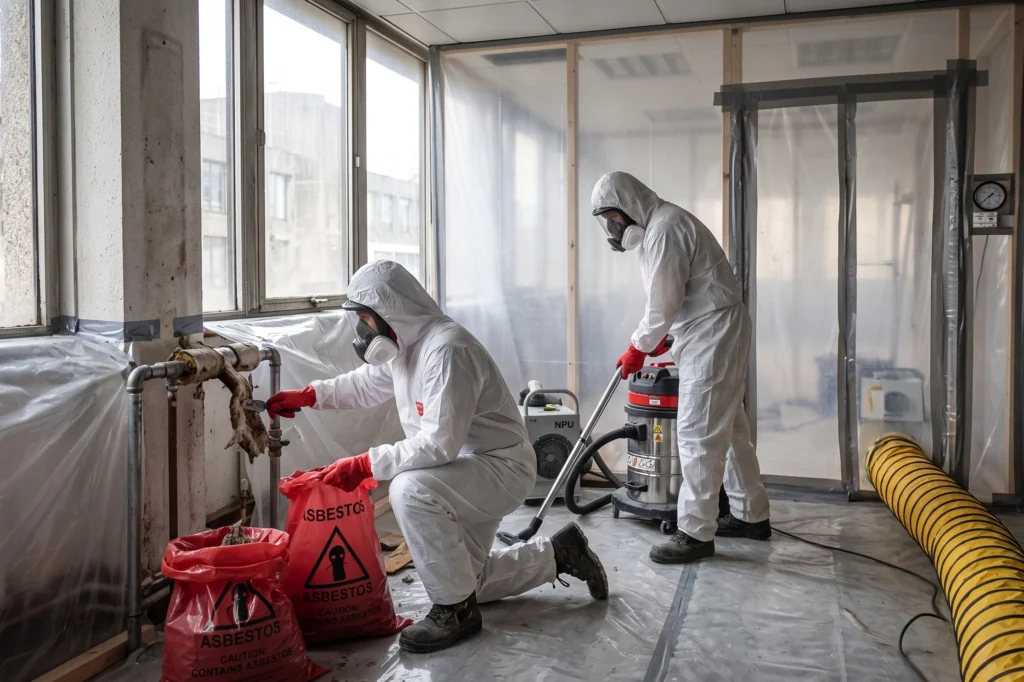
Negative-pressure units maintain continuous inward airflow within an asbestos containment enclosure to prevent fibre escape into neighbouring spaces. Units must deliver at least eight air changes per hour for large enclosures. Smaller spaces require 1,000 cubic metres per hour. All units filter exhaust air through absolute HEPA filters.
Operatives continually monitor enclosure pressure differentials using calibrated magnehelic gauges. They maintain negative pressures between 0.05 and 0.15 millibars. These mechanical units run continuously throughout the project lifecycle, including break periods and night shifts. Operatives verify exhaust discharge points to ensure filtered air vents safely outside the building envelope without entering open ventilation intakes.
Airlock Construction and Containment Integrity
Asbestos enclosures require durable construction from heavy-duty 1000-gauge polythene film sealed with low-permeability technical tape to timber or scaffold frames. Contractors erect three-stage airlocks comprising clean, intermediate, and dirty chambers to control worker transit. Visual smoke testing validates that seals remain completely airtight before active removal works commence.
Airlocks incorporate weighted flap doors and dedicated viewing windows. These transparent windows allow external supervisors to monitor internal activities safely. Every pipe penetration, cable tray, and structural joint receives detailed sealing with spray mastic or polythene boots. Contractors establish dedicated bag-lock chambers alongside personnel airlocks to facilitate the sealed transfer of double-bagged waste.
Management, refurbishment, and demolition surveys for all property types.
Respiratory Protection and Operative Safety
Powered Air Purifying Respirator Selection
Operatives undertaking licensable asbestos removal must utilise positive-pressure full-face respirators certified to EN 12942 Class TM3 standards. These units feature high-efficiency particulate filters that continuously blow clean air into the mask facepiece. This positive airflow prevents inward particulate leakage around mask seals during heavy physical exertion and demanding overhead work.
Abatement teams select combined filtration cartridges when underlying commercial processes or adhesives introduce volatile solvent vapours alongside mineral fibres. Half-mask respirators with P3 filters remain restricted to minor, non-licensable maintenance tasks of brief duration. Supervisors inspect respiratory systems daily. They validate continuous air blow rates, battery charge levels, and physical housing integrity before every work shift.
Face-Fit Protocols and Decontamination Disciplines
Every operative must pass a quantitative face-fit test to ensure an airtight seal between the respirator and facial skin. CAR 2012 strictly prohibits facial hair or stubble that crosses the sealing boundary. Operatives undergo rigorous training in decontamination routines, moving sequentially through shower units to wash away surface fibres.
Operatives systematically remove contaminated disposable overalls in the dirty chamber before entering the central shower compartment. They keep their respirators operational throughout this stage. Only after thoroughly cleaning the exterior of the respirator mask do operatives unfasten head harnesses and enter the clean room. Decontamination facilities collect wash water through specialist two-stage particulate filtration systems.
Asbestos Removal
Safe, certified removal of asbestos materials in line with HSE guidelines.
Four-Stage Clearance and Reoccupation Protocols
Visual Inspection and Debris Removal
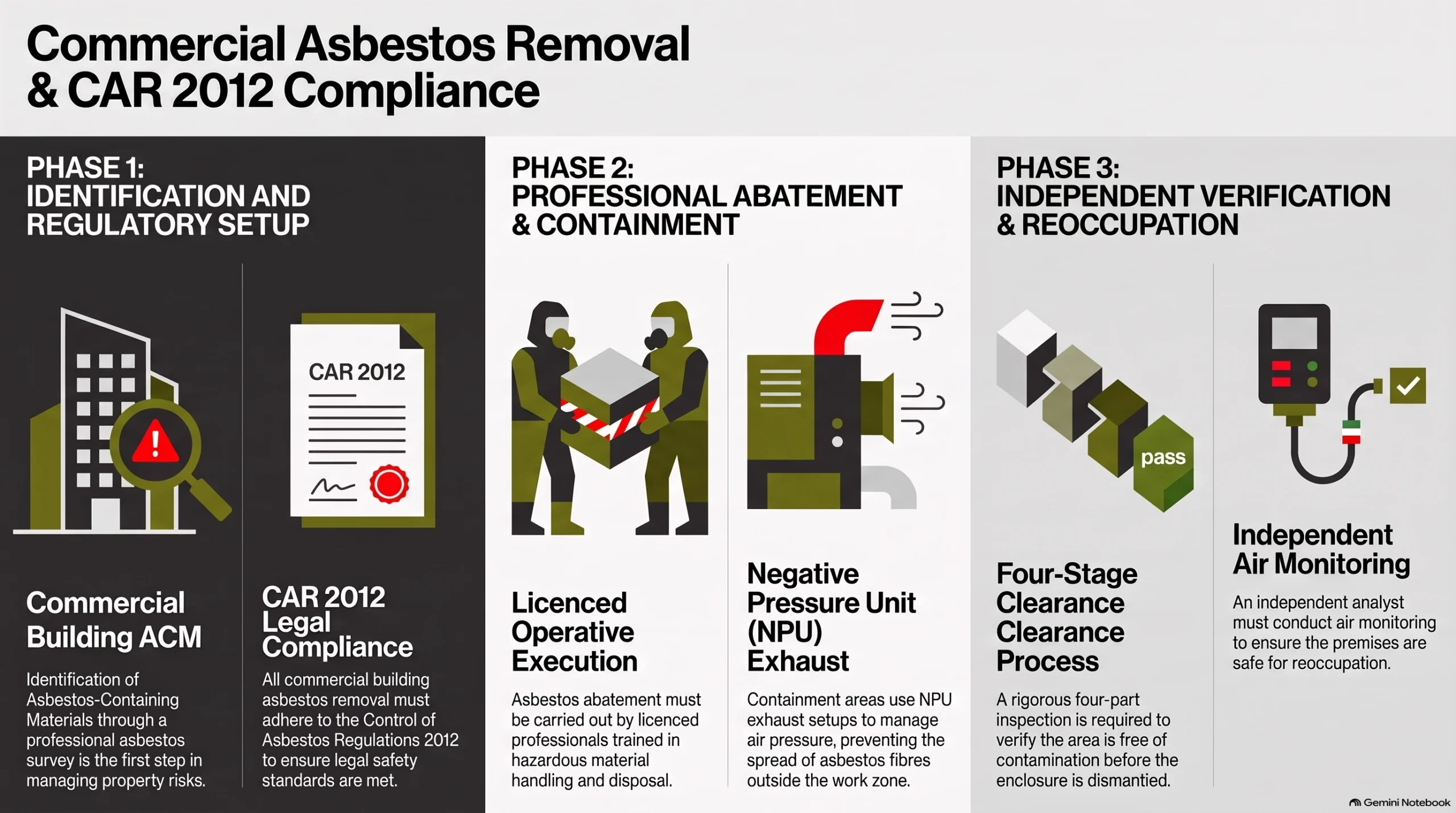
The statutory four-stage clearance process begins with a meticulous visual inspection conducted by an independent UKAS-accredited analyst inside the enclosure. The analyst inspects all bare substrates, polythene walls, ledges, and floor areas using high-intensity spotlights. The presence of any residual dust, fibres, or debris results in immediate failure.
Contractors carry out progressive cleaning stages using Type H HEPA vacuums and wet-wiping techniques with multi-surface tack cloths. The analyst carefully checks behind brackets, within brickwork crevices, and around structural supports where loose material often settles. Remediation teams must reclean the entire enclosure if the analyst detects any trace of unsealed mineral residue.
Independent Air Testing and Certification
Following successful visual cleaning verification, the independent analyst conducts aggressive air monitoring within the sealed enclosure using electric brush disturbance or air movers. The statutory clearance indicator requires airborne fibre concentrations below 0.01 fibres per millilitre. Once passing, the analyst issues an official Certificate of Reoccupation authorising enclosure dismantling.
Analysts collect measured air volumes across 25-millimetre membrane filters. They evaluate fibre counts on site using phase-contrast optical microscopy. The analyst also performs reassurance monitoring in surrounding spaces and adjacent corridors during the dismantling of polythene containment. The dutyholder must file the final four-stage clearance report into the premises logbook before returning the space to commercial occupancy.
Hazardous Waste Consignment and Record Retention
Waste Packaging and Carriage Regulations
Asbestos waste is strictly classed as hazardous waste and requires double-bagging in heavy-duty red inner and clear outer UN-approved polythene sacks. Operatives seal bags using swan-neck tape closures and wipe outer surfaces clean within the bag-lock. Authorised carriers transport sealed skips directly to licensed hazardous waste landfill sites.
Waste transit must comply fully with the Carriage of Dangerous Goods regulations and hazardous waste consignment procedures. Dutyholders receive a consignment note featuring a unique tracking code detailing waste volume and European Waste Catalogue classifications. Receiving facility managers sign these notes upon disposal. Skips parked on commercial premises must remain lockable, fully enclosed, and conspicuously marked with warning signboards.
Long-Term Record Auditing and File Retention
Commercial building asbestos removal projects require comprehensive documentary evidence to satisfy statutory health, safety, and property governance standards. Dutyholders must retain completed waste consignment notes for at least three years under environmental legislation. Furthermore, air monitoring records, surveyor registers, and employee health surveillance files require secure retention for forty years.
Maintaining centralised digital records ensures smooth transitions during commercial property transactions, tenant lease assignments, and institutional financing audits. Prospective buyers and legal surveyors routinely scrutinize historic removal records during corporate due diligence. Robust record keeping proves historical compliance. It insulates property owners against legacy health claims and simplifies future capital refurbishment programmes across commercial portfolios.
Final Thoughts
Properly executing building asbestos removal represents a fundamental operational responsibility for commercial property owners, landlords, and facilities managers. Eliminating hazardous materials eliminates catastrophic occupational health exposures, prevents regulatory enforcement actions, and avoids expensive structural delays during major refurbishment projects. Diligent planning, accredited contractor procurement, and strict containment disciplines protect building users. These actions guarantee that high-risk commercial premises transition safely into modern, fully compliant working environments.
Commercial property portfolios frequently modernise through energy retrofits and floorplate reconfigurations. Managing legacy materials will therefore remain a critical operational priority. Integrating dynamic digital asbestos registers with proactive maintenance programmes allows asset managers to forecast remediation liabilities. Commercial organisations that treat hazardous material compliance as an essential element of strategic asset lifecycle planning will protect occupants and enhance real estate value across their UK portfolios.
Submit Enquiry
Frequently Asked Questions
Licensable work involves higher-risk, friable materials including sprayed coatings, pipe lagging, and asbestos insulating board. These materials readily crumble and release respirable fibres under light disturbance, legally requiring a contractor licensed by the Health and Safety Executive alongside formal statutory notification. Non-licensable work involves denser, tightly bonded matrices such as asbestos cement sheets or thermoplastic floor tiles. Trained operatives can remove non-licensable materials without an HSE licence provided they apply appropriate dust suppression controls, wet working methods, shadow vacuuming, and verified personal protective equipment.
Commercial building ACM surveys focus on business operational dynamics, larger scale building systems, and strict non-domestic compliance under Regulation 4 of CAR 2012. Commercial premises feature extensive plant rooms, complex service risers, lift shafts, and industrial ductwork that are rarely found in residential properties. Commercial surveys also incorporate operational priority assessments, which evaluate foot traffic density, maintenance likelihood, and occupancy profiles across office or industrial floors. This data directly populates a mandatory written Asbestos Management Plan that dutyholders must actively maintain and share with contractors before commencing work.
The four-stage clearance process provides independent, UKAS-accredited verification that an enclosure is thoroughly clean and safe for unprotected reoccupation. Stage one confirms the preliminary scope and visual cleanliness of the work area. Stage two involves a meticulous visual inspection of all surfaces under high-powered lighting to detect microscopic dust or debris. Stage three entails dynamic air monitoring under agitated conditions, which must demonstrate fibre counts below 0.01 fibres per millilitre. Stage four completes a final inspection after enclosure dismantling, culminating in the formal issue of a Certificate of Reoccupation.
Commercial business operations can typically proceed in adjacent zones provided licensed contractors implement robust isolation engineering controls. Abatement teams isolate work zones with airtight timber-framed polythene enclosures under continuous negative pressure, ensuring air flows inward rather than outward. Independent analysts conduct operational leak testing around enclosure seams and background air monitoring in adjacent occupied corridors throughout the project. For extensive or high-risk projects within shared office blocks, facilities managers frequently schedule intrusive removal phases during night shifts or weekends to eliminate tenant disruption and address occupier sensitivities.
Following completed asbestos removal, commercial building dutyholders must collect and archive a comprehensive project handover pack. This file must contain the contractor's site-specific Plan of Work, the fourteen-day HSE notification form where applicable, daily air monitoring records, and the formal four-stage Certificate of Reoccupation issued by an independent UKAS-accredited analyst. The dutyholder must also obtain fully completed hazardous waste consignment notes demonstrating lawful transfer to an authorised disposal site. Finally, facilities teams must immediately update the commercial property's asbestos register and management plan to reflect the removal.

Ora Asbestos Management Ltd
Unit A9, Seedbed Centre,
Shoeburyness, Southend-on-Sea SS3 9QY..
About the Author
Gordon Ringland is the founder, Director and principal asbestos surveyor at Ora. He holds the BOHS P402 qualification — the recognised industry standard for surveying and sampling strategies for asbestos in buildings — awarded by the British Occupational Hygiene Society (BOHS) Faculty of Occupational Hygiene (Certificate No. 20140911-32845-4254).
Gordon has over 12 years of hands-on experience in the asbestos industry, built on more than 20 years working in roofing. He carries out all three main survey types — management surveys, R&D surveys and re-inspections — and designs the sampling strategies used to find asbestos-containing materials (ACMs). He also leads non-licensed asbestos removal projects.
His work spans the full range of buildings, from residential garages and family homes to large commercial sites. Gordon has particular experience in heritage and museum environments, including listed buildings, where careful, fully compliant work matters most. He oversees Ora’s survey work and is the named author of our asbestos guides.