Asbestos Management Plan for Commercial Premises
Commercial property owners and facility directors face strict statutory obligations to protect building occupants, maintenance workers, and visitors from airborne fibres. Under the Control of Asbestos Regulations 2012, dutyholders cannot simply file away a historical survey report and assume compliance. Establishing an operational asbestos management plan ensures that all known or presumed hazardous materials receive systematic inspection, appropriate risk scoring, and controlled maintenance procedures. Proactive oversight prevents catastrophic health exposures whilst shielding commercial organisations from severe legal enforcement and financial liability.
Many commercial dutyholders struggle to convert complex survey data into active working procedures that prevent hazardous fibre release during maintenance tasks or routine occupancy. Without clear administrative protocols, organisations face substantial regulatory penalties and severe operational disruptions. How can responsible persons structure, execute, and maintain a legally compliant written strategy that effectively mitigates health risks across diverse non-domestic facilities?
Key Takeaways
- Regulation 4 of the Control of Asbestos Regulations 2012 requires dutyholders to identify, document, and actively manage all asbestos materials across non-domestic commercial premises.
- Every compliant written management plan must designate accountable personnel, establish clear contractor permit systems, and detail immediate emergency containment procedures for accidental disturbance.
- Risk scores combine material assessments of product vulnerability with priority assessments detailing operational occupancy levels, maintenance frequency, and human exposure potential across work areas.
- Dutyholders must review management procedures at least annually, updating records whenever structural modifications occur, materials degrade, or removal works reach verified completion.
- Independent accredited surveyors provide essential management and refurbishment surveys, ensuring that non-domestic asset registers accurately reflect true physical site conditions and legal obligations.
Statutory Components of Commercial Asbestos Oversight
The Control of Asbestos Regulations 2012 mandate precise operational duties for commercial dutyholders. Legal compliance extends far beyond commissioning an initial inspection report. Responsible persons must coordinate active risk assessments, maintain transparent records, and enforce strict work authorisation protocols. These mechanisms protect contractors and staff from preventable airborne fibre exposures whilst avoiding severe statutory enforcement notices.
The table below outlines the core administrative components required within a standard operational framework. Each element addresses a specific statutory duty under Approved Code of Practice L143. Commercial property managers should benchmark existing site documentation against these standard requirements to confirm institutional compliance and operational safety.
| Core Component | Statutory Framework | Practical Function in Buildings |
|---|---|---|
| Asbestos Register | CAR 2012 Regulation 4 | Live inventory detailing location, extent, type, and physical condition of all ACMs. |
| Risk Prioritisation | HSG264 Survey Guide | Algorithmic score combining material friability with occupant activity and maintenance footfall. |
| Pre-Work Identification | CAR 2012 Regulation 5 | Duty to identify the type, location, and condition of asbestos before any work liable to disturb it begins. |
| Monitoring Programme | Approved Code of Practice L143 | Scheduled schedule defining re-inspection frequencies, surface sealing, or licensed removal actions. |
| Emergency Procedure | CAR 2012 Regulation 15 | Immediate isolation, evacuation, sealing, and specialist reassurance air testing following unexpected fibre release. |
Statutory Requirements for Non-Domestic Dutyholders
Regulation 4 of the Control of Asbestos Regulations 2012
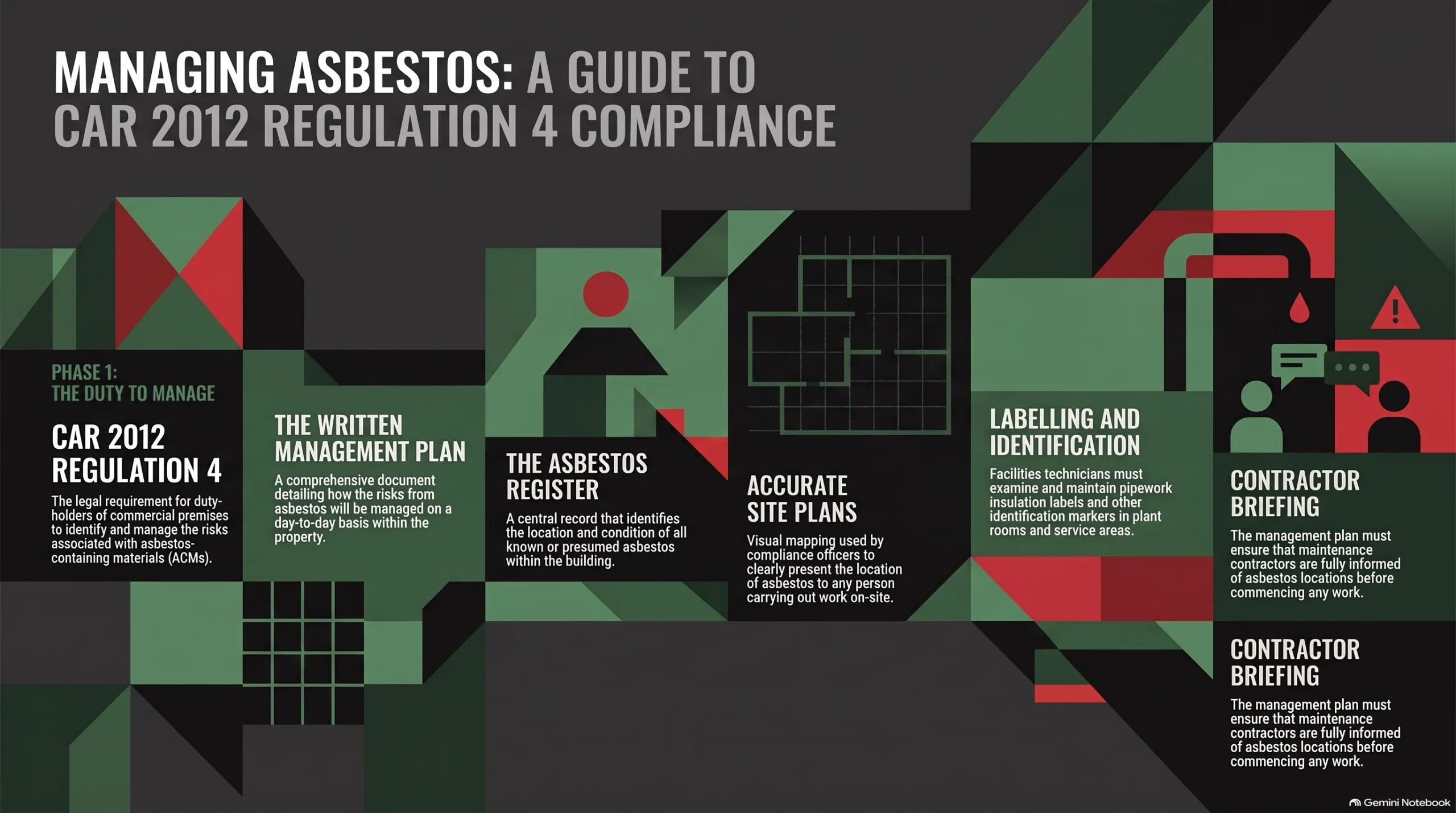
Regulation 4 places a strict legal obligation upon commercial dutyholders to protect building occupants from asbestos exposure. Dutyholders must determine the presence of hazardous materials, evaluate their physical condition, and compile an active register. Furthermore, legislation requires a written management plan to govern all maintenance activities safely.
The duty applies to all non-domestic premises across the United Kingdom. This scope includes industrial factories, logistics hubs, retail developments, commercial offices, and common parts of residential blocks. The Health and Safety Executive inspects commercial facilities to verify adherence to Approved Code of Practice L143. Inspectors issue immediate Improvement Notices or Prohibition Notices when organisations fail to produce adequate documentation. Severe breaches trigger formal prosecution, substantial financial fines, and individual custodial sentences for responsible directors.
Allocation of Dutyholder and Maintenance Responsibilities
Commercial lease agreements determine who holds statutory dutyholder status for a specific property. Freeholders, commercial tenants, and appointed managing agents often share legal accountability under tenancy terms. A written agreement must explicitly allocate maintenance obligations to ensure that no structural element or communal area escapes active oversight.
In multi-occupancy assets, institutional landlords typically maintain common structural elements, central heating risers, plant spaces, and circulation corridors. Conversely, institutional lease agreements often designate tenants as dutyholders for their demised, internal trading spaces. If tenancy contracts remain silent on maintenance liabilities, the legal duty falls on whichever party exercises effective operational control over the building fabric. Appointing a named individual as compliance coordinator guarantees that operational maintenance duties never stall due to administrative ambiguity.
Core Elements of a Written Management Plan
Essential Records and Physical Asset Registers
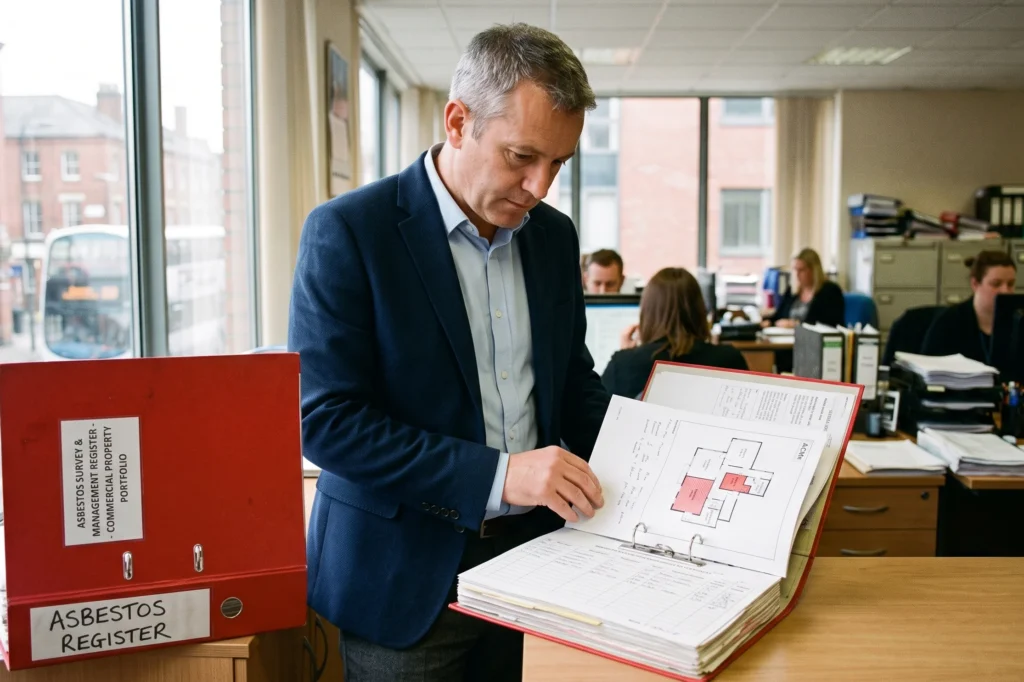
An up-to-date asbestos register forms the primary evidentiary foundation of every compliance system. This live document records the precise location, quantity, material type, and surface condition of every hazardous item. Dutyholders must presume that uninspected building elements contain asbestos until competent sampling proves otherwise.
Developing an effective asbestos management plan commercial landlords can rely upon demands rigorous documentation and clear emergency arrangements. Digital registers allow facilities teams to update physical condition scores in real time. Surveyors tag sample records to annotated architectural drawings, enabling rapid spatial verification. If refurbishment plans access sealed ceiling voids or pipe chases, the register immediately highlights potential hazards. Maintaining clear photographic evidence alongside laboratory certificates ensures full regulatory traceability.
Operational Procedures for Contractor and Staff Safety
A robust written strategy defines mandatory communication workflows for anyone visiting or modifying commercial premises. Dutyholders must train internal maintenance personnel and brief external trade contractors before site works commence. Clear procedures prevent accidental mechanical abrasion of hazardous materials during routine electrical, plumbing, or decorating tasks.
Every commercial contractor must sign an asbestos acknowledgement sheet before accessing plant rooms or structural voids. Facility teams should issue specific task permits that describe exact work boundaries. If workers encounter unidentified materials, protocols must instruct them to halt immediately. Clear communication eliminates the common assumption that all older commercial finishes are harmless.
Did You Know?
Under Regulation 22 of the Control of Asbestos Regulations 2012, employers must keep the health record and medical surveillance documents for any employee on licensable asbestos work for at least forty years from the date of the last entry.
Risk Assessment and Material Prioritisation Strategies
Material Assessment Scores Under HSG264 Guidance
Material assessments evaluate the intrinsic potential of an item to release respirable fibres if disturbed. Following Health and Safety Executive guidance HSG264, surveyors evaluate product type, extent of deterioration, surface treatment, and asbestos type. Each parameter receives a numerical score from zero to three, establishing an objective baseline.
Friable materials like sprayed coatings or loose thermal lagging score highest due to high release risks. Conversely, tightly bound composites like vinyl floor tiles score lower. Adding these scores produces an overall material score between two and twelve. This classification shows dutyholders which materials require immediate remedial sealing or prompt specialist removal.
Priority Assessment Factors for Occupant Exposure
Priority assessments calculate the likelihood of human disturbance during normal daily operations. Unlike material assessments conducted purely by surveyors, the commercial dutyholder must evaluate operational site activities. Factors include occupant numbers, exposure frequency, average maintenance needs, and the physical vulnerability of the material.
Combining the material score with the priority score yields a comprehensive risk ranking. An undamaged asbestos cement roof over an unoccupied warehouse generates a low priority. Conversely, asbestos insulating board inside a busy corridor requires aggressive monitoring. This dual-assessment strategy ensures facility budgets target genuine life-safety risks effectively.
Detailed ACM condition checks and regulatory compliance reports.
Survey Selection and Pre-Construction Procedures
Management Surveys for Normal Building Operations
Management surveys represent the standard baseline inspection for day-to-day commercial property operations. The surveyor locates, assesses, and samples accessible materials that occupants might disturb during routine cleaning and minor maintenance. Dutyholders use these comprehensive findings to establish an initial register and form their ongoing written management plan.
These inspections involve minimal surface disturbance. Surveyors inspect accessible ceiling panels, floor finishes, service ducts, and plant areas. If sampling poses hazards, the surveyor presumes the presence of asbestos. The resulting data enables dutyholders to manage intact materials safely in place without incurring unnecessary structural disruption.
Intrusive Refurbishment and Demolition Surveys
Commercial alterations require a dedicated refurbishment and demolition survey before any physical works begin. This intrusive inspection targets the exact work zone, penetrating wall cavities, structural cladding, and underfloor voids. Contractors use these specific reports to eliminate hidden asbestos risks before stripping out commercial interiors.
Unlike management surveys, these destructive audits require isolated work zones and controlled conditions. Surveyors access sealed structural voids to locate thermal lagging, fireproofing sprays, and partition linings. Construction managers incorporate these findings into pre-construction information under CDM 2015 regulations. This foresight prevents unexpected contamination stoppages during major building refurbishments.
Management, refurbishment, and demolition surveys for all property types.
Operational Control Measures and Maintenance Protocols
Permit-to-Work Systems and Access Authorisation
Permit-to-work systems prevent unauthorised trades from penetrating building surfaces containing hazardous fibres. Commercial facilities managers must review all project plans against the live register before issuing site permits. This formal sign-off confirms that trades understand exact material locations and use appropriate dust suppression methods.
High-risk areas like boiler houses or ceiling voids should remain locked under controlled key management. Only inducted personnel with verified asbestos awareness training may sign out access keys. Dutyholders must document permit approvals and retain signed logs on site. This paper trail demonstrates regulatory diligence during external safety audits.
Labelling and Physical Protection of Intact Materials
Clear physical warning labels alert personnel to the presence of hazardous materials within service zones. Dutyholders apply standardised warning signs to accessible asbestos panels, pipe casing, and plant room enclosures. However, public spaces often require discreet asset tracking codes to prevent unnecessary building panic.
Where physical labelling is unsuitable, dutyholders rely on digital floor plans and staff inductions. Encapsulation techniques, such as elastomeric coatings, seal intact boards and prevent superficial damage. Physical impact barriers also protect vulnerable column casings in busy loading bays. Maintaining these barriers extends material lifespans whilst protecting operational staff.
Asbestos Removal
Safe, certified removal of asbestos materials in line with HSE guidelines.
Review Schedules and Documentation Auditing
Mandatory Twelve-Month Inspection Cycles
Statutory regulations mandate that dutyholders re-inspect all recorded materials at regular intervals, typically every twelve months. A competent surveyor visits the site to verify that encapsulating seals remain intact and materials show no mechanical damage. Every inspection generates updated condition scores within the official asset register.
Wear and tear from weather, footfall, or water leaks can degrade stable materials over time. For instance, external asbestos cement sheets become porous and brittle after decades of exposure. Annual audits catch early deterioration before fibres escape into ambient air. The surveyor records comparative photographs to track material stability between successive inspection visits.
Triggers for Immediate Operational Plan Updates
Commercial premises change frequently through tenant turnovers, layout redesigns, and routine equipment upgrades. Whenever structural modifications take place or licensed remediation finishes, dutyholders must update their register immediately. Waiting for the annual audit leaves organisations exposed to compliance breaches and unsafe working assumptions.
Staff changes also demand immediate updates to the written scheme. If the designated health and safety lead leaves the company, the document must state their replacement. Furthermore, discovery of suspect materials during works requires immediate survey confirmation. Documenting these updates keeps the management plan legally defensible and operationally current.
Emergency Incident Protocols and Remediation
Immediate Containment of Accidental Damage
Accidental damage to hazardous materials requires immediate, decisive containment actions to protect building occupants. Dutyholders must evacuate the affected zone, shut down mechanical ventilation systems, and lock access doors. Clear emergency protocols prevent dust migration into adjacent commercial offices, retail zones, or public corridors.
Emergency procedures must display contact numbers for licensed remediation specialists and UKAS-accredited analysts. Staff should post warning notices outside the contaminated area to restrict unauthorised entry. Dutyholders must never allow untrained cleaning operatives to sweep or vacuum asbestos debris. Uncontrolled cleaning spreads respirable dust across wider facilities.
Four-Stage Clearance and Air Monitoring Verification
Following licensed removal or major remedial cleaning, the site must pass a strict four-stage clearance process. An independent analyst conducts visual checks, enclosure air sampling, and final reassurance testing before reoccupation. Only a formal Certificate of Reoccupation confirms that the commercial space is safe to re-enter.
Guidance under HSG248 governs clearance protocols. The analyst tests ambient air within temporary containment enclosures to confirm fibre counts remain below 0.01 fibres per millilitre. Dutyholders must file clearance certificates, consignment waste notes, and air monitoring logs alongside the master register. Maintaining these records for forty years fulfils statutory legal requirements.
Final Thoughts
Maintaining an active asbestos management plan protects commercial building occupants, visiting contractors, and business assets from severe risks. Proactive management requires accurate registers, clear operational controls, and disciplined re-inspection schedules rather than passive compliance filing. Dutyholders who integrate these systems into everyday facility operations ensure lasting safety across their premises.
Implementing structured administrative systems today establishes a defensible framework against evolving regulatory enforcement. Regular reviews, clear staff training, and rigorous contractor oversight will keep commercial facilities safe, legally compliant, and operationally resilient for decades to come.
Submit Enquiry
Frequently Asked Questions
The primary purpose of an asbestos management plan is to prevent accidental exposure to hazardous airborne fibres within non-domestic properties. The plan outlines who is responsible for safety, contains an up-to-date register of all identified materials, and details an active strategy for monitoring their physical condition. It also establishes mandatory work authorisation protocols and emergency procedures, ensuring contractors and employees can work safely without unknowingly disturbing hazardous materials.
Under Regulation 4 of the Control of Asbestos Regulations 2012, the dutyholder is anyone who has clear responsibility for the maintenance or repair of non-domestic premises. This role typically belongs to the property owner, the freeholder, or a commercial tenant holding full repairing lease terms. Managing agents appointed under commercial contracts may also assume statutory dutyholder responsibilities, requiring transparent written agreements to define individual legal obligations.
Dutyholders must review their management plan at regular intervals, with statutory best practice requiring a review at least once every twelve months. However, immediate updates are legally necessary whenever building layouts change, tenants relocate, or structural repairs occur. The discovery of previously unrecorded materials or the completion of licensed asbestos remediation works also triggers an immediate review to ensure registers accurately reflect current building conditions.
A management survey is a standard, non-intrusive inspection designed to locate and assess materials that could be disturbed during normal daily operations and routine maintenance. In contrast, a refurbishment and demolition survey is a fully intrusive, destructive examination required before any structural alterations commence. It penetrates walls, floors, and ceiling cavities to find hidden hazardous materials within the specific construction zone.
Asbestos materials in sound physical condition that are unlikely to suffer mechanical damage or disturbance do not require immediate removal. Current Health and Safety Executive guidance advises managing intact materials in situ. Dutyholders can safely seal, label, and encapsulate these products, provided they monitor them through documented twelve-month inspection cycles to confirm their surface seals remain undamaged and no fibres have escaped over time.

Ora Asbestos Management Ltd
Unit A9, Seedbed Centre,
Shoeburyness, Southend-on-Sea SS3 9QY..
About the Author
Gordon Ringland is the founder, Director and principal asbestos surveyor at Ora. He holds the BOHS P402 qualification — the recognised industry standard for surveying and sampling strategies for asbestos in buildings — awarded by the British Occupational Hygiene Society (BOHS) Faculty of Occupational Hygiene (Certificate No. 20140911-32845-4254).
Gordon has over 12 years of hands-on experience in the asbestos industry, built on more than 20 years working in roofing. He carries out all three main survey types — management surveys, R&D surveys and re-inspections — and designs the sampling strategies used to find asbestos-containing materials (ACMs). He also leads non-licensed asbestos removal projects.
His work spans the full range of buildings, from residential garages and family homes to large commercial sites. Gordon has particular experience in heritage and museum environments, including listed buildings, where careful, fully compliant work matters most. He oversees Ora’s survey work and is the named author of our asbestos guides.