Commercial Asbestos Inspections Across Portfolios
Estate directors and asset managers carry complex duties under British health and safety law. Commercial asbestos inspections keep non-domestic premises safe for occupants, visitors, and maintenance contractors. Annual intrusive surveys are not the answer. Structured re-inspection programmes monitor known materials instead. This approach limits disruption, reduces liability, and protects capital value across a portfolio.
Managing a large estate demands continuous visibility of hazardous materials. Without unified reporting and routine condition review, dutyholders invite enforcement action. Reputational damage and project delays follow. So how can a multi-site operator coordinate statutory compliance across varied building types whilst controlling facilities expenditure?
Key Takeaways
- Regulation 4 of the Control of Asbestos Regulations 2012 requires non-domestic dutyholders to inspect, monitor, and manage all identified asbestos-containing materials.
- Commercial asbestos inspections verify material condition across an estate and update risk assessments without commissioning a full management survey each year.
- A structured portfolio inspection cycle delivers multi-site compliance, simplifies maintenance planning, and standardises asbestos data across diverse commercial property holdings.
- HSG264 guidance combines intrinsic material scores with occupancy-based priority scores so dutyholders can select proportionate control measures for each location.
- Appointing inspection bodies accredited to BS EN ISO/IEC 17020 secures surveyor competence, impartial findings, and legally defensible asbestos registers.
Inspection Types Used Across Commercial Estates
Proactive estate governance balances baseline discovery with cyclic monitoring. Statutory compliance rests on accurate, current documentation for every facility. Those records must reflect asset deterioration, tenant fit-outs, and operational wear. Robust management plans prevent contamination incidents. They also keep commercial environments safe for occupants and visiting trades throughout the year.
The framework below sets out how survey tiers, condition re-assessments, and documentation protocols work together. Each inspection type serves a distinct regulatory purpose. Property managers use the hierarchy to protect life safety and control maintenance liabilities. The same structure satisfies Health and Safety Executive expectations during audits and property transactions.
| Inspection Type | Regulatory Purpose | Application Across Portfolios |
|---|---|---|
| Management Survey | Locate and assess accessible materials | Establishes the core baseline register for daily operational management |
| Periodic Re-Inspection | Monitor condition of known materials | Executes the recurring annual audit cycle across all documented assets |
| Refurbishment Survey | Locate concealed materials in work zones | Precedes invasive capital projects, soft strips, or major mechanical installations |
| Priority Risk Assessment | Score human exposure and disturbance potential | Informs capital expenditure ranking within the estate management plan |
Statutory Duties Under British Law
Duty to Manage Non-Domestic Premises
Regulation 4 of the Control of Asbestos Regulations 2012 places legal responsibility on commercial dutyholders. They must identify, assess, and manage asbestos in non-domestic premises. The duty applies to freeholders and landlords. It also applies to tenants holding repairing leases across industrial units, retail premises, and corporate offices.
The statute requires dutyholders to locate materials and record their extent. They must assess current condition and write a management plan. Those findings must reach every trade and maintenance operative before work starts. Poor records breach the Health and Safety at Work etc. Act 1974. Enforcement notices or prosecution follow.
Penalties for Statutory Non-Compliance
Regulators act decisively when commercial dutyholders fail to manage hazardous materials. The Health and Safety Executive inspects commercial facilities regularly. Inspectors issue Improvement Notices where management systems fall short. They serve Prohibition Notices where unmanaged asbestos threatens worker welfare or public safety. Both notices carry immediate legal force.
Prohibition notices halt commercial activity immediately. Business interruption costs mount within hours. Where exposure occurs, courts impose unlimited fines on the organisation. Individual directors also face custodial sentences. In practice, we find that routine inspections commercial buildings undergo each year build the evidence trail regulators expect.
Portfolio Inspection Cycle Design
Programme Design and Review Scheduling
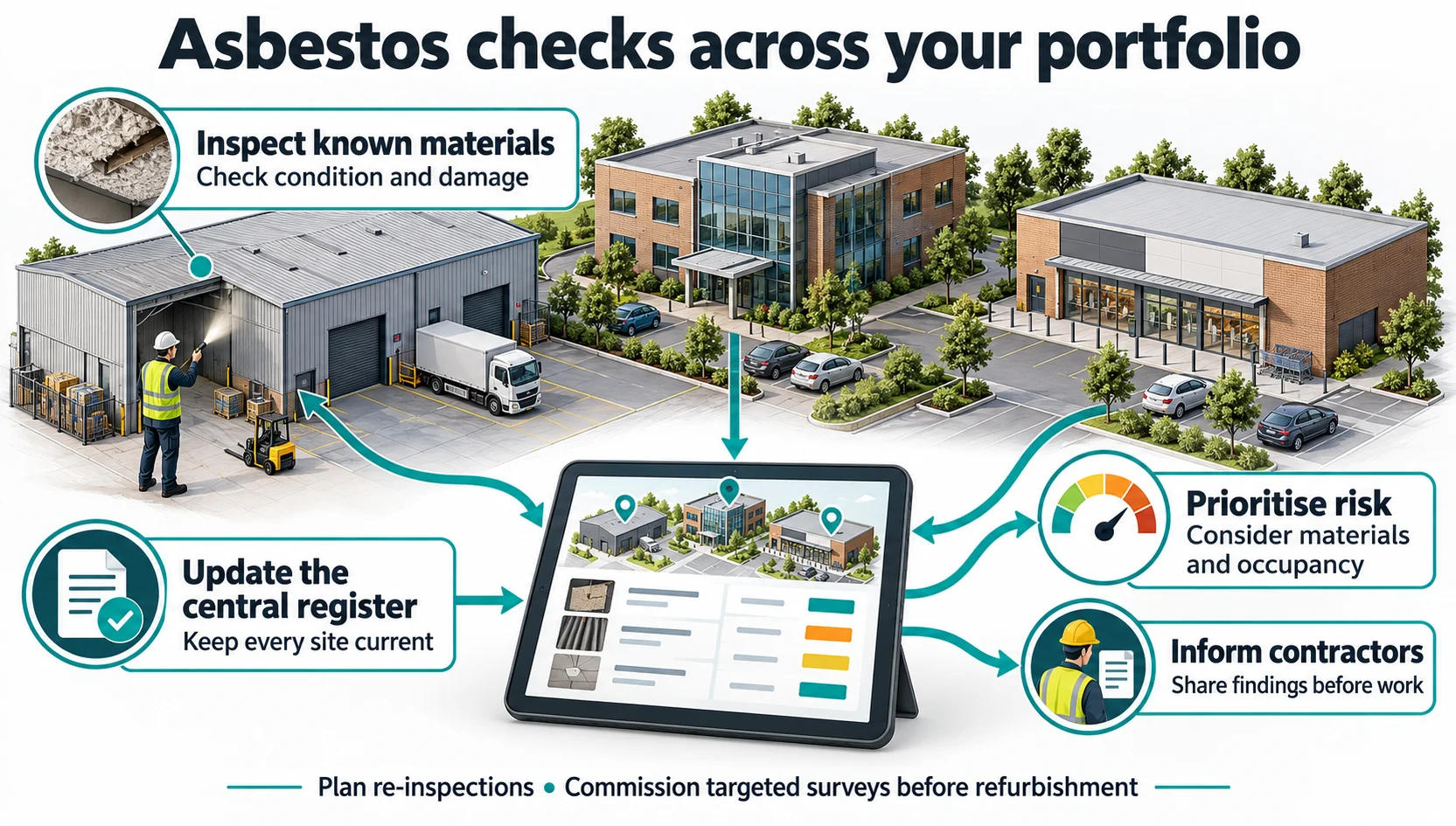
A portfolio inspection cycle verifies the condition of previously recorded materials across multi-site holdings. It avoids annual re-sampling. Qualified surveyors inspect catalogued items instead. They photograph each item, record deterioration, and confirm that warning labels remain legible. The resulting data refreshes the register for every operational asset.
A strict twelve-month cycle stops stable materials degrading unnoticed. Estate managers gain economies of scale by clustering regional properties into coordinated routes. This scheduling prevents site drift. It also controls surveying expenditure. Condition metrics then arrive in a consistent format across the whole portfolio.
Centralised and Dynamic Asbestos Registers
Centralised digital registers hold the data gathered during each site audit. They give estate leaders live operational oversight. Static spreadsheets fail complex portfolios. Contractors mislay printed reports or work from obsolete copies. Those copies rarely reflect recent tenant fit-outs, service alterations, or remedial works completed since the last inspection.
Modern estate management needs cloud-hosted systems. These link live condition scores to maintenance dispatch workflows. Surveyors flag surface wear on insulating board or pipe lagging. The platform then alerts the regional facilities team. Contractor permissions reflect current site conditions before building services work begins.
Did You Know?
The United Kingdom banned the import, supply, and use of all asbestos in November 1999. The Health and Safety Executive estimates that asbestos remains present in around 1.5 million buildings across Great Britain.
Survey Methodologies Across Asset Types
Management Surveys Versus Re-Inspections
Management surveys build the primary inventory. Surveyors sample accessible materials and presume presence where doubt remains. Routine commercial asbestos inspections work differently. They re-verify known items only. The surveyor checks whether surface damage, water leaks, or foot traffic have compromised containment inside an operational building.
Re-inspections take fewer site hours and cause no destructive damage. Occupied tenant premises keep trading throughout. Surveyors consult the existing register, locate marked panels, and note any flaking. They confirm that encapsulant coatings remain intact. This distinction lets facilities directors budget accurately whilst meeting statutory duties.
Targeted Refurbishment and Demolition Surveys
Intrusive surveys become legally mandatory before structural work starts. A management register carries insufficient detail for invasive construction. It omits concealed voids, enclosed riser shafts, and structural floor zones. Workers disturb those areas during major renovation. Commercial tenants and developers must therefore commission a refurbishment survey first.
Refurbishment surveys use destructive access within the project envelope. Surveyors break into partition cavities and examine structural steel fireproofing. They lift subfloors to confirm what lies beneath. These findings feed the pre-construction information pack. That transfer satisfies the duties set out under CDM 2015.
Detailed ACM condition checks and regulatory compliance reports.
Risk Scoring and Action Prioritisation
Material Risk Assessment Metrics
HSG264 standardises material risk scoring. Surveyors assess four intrinsic parameters that dictate potential fibre release. They record product type and the extent of surface damage. They also judge surface treatment quality and fibre classification. Each parameter receives a score during every physical inspection across the estate.
Asbestos cement scores lower than friable thermal insulation. Unsealed insulating board scores higher again. A damaged, bare coating ranks worst because light impact dislodges fibres into the air. Surveyors sum the four parameters. The total produces an objective material assessment between two and twelve.
Priority Assessment and Operational Scoring
Priority assessments measure human interaction with each recorded item. The score reflects true operational risk inside an occupied building. Surveyors record normal occupant activity and maintenance frequency. They also weigh location accessibility and occupant numbers. These factors combine into a practical rating for every surveyed commercial property.
A sealed ceiling tile in a quiet plant room attracts a modest priority score. The same tile in a busy retail delivery corridor scores far higher. Disturbance potential drives the difference. Combined material and priority scores then direct funding. Budget moves toward encapsulation, cleaning, or licensed removal in order of urgency.
Management, refurbishment, and demolition surveys for all property types.
Surveyor Competence and Quality Assurance
Individual Competency and Corporate Accreditation
Survey integrity depends on qualified technical personnel. Surveyors should hold a recognised British Occupational Hygiene Society certificate, usually the P402. Individual credentials alone are not sufficient. The Health and Safety Executive advises commissioning inspection bodies accredited to BS EN ISO/IEC 17020 by UKAS for commercial work.
Corporate accreditation confirms documented quality frameworks and technical impartiality. Accredited bodies run in-progress audits on live site work. They also carry out technical peer review before issuing a report. That oversight produces legally defensible data. Asset managers gain protection against later liability claims.
Laboratory Standards for Bulk Analysis
Bulk analysis of building samples must satisfy exacting national standards. Any laboratory identifying asbestos fibres in construction materials needs UKAS accreditation. That accreditation aligns with ISO/IEC 17025. The standard governs method validation, equipment calibration, and analyst competence. Results then stand as legally admissible records for the dutyholder.
Analysts follow the criteria set out in HSG248. They examine bulk materials using polarised light microscopy and dispersion staining. Accredited laboratories also join the Asbestos In-House Proficiency Testing Scheme. That scheme proves consistent analytical accuracy. Retained samples and analytical records support property transactions and due diligence.
Asbestos Removal
Safe, certified removal of asbestos materials in line with HSE guidelines.
Operational Challenges Across Built Environments
Industrial Corridors and Brittle Materials
Ageing logistics assets present severe building fabric hazards. Deteriorating external asbestos cement causes most of them. Roof claddings, gutters, and downpipes fitted between 1960 and 1990 have passed their design life. The sheets turn brittle and fragile. Water leaks follow, and fibre release becomes a genuine prospect.
Safe access constrains every inspection of fragile corrugated cement roofing. Surveyors assess structural integrity without stepping onto the sheets. They note internal flaking and external water damage from a safe position. From experience across the sector, early intervention prevents sudden roof failures. Factory operational zones stay clear and productive.
Heritage Adaptations and Retail Pressures
Historic city centre premises hide hazards introduced long after construction. Post-war modernisation added asbestos insulating board behind period joinery. Contractors also fitted it around cast-iron risers and above ornate ceilings. The aim was improved fire separation. Those linings remain in place across many older retail buildings today.
High street fit-outs disturb these concealed linings regularly. Shopfitters alter suspended grid layouts without knowing what sits above. Facility teams running fast strip-outs should commission a pre-works inspection. Careful scoping protects the trading schedule. It also protects period features from avoidable contamination.
Contractor Management and Estate Information
Hazard Information for Working Contractors
Dutyholders must supply current asbestos information before contractors start work. Mechanical, electrical, and plumbing trades all need it. Paper distribution frequently fails. Operatives overlook files held in a distant facilities office. They rarely review hazard data directly at the location where they intend to work.
Estate directors should build induction protocols around digital sign-off. Trade operatives review and sign the relevant hazard register before entry. Permit-to-work documentation ties directly to current survey findings. Proactive disclosure prevents accidental disturbance. It also removes the cost of emergency decontamination in a trading environment.
Record Retention and Management Reviews
Statutory compliance requires scheduled review of asbestos management documentation. Dutyholders must also update it whenever a property changes physically. Regulations set minimum retention periods for air monitoring certificates. The same applies to training logs and health surveillance records. Those obligations run across every active commercial site in the estate.
Asset managers need continuous documentation through every acquisition and tenancy handover. Refurbishment cycles demand the same discipline. An annual audit confirms that completed remedial works reach the central register. Encapsulant repairs and licensed removals must appear there too. An unbroken chain of custody protects yields at disposal or refinancing.
Final Thoughts
Commercial asbestos inspections protect people, investment, and business continuity across a property portfolio. A cyclic monitoring model replaces reactive one-off surveys. Dutyholders keep constant oversight of high-risk materials. Routine condition tracking preserves capital value and keeps contractors safe. It also produces defensible evidence of statutory compliance.
Commercial estates keep changing through green retrofits, tenant alterations, and structural upgrades. Dynamic digital registers absorb that change without administrative friction. Accredited inspection partners keep the data reliable. Verified condition information remains the foundation of a compliant, safe, and fully operational portfolio.
Submit Enquiry
Frequently Asked Questions
A:
Commercial asbestos inspections assess the physical condition of recorded asbestos-containing materials across corporate buildings. The process updates the asset register and checks whether existing encapsulation remains intact. Surveyors reassess exposure risk and recommend corrective action where needed. Routine inspection prevents accidental fibre release during ordinary maintenance work. It protects building occupants and contractors. It also evidences compliance with Regulation 4 of the Control of Asbestos Regulations 2012.
A:
British regulations require dutyholders to review the asbestos management plan regularly. Standard practice places re-inspection at least every twelve months on commercial premises. Higher-risk areas need more frequent attention. Plant rooms, busy corridors, and warehouse zones exposed to mechanical impact may warrant quarterly review. The combined material and priority risk scores determine the interval for each item. A proactive schedule ensures deteriorating materials receive remediation before fibres become airborne.
A:
A standard re-inspection does not involve intrusive sampling. Surveyors examine only those items already recorded or presumed within the existing register. The visual review looks for physical damage, water ingress, surface flaking, and missing identification labels. Intrusive sampling happens in two situations. An unsurveyed area becomes accessible, or contractors plan invasive refurbishment work in that zone. This approach keeps routine compliance audits safe, quick, and cost-effective for the dutyholder.
A:
Dutyholder status under Regulation 4 depends on the terms of the lease. A tenant holding a full repairing and insuring lease usually takes on the duty for the demised area. Freeholders and managing agents normally retain responsibility for communal risers, shared plant rooms, reception areas, and external roofs. Overlap is common in multi-let buildings. Both parties should agree responsibilities in writing and maintain a single, shared register.
A:
Competent surveyors hold recognised industry certification, most commonly the British Occupational Hygiene Society P402 certificate. Supervised field experience supports that qualification. The Health and Safety Executive also advises appointing organisations accredited to BS EN ISO/IEC 17020 by UKAS. Corporate accreditation confirms procedural competence, technical impartiality, calibrated instrumentation, and internal quality auditing. These credentials give estate directors confidence that survey findings will withstand scrutiny during a statutory compliance audit.

Ora Asbestos Management Ltd
Unit A9, Seedbed Centre,
Shoeburyness, Southend-on-Sea SS3 9QY..
About the Author
Gordon Ringland is the founder, Director and principal asbestos surveyor at Ora. He holds the BOHS P402 qualification — the recognised industry standard for surveying and sampling strategies for asbestos in buildings — awarded by the British Occupational Hygiene Society (BOHS) Faculty of Occupational Hygiene (Certificate No. 20140911-32845-4254).
Gordon has over 12 years of hands-on experience in the asbestos industry, built on more than 20 years working in roofing. He carries out all three main survey types — management surveys, R&D surveys and re-inspections — and designs the sampling strategies used to find asbestos-containing materials (ACMs). He also leads non-licensed asbestos removal projects.
His work spans the full range of buildings, from residential garages and family homes to large commercial sites. Gordon has particular experience in heritage and museum environments, including listed buildings, where careful, fully compliant work matters most. He oversees Ora’s survey work and is the named author of our asbestos guides.