Industrial Asbestos Abatement for Plant & Cladding
Safe industrial asbestos abatement protects the workforce and keeps a commercial site inside UK law. Manufacturing plants, logistics hubs and processing facilities built before 2000 still hold significant volumes of asbestos. The material sits in the building fabric and in the mechanical assets alike. Dutyholders must establish what a suspect product actually is before sanctioning any intrusive work. Guesswork releases fibre into occupied space.
Modern industrial operations run on uptime. Ageing infrastructure still needs intervention when material degrades or faces mechanical disturbance during a refit. Factory managers ask the same question every time. Corrugated sheeting fails, lagging is damaged, and production cannot simply stop. How do you meet the statutory duty without surrendering the production schedule?
Key Takeaways
- CAR 2012 requires every industrial dutyholder to hold a written, annually reviewed asbestos management plan.
- Industrial ACM abatement splits into licensed, notifiable non-licensed and non-licensed work, decided by material friability and likely exposure.
- Fragile cement roof sheets need fall protection, wet suppression and careful unbolting rather than mechanical cutting.
- Plant room lagging demands a sealed enclosure, three-stage airlocks and at least eight air changes hourly.
- Four-stage clearance by an independent UKAS analyst must precede reoccupation of any industrial work zone.
Asbestos Material Types Found in Industrial Premises
Industrial premises hold several distinct asbestos products, and each one behaves differently when disturbed. Facilities built before 2000 used chrysotile, amosite and crocidolite across roofs, plant rooms and structural steel. Friability decides the control regime. In practice, we find that accurate material identification shapes the cost, duration and legal category of every remediation programme.
The table below sets out the materials we encounter most often on manufacturing, warehousing and processing sites. It records where each product usually sits and which statutory work category applies. Dutyholders can use it to scope surveys and budgets early. Final classification still rests on a competent risk assessment carried out at the building itself.
| Material Profile | Typical Facility Location | Statutory Work Category |
|---|---|---|
| Corrugated cement sheets | External roof spans and warehouse cladding | Non-licensed or NNLW |
| Thermal pipe lagging | Boiler rooms, steam distribution, calorifiers | Licensed work |
| Sprayed structural coatings | Structural steel frames and concrete soffits | Licensed work |
| Asbestos insulating board | Fire barriers, partitions and service risers | Licensed work or NNLW |
| Woven gaskets and ropes | High-temperature flanges and valve assemblies | Non-licensed work |
Statutory Duties and Regulatory Thresholds
Control of Asbestos Regulations 2012
Regulation 4 of CAR 2012 places a legal duty on industrial facility owners and maintenance managers. Dutyholders must inspect the premises, record every suspect material on an accessible register and assess the risk of exposure. They must then review that written management plan each year and keep it current.
A missing or outdated management plan carries real consequences. Prosecution can follow under the Health and Safety at Work etc. Act 1974. The HSE may serve a prohibition notice and stop production the same day. Fines follow when unrecorded material suffers accidental damage during routine maintenance. Clear documentation protects the workforce and the production schedule alike.
Licensing Thresholds and Notification Duties
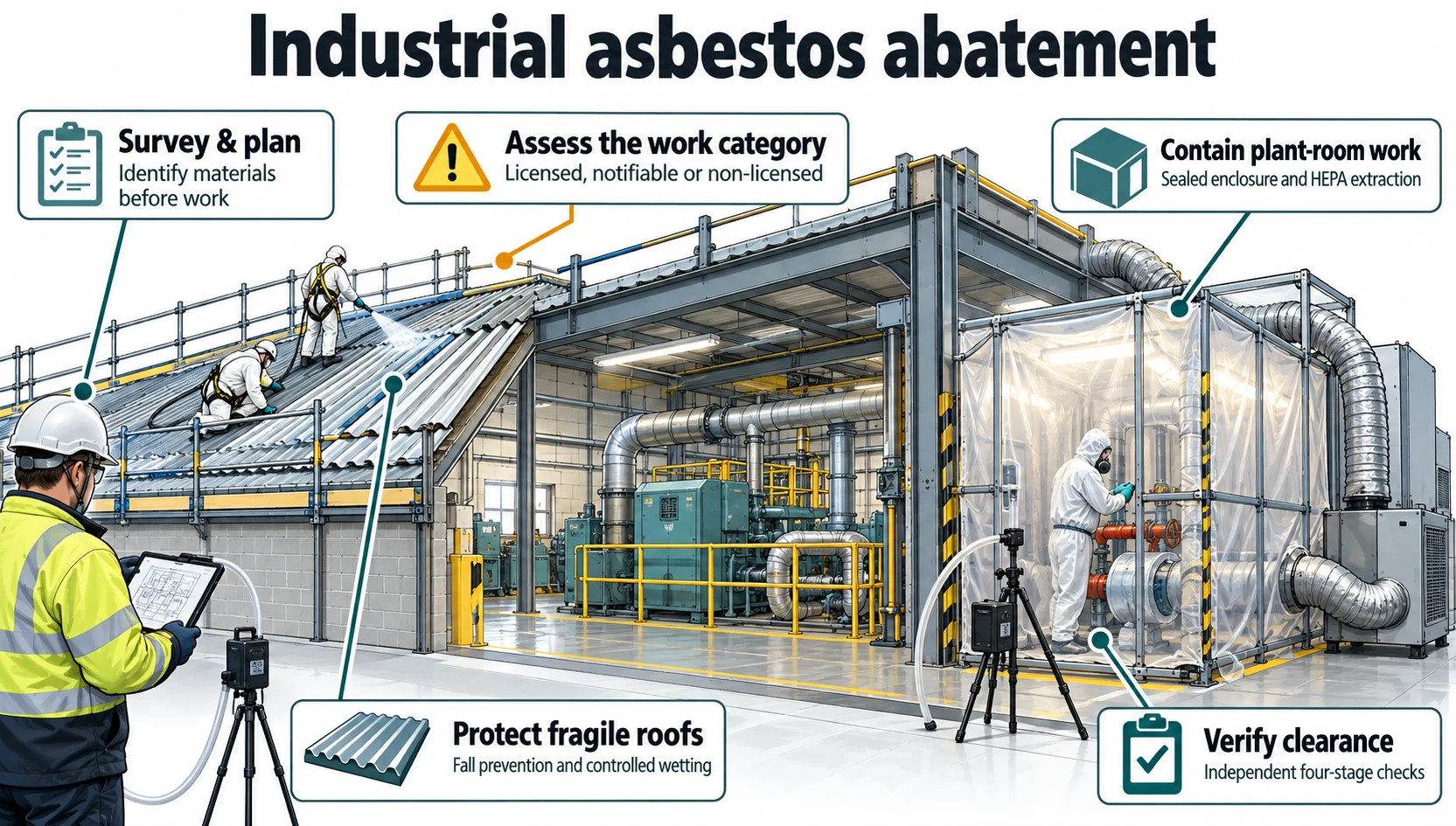
CAR 2012 sets three tiers of work, judged on friability and likely exposure. Friable products such as thermal lagging and sprayed fireproofing fall under licensed work. Only an HSE-licensed contractor may remove them. Dense materials such as exterior cement sheeting usually sit within non-licensed or notifiable non-licensed categories.
Placing a project in the wrong tier is a direct legal breach. It also leaves operatives exposed. Assess the density of the matrix and the planned degree of disturbance before work starts. Licensable work requires an ASB5 notification to the HSE fourteen days before mobilisation. Notifiable non-licensed work requires a separate NNLW notification instead.
Survey Protocols and Planning Controls
Targeted Refurbishment Surveys
Commission a refurbishment and demolition survey under HSG264 before any structural alteration, roof renewal or machinery replacement. The surveyor uses destructive methods to open pipe channels, wall voids and floor cavities. The report tells contractors exactly what sits behind the fabric. Nobody then strikes unrecorded material during a live plant installation.
A management survey is a different instrument. It covers only material encountered during normal occupancy and routine maintenance. Relying on it for demolition or retrofit work invites serious contamination. Opening an internal wall or service riser can release fibres across a live bay. From experience across the sector, a proper pre-construction survey costs far less than a contaminated factory floor.
Plan of Work Requirements
Regulation 7 of CAR 2012 obliges the contractor to produce a written plan of work before removal begins. That document fixes the engineering controls, transit corridors, negative pressure calculations, RPE specification and emergency arrangements. It is the operational basis for safe industrial ACM abatement on any live site.
The plan must stay in the work zone for the duration of the project. Supervisors brief operatives on emergency isolations, waste routes and decontamination before each shift. Plant layouts change, and method statements must change with them. When an unexpected service run appears, the supervisor stops work and revises the controls.
Did You Know?
The control limit set by CAR 2012 is 0.1 asbestos fibres per cubic centimetre of air, averaged over four hours. Exposure must never exceed 0.6 fibres per cubic centimetre over any ten-minute period. The HSE attributes more than 5,000 deaths a year in Great Britain to past asbestos exposure.
Plant Room and Mechanical Infrastructure Containment
Full Negative Pressure Enclosures
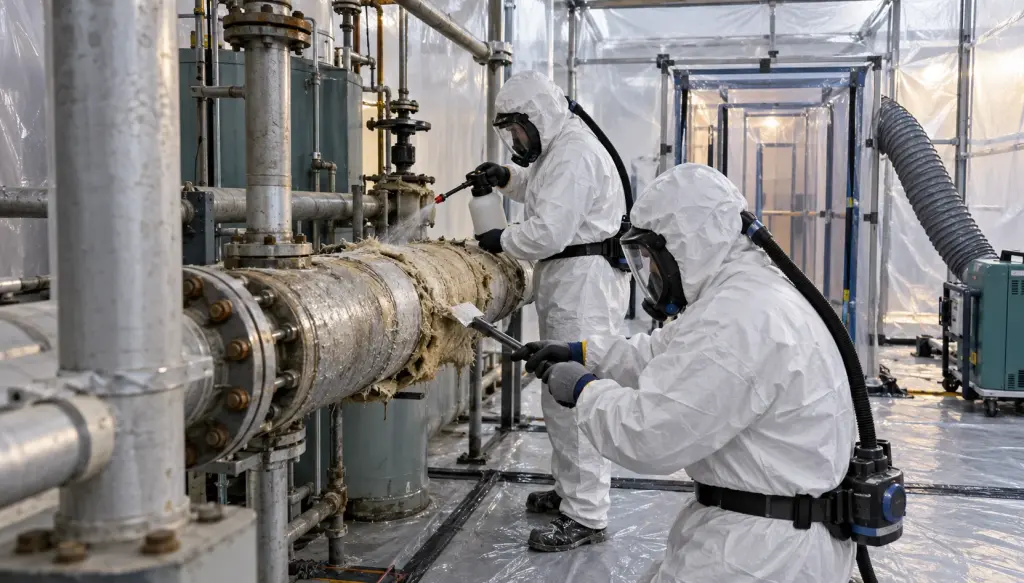
Plant rooms holding thermal pipe insulation need a high-integrity enclosure built from 1000-gauge polythene. Operatives erect a timber or modular frame and seal every sheet seam with low-permeability tape. The enclosure must wrap the whole workspace. Nobody strips friable lagging from historic pipe circuits until that shell is complete.
Engineers calculate the enclosure volume and size the negative pressure units accordingly. Each unit carries certified HEPA filtration and must deliver at least eight air changes per hour. Exhaust air vents outside, well away from building intakes. Operatives then prove integrity with a smoke test and a digital pressure gauge before any disturbance.
Three-Stage Airlocks and Decontamination Units
Entry to a contaminated plant room runs through a three-stage airlock with dirty, intermediate and clean chambers. Operatives shed contaminated clothing in the first stage and vacuum particulate deposits in the second. They wash in the clean chamber before stepping back into the wider facility at the end of each shift.
Each compartment uses weighted, self-closing flaps to hold the internal pressure differential during movement. Extraction airflow must exceed the volume drawn in through those airlocks. Pressure collapses the moment that balance slips. These transition points are what keep contaminated air out of the production hall next door.
Detailed ACM condition checks and regulatory compliance reports.
External Roof and Cladding Removal Methods
Fragile Asbestos Cement Sheet Handling
Asbestos cement roof sheets are a fragile surface, and falls through them still kill. Roof-crawler boards, perimeter netting and elevated working platforms come first. Operatives then unbolt the fixings with low-speed tooling, never cutting or breaking the panel. Mechanical hoists lower whole sheets to ground level for wrapping.
Decades of freeze-thaw cycles and industrial fallout leave weathered sheets exceptionally brittle. Operatives apply a wetting agent to bind surface fibres before handling. High-pressure washing has no place on an asbestos roof, because it drives contaminated residue into gutters and surface drains. In practice, we find patience with fixings saves far more time than breaking a sheet ever does.
Fibre Control on External Elevations
External cladding work needs a defined exclusion zone, ground drop sheets and continuous environmental monitoring. Operatives mist the working face to suppress airborne dust throughout the strip. Intact panels go into heavy-gauge polythene bags, which then travel straight into a sealed, lockable skip under supervision.
Eaves gutters are the hidden problem on most industrial roofs. Decades of run-off leave degraded cement slurry, moss and loose fibre sitting in the channel. Specialists clear them with HEPA-filtered industrial vacuums before any wall panel comes off. That sequence stops contamination draining into the site surface water system.
Management, refurbishment, and demolition surveys for all property types.
Air Monitoring Protocols and Boundary Verification
Personal and Boundary Air Monitoring
Air monitoring on abatement industrial buildings projects proves that the engineering controls are working. Static pumps sit at the enclosure boundary and sample the surrounding atmosphere continuously. Personal pumps clip to the operative lapel inside the breathing zone. Together they confirm whether airborne fibre stays below the statutory control limit.
Analysts draw a known air volume through a 25-millimetre membrane filter. They then count respirable fibres by phase contrast optical microscopy under the relevant MDHS method. Boundary readings carry a 0.01 fibres per cubic centimetre action level. Supervisors stop work immediately when a reading breaches it, and the adjacent bays stay protected.
Four-Stage Clearance Procedure
No industrial work zone reopens until it passes the four-stage clearance set out in HSG248. An independent UKAS-accredited analyst reviews the site paperwork first. The analyst then completes a thorough visual inspection and air testing inside the enclosure. A final check follows once containment comes down.
All four stages must pass in sequence before the analyst issues a certificate of reoccupation. The clearance indicator is 0.01 fibres per cubic centimetre, measured under active air disturbance. Brushing and agitation during the test are deliberate. They prove the space is safe for normal factory work, not merely quiet.
Asbestos Removal
Safe, certified removal of asbestos materials in line with HSE guidelines.
Waste Packaging and Consignment Regulations
Waste Packaging Standards on Site
Stripped waste goes into heavy-duty red polythene sacks that carry the statutory hazard warning. Operatives seal each sack inside a clear secondary bag before it leaves the enclosure. Rigid items such as cement sheets need double wrapping in 1000-gauge polythene, taped and labelled before removal.
Packaging must survive sharp roofing edges, degraded fixings and a long road journey. Operatives wet-wipe the outside of every sack inside the decontamination airlock. Waste then moves to a secure external holding container, locked between collections. A torn bag on a yard surface undoes the whole containment strategy.
Consignment Notes and Authorised Disposal
Every load leaving an industrial site needs a completed hazardous waste consignment note. The waste producer must check that the carrier holds a valid registration with the environmental regulator. The producer must also confirm the receiving site is a permitted hazardous waste landfill or treatment facility.
Keep consignment notes for at least three years, filed alongside the site asbestos register. Environmental enforcement officers audit that paperwork, and gaps attract immediate scrutiny. An unbroken documentary trail shows the material reached a legitimate destination. Nothing else proves it after the skip has left the gate.
Operational Continuity and Industrial Risk Controls
Phased Project Delivery Schedules
Remediation inside a live factory demands careful phasing. Most programmes run during planned shutdowns, night shifts or holiday periods so that heavy processes keep moving. Physical hoardings separate the production bays from the active work zone. From experience across the sector, early coordination with production managers decides whether a programme runs to time.
Contractors set dedicated transit routes for waste, kept clear of factory traffic. Forklift movements and temporary airlocks must never share a corridor. One collision with an enclosure wall can end a shift and trigger a reassessment. Separate access corridors let factory staff work normally without entering restricted zones.
Emergency Isolation Protocols
Every industrial remediation plan needs clear emergency isolation procedures for mechanical and electrical services. Plant engineers isolate high-pressure steam lines, gas mains and high-voltage conduits before operatives disturb any suspect material. A formal lock-out and tag-out system then verifies a zero energy state across the affected plant.
Enclosures fail. Sudden pressure loss or physical damage demands an immediate response. Operatives stop disturbance work, withdraw and bring backup negative pressure units online. The work zone stays sealed and unoccupied until stable pressure returns and the supervisor records the incident formally.
Final Thoughts
A sound industrial asbestos abatement programme balances statutory duty, engineering control and production reality. Twentieth-century plant, structural steel and roof profiles all demand systematic survey work, honest risk assessment and properly designed containment. Dutyholders who follow CAR 2012 protect their site teams. They also avoid the shutdowns that follow an uncontrolled release.
Legacy material management keeps moving towards digital registers, continuous monitoring and planned capital replacement. Operators who survey early and appoint competent specialists keep their premises clean and their output steady. The register is never finished. It is a live document, and it should reflect the building as it stands today.
Submit Enquiry
Frequently Asked Questions
A:
No. Licensing depends on the friability of the material, the matrix it sits in and the likely exposure. Highly friable products such as pipe lagging, sprayed coatings and asbestos insulating board are licensable. That work requires a fourteen-day notification to the HSE. Dense products such as corrugated cement sheeting usually fall into non-licensed or notifiable non-licensed work. A competent risk assessment settles the category before anyone starts on site.
A:
The units pull air out of a sealed enclosure through HEPA filters at high volume. That continuous extraction holds the inside of the enclosure below the pressure of the surrounding building. Air therefore flows inwards through any small breach in the polythene. Clean factory air enters the enclosure instead of contaminated air escaping from it. Operatives confirm the differential with a gauge and a smoke test before work begins.
A:
Often yes, provided the internal controls are right. Contractors fit crash decks, internal netting and continuous polythene drop sheets beneath the working bay to catch debris. Production can then continue below with supervision and exclusion zones in place. Clear internal areas where ceilings, service runs or lighting might suffer disturbance. Project planners weigh structural access against output targets before deciding whether any bay pauses.
A:
Powered air-purifying respirators with a full-face mask and P3 filters are the standard choice for licensed work on thermal insulation. The powered supply delivers filtered air continuously, which raises the protection factor and reduces breathing fatigue over a long shift. Every operative needs a face-fit test to prove the mask seals against their own facial contours. Half-mask respirators suit only brief, low-exposure inspection or non-licensed handling tasks.
A:
Keep the plan of work, the air monitoring results, the four-stage certificate of reoccupation and the hazardous waste consignment notes. Update the site asbestos register to show exactly what came out and what remains in place. Consignment notes stay on file for at least three years. Personal exposure records and health surveillance records run far longer, and CAR 2012 requires forty years for both.

Ora Asbestos Management Ltd
Unit A9, Seedbed Centre,
Shoeburyness, Southend-on-Sea SS3 9QY..
About the Author
Gordon Ringland is the founder, Director and principal asbestos surveyor at Ora. He holds the BOHS P402 qualification — the recognised industry standard for surveying and sampling strategies for asbestos in buildings — awarded by the British Occupational Hygiene Society (BOHS) Faculty of Occupational Hygiene (Certificate No. 20140911-32845-4254).
Gordon has over 12 years of hands-on experience in the asbestos industry, built on more than 20 years working in roofing. He carries out all three main survey types — management surveys, R&D surveys and re-inspections — and designs the sampling strategies used to find asbestos-containing materials (ACMs). He also leads non-licensed asbestos removal projects.
His work spans the full range of buildings, from residential garages and family homes to large commercial sites. Gordon has particular experience in heritage and museum environments, including listed buildings, where careful, fully compliant work matters most. He oversees Ora’s survey work and is the named author of our asbestos guides.