Industrial Asbestos Survey for Factories & Warehouses
Commissioning an industrial asbestos survey is a fundamental duty for commercial property owners and plant operators across Great Britain. Industrial sites constructed or refurbished prior to 2000 frequently house hazardous materials within structural frameworks, lagging, and roof claddings. Failing to manage these materials exposes site workers to airborne fibres. It also creates legal liabilities under health and safety legislation.
Managing large-scale commercial units requires a clear understanding of regulatory standards and survey methodologies. How can commercial dutyholders keep operational facilities compliant with asbestos regulations? Furthermore, how do they protect personnel during routine operations and structural alterations?
Key Takeaways
- Regulation 4 of CAR 2012 mandates that commercial dutyholders maintain an accurate asbestos register for all non-domestic premises.
- HSG264 sets out the recognised national standards for conducting management, refurbishment, and demolition surveys across industrial and warehouse environments.
- Factory roof claddings, thermal pipe lagging, and floor tiles represent primary high-risk areas during any industrial building asbestos survey.
- An intrusive factory warehouse survey remains mandatory before any structural alteration, maintenance, or demolition project begins.
- Surveying organisations holding UKAS accreditation to ISO/IEC 17020 offer verified competence and independent quality assurance for dutyholders.
Survey Types and When Each One Applies
Not every situation calls for the same type of inspection, and dutyholders often ask which survey applies to their circumstances. HSG264 sets out two principal survey types, each suited to a different stage of a building’s operational life. Choosing the wrong survey type risks missing hidden asbestos-containing materials before disruptive work begins.
The table below sets out the most common triggers dutyholders encounter and the survey type each one requires under current guidance. Routine occupation and ongoing maintenance call for a management survey. Any planned refurbishment, retrofit, or demolition work requires a fully intrusive refurbishment and demolition survey beforehand. Matching the trigger to the correct survey protects workers and satisfies statutory obligations.
| Trigger for the Survey | Survey Type Required |
|---|---|
| Routine occupation and day-to-day maintenance | Management Survey |
| Annual register review or re-inspection | Management Survey (re-inspection) |
| Planned refurbishment or fit-out works | Refurbishment and Demolition Survey |
| Full or partial demolition | Refurbishment and Demolition Survey |
| Property acquisition or change of use | Management Survey |
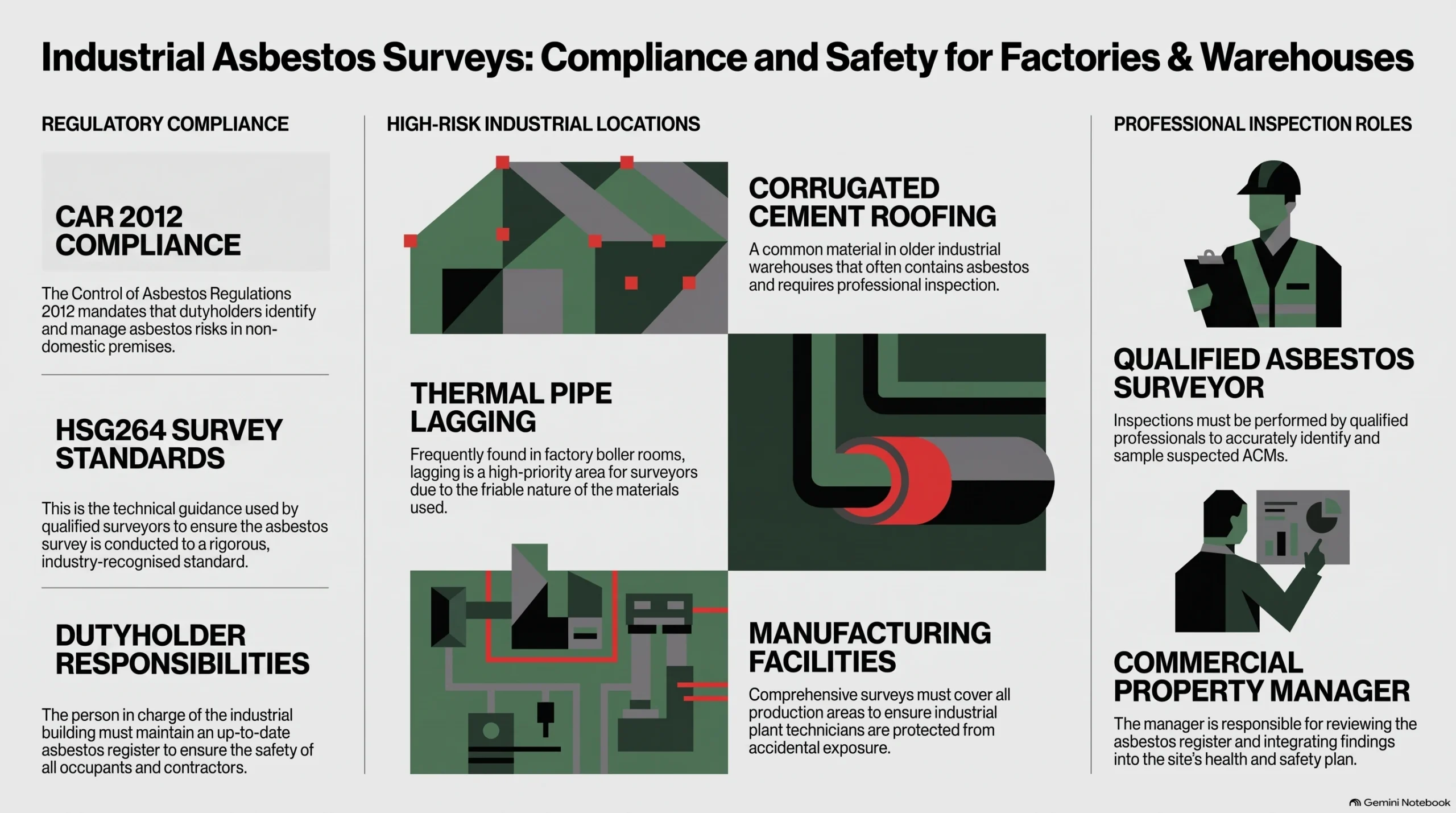
Statutory Duties Under the Control of Asbestos Regulations 2012
Regulation 4 Duties for Non-Domestic Premises
Regulation 4 of the Control of Asbestos Regulations 2012 places a clear legal duty on dutyholders to manage asbestos within non-domestic premises. Dutyholders include factory owners, commercial landlords, and facility management teams who exercise control over maintenance activities. Compliance requires systematic identification, ongoing risk assessment, and accurate record-keeping across the entire site.
In practice, we find that dutyholders must also produce a written management plan detailing individual responsibilities, emergency procedures, and monitoring schedules. The plan should name who holds authority to permit work and who maintains the asbestos register day to day.
Enforcement Action and Penalties for Non-Compliance
The Health and Safety at Work etc. Act 1974 reinforces these duties across every operational workplace in Great Britain. Failure to maintain an up-to-date asbestos register can trigger formal enforcement action from the Health and Safety Executive. Penalties range from unlimited fines to prohibition notices that halt site operations entirely.
From experience across the sector, enforcement typically follows a serious incident, a worker complaint, or a routine inspection that uncovers gaps in the register. Dutyholders who can evidence a current survey and an active management plan are far better placed to demonstrate compliance.
Survey Classifications for Commercial Facilities
Management Surveys for Day-to-Day Operations
Management surveys locate and assess asbestos-containing materials likely to be disturbed during routine occupancy and everyday maintenance tasks. Surveyors carry out non-destructive inspections across all reasonably accessible areas, taking samples or recording presumptions where sampling is not possible. The findings form the foundation of the site’s asbestos register.
When operating in this area, surveyors typically prioritise plant rooms, riser cupboards, and ceiling voids first, since these spaces see the least routine access. A thorough management survey gives facility teams the confidence to plan maintenance without disturbing hidden materials.
Refurbishment and Demolition Surveys for Structural Works
Refurbishment and demolition surveys are fully intrusive inspections required before any structural alteration, plant upgrade, or site clearance begins. Surveyors access hidden voids, wall cavities, and sub-floor areas, using destructive techniques where necessary to reach every relevant surface. Every factory warehouse survey of this type must confirm complete material identification before contractors start work.
Because these surveys are destructive, they can only take place once a building or area is vacated. Contractors should never begin structural work on the assumption that an earlier management survey has already covered every hidden void.
Did You Know?
Although blue and brown asbestos were banned in Great Britain in 1985, white asbestos (chrysotile) remained legal in building products until November 1999, meaning any commercial building constructed before 2000 may contain hazardous asbestos materials.
Materials Commonly Found in Industrial and Warehouse Structures
High-Risk Friable Materials
Industrial buildings from the mid-to-late twentieth century relied heavily on asbestos products for their thermal insulation, durability, and fire resistance. Sprayed limpet insulation on structural steelwork and thermal pipe lagging in boiler rooms are highly friable and release fibres readily once disturbed. Asbestos insulating board in partition walls and ceiling tiles carries a similar medium-to-high risk.
These materials demand extreme caution during any intrusive work, since even light disturbance can generate a significant release of airborne fibres. Encapsulation or controlled removal by a licensed contractor is usually the only safe long-term option.
Lower-Risk Non-Friable Materials
Asbestos cement sheets used in roof claddings, external wall panels, and flues present a medium risk that becomes more serious once the material grows brittle with age. Thermoplastic floor tiles found in office areas, canteens, and corridors carry a low risk whilst they remain intact and unsanded. Both material types still require entry into the asbestos register.
Ageing and weathering are the main concerns for cement products, since brittle sheets can shed fibres if drilled, cut, or broken during routine repairs. Floor tiles pose minimal risk unless sanded, stripped, or otherwise abraded during refurbishment.
Detailed ACM condition checks and regulatory compliance reports.
Planning an Effective Survey Strategy
Desktop Review and Scope Definition
A structured inspection strategy begins with a desktop review of historical building plans, maintenance logs, and any existing asbestos documentation. Surveyors then define the exact scope of the inspection, agreeing access arrangements and sampling protocols with the site team. This preparatory stage identifies site-specific hazards before any physical inspection begins.
High-voltage networks, confined spaces, elevated roofing, and live production lines all shape how and when a survey can safely proceed. Close co-ordination between surveyors and facility managers keeps the inspection on schedule without disrupting operations.
Site Inspection and Sampling Procedures
Surveyors carry out a systematic, zone-by-zone visual inspection of the site, supported by thorough photographic recording of every area assessed. They collect representative material samples under controlled conditions and send them for laboratory analysis to confirm asbestos content. They then log findings directly into an accessible digital asbestos register.
Digital registers make it far easier to update records as materials are removed, encapsulated, or reassessed over time. Photographic evidence also gives facility managers a clear reference point during future maintenance planning.
Management, refurbishment, and demolition surveys for all property types.
Scoring and Prioritising Asbestos Risk
Material Assessment Scoring
The material assessment evaluates the intrinsic potential of an asbestos-containing item to release airborne fibres if it is disturbed. Surveyors score four specific parameters: product type, surface treatment, extent of damage, and asbestos fibre category. Summing these scores produces an overall material risk rating ranging from low to high.
A high material score signals a product that will release fibres readily if it is drilled, sanded, or broken. This score alone does not determine urgency, since the likelihood of disturbance still needs separate evaluation.
Priority Assessment for Workplace Risk
Priority assessments calculate the likelihood of fibre disturbance during normal site operations rather than the material’s inherent hazard. Surveyors evaluate occupant activity levels, maintenance frequency, location accessibility, and the average number of people exposed. Combining material scores with priority scores creates a full risk matrix for the site.
This matrix directs compliance spending toward the highest-priority hazards first. Lower-priority materials are not ignored; they simply move to a longer-term monitoring and re-inspection cycle.
Asbestos Removal
Safe, certified removal of asbestos materials in line with HSE guidelines.
Choosing a Competent Surveying Organisation
Accreditation Standards for Survey Bodies
Survey accuracy depends on engaging technical specialists with verified accreditation and genuine industry experience. The Health and Safety Executive advises dutyholders to select inspection bodies accredited to ISO/IEC 17020 by the United Kingdom Accreditation Service. This accreditation confirms organisational independence and technical competence across the entire surveying process.
UKAS accreditation provides an independent check that a surveying organisation follows recognised methodology consistently. Dutyholders should ask to see current accreditation certificates before commissioning any survey work.
Surveyor Qualifications and Laboratory Analysis
Individual surveyors should hold recognised qualifications, such as the BOHS P402 certification, backed by structured practical experience in the field. Bulk sample analysis must be carried out by laboratories accredited to ISO/IEC 17025 to guarantee reliable results. Selecting accredited organisations gives dutyholders defensible documentation that satisfies statutory enforcement bodies.
From experience across the sector, dutyholders who query surveyor qualifications upfront avoid disputes over survey quality later. Defensible documentation also protects long-term asset value if a property is sold or refinanced.
Maintaining Compliance After the Survey
Updating and Reviewing the Asbestos Register
Dutyholders must review and update the asbestos register at regular intervals, and at least once every twelve months under Regulation 4. Regulation 4 also requires additional updates whenever structural alterations take place or when materials are encapsulated or removed. Regular visual re-inspections catch deterioration early, before airborne fibre risks threaten workplace safety.
Dutyholders and employers must also retain management plans, registers, and exposure records for a minimum of 40 years. This long retention period reflects how long asbestos-related conditions such as mesothelioma can take to develop.
Materials Left in Place
An asbestos finding does not automatically require immediate removal from the building. Materials that are undamaged, well-sealed, and unlikely to be disturbed during normal operations can usually be left in place and actively managed instead. Management means labelling the material, recording it in the register, and setting protective controls.
Regular visual re-inspections confirm the material remains in a safe, undisturbed condition. If damage does occur, dutyholders should arrange prompt encapsulation or removal by a licensed contractor.
Final Thoughts
Executing a thorough industrial asbestos survey remains a statutory necessity for anyone managing commercial or manufacturing property. Identifying asbestos-containing materials lets dutyholders control health risks and protect site workers from exposure. It also prevents costly delays once maintenance or refurbishment work gets under way.
Keeping the asbestos register current and reviewing the management plan every year sustains compliance over the long term. Proactive management protects asset value whilst keeping industrial and warehouse sites safe to operate.
Submit Enquiry
Frequently Asked Questions
Under Regulation 4 of the Control of Asbestos Regulations 2012, dutyholders must review and update their asbestos register at regular intervals, and at least once every 12 months. Additional updates are legally required whenever structural alterations take place, when materials are encapsulated or removed, or if the condition of known asbestos-containing materials changes. Regular visual re-inspections ensure that any deterioration is identified early, allowing site managers to implement corrective controls before airborne fibre risks threaten workplace safety or operational continuity.
A management survey is a standard inspection designed to locate and assess asbestos-containing materials that could be disturbed during normal daily operations and routine maintenance. In contrast, a refurbishment survey is a fully intrusive, destructive inspection required before any construction, demolition, or structural modification work begins. Refurbishment surveys access hidden voids, wall cavities, and sub-floor spaces to identify all asbestos-containing materials within the specific work area, ensuring they are safely managed or removed before contractors commence structural works.
No maintenance or construction work likely to disturb the fabric of a commercial building constructed before 2000 should proceed without reviewing an up-to-date asbestos survey. Regulation 5 of the Control of Asbestos Regulations 2012 mandates that dutyholders must determine the presence, location, and condition of asbestos before starting any work. Undertaking intrusive maintenance work without checking the asbestos register risks accidental fibre exposure, severe legal penalties from the Health and Safety Executive, and immediate operational prohibition notices.
Dutyholders and employers must retain asbestos management plans, inspection registers, and personal exposure records for a minimum of 40 years under UK health and safety regulations. Long-term retention is necessary because asbestos-related health conditions, such as mesothelioma and asbestosis, typically develop decades after initial fibre exposure. Maintaining complete digital records ensures legal compliance, provides clear historical evidence for corporate audits, and protects business owners against historical liability claims arising from commercial site operations.
An asbestos survey finding does not automatically require immediate material removal. If asbestos-containing materials are undamaged, well-sealed, and located where disturbance is unlikely during normal operations, the recommended strategy is usually to leave them in place and manage their condition. Management involves entering the items into the site asbestos register, labelling them where appropriate, establishing protective controls, and conducting regular visual re-inspections to ensure the materials remain in a safe, undisturbed state.

Ora Asbestos Management Ltd
Unit A9, Seedbed Centre,
Shoeburyness, Southend-on-Sea SS3 9QY..
About the Author
Gordon Ringland is the founder, Director and principal asbestos surveyor at Ora. He holds the BOHS P402 qualification — the recognised industry standard for surveying and sampling strategies for asbestos in buildings — awarded by the British Occupational Hygiene Society (BOHS) Faculty of Occupational Hygiene (Certificate No. 20140911-32845-4254).
Gordon has over 12 years of hands-on experience in the asbestos industry, built on more than 20 years working in roofing. He carries out all three main survey types — management surveys, R&D surveys and re-inspections — and designs the sampling strategies used to find asbestos-containing materials (ACMs). He also leads non-licensed asbestos removal projects.
His work spans the full range of buildings, from residential garages and family homes to large commercial sites. Gordon has particular experience in heritage and museum environments, including listed buildings, where careful, fully compliant work matters most. He oversees Ora’s survey work and is the named author of our asbestos guides.