
Who is Responsible for Asbestos in Leased Property?
Responsibility for asbestos in leased property rarely sits where people assume. The building owner holds the title. The lease, however, decides who carries the statutory duty to manage. Get that wrong and a routine repair can trigger prosecution, closure of the premises, and a large remediation bill.
Landlords and tenants often discover the answer only after a contractor drills into a ceiling void. By then the costs are already running. So who actually holds the legal duty when commercial premises contain asbestos?
Key Takeaways
- Regulation 4 of the Control of Asbestos Regulations 2012 places the duty to manage on whoever holds repair obligations.
- Tenants on full repairing and insuring leases normally fund surveys, register upkeep, encapsulation and licensed removal for the whole demise.
- Landlords retain the duty over common parts in multi-let buildings, including risers, plant rooms, stairwells and shared entrance areas.
- A refurbishment and demolition survey is mandatory before any intrusive fit-out, shopfitting or structural work begins on site.
- Breaching the duty to manage carries unlimited fines in the Crown Court and up to two years’ imprisonment.
Asbestos Duties Set by Lease Structure
Lease structure is the single biggest factor in who pays for asbestos compliance. Regulation 4 attaches the duty to the party with repair and maintenance obligations. Where the lease is silent, the duty falls to whoever controls the premises in practice. The table below sets out the arrangements seen most often in UK commercial property.
In practice we find the split is rarely as clean as the table suggests. Mixed demises, service charge caps and historic side letters all shift the burden. Treat the table as a starting position only. Then read the repairing covenant, the yield-up clause and the service charge schedule before you accept any liability.
| Lease Structure | Dutyholder | Who Funds Surveys | Who Funds Remediation |
|---|---|---|---|
| Full repairing and insuring (FRI) | Tenant | Tenant, for the whole demise | Tenant |
| Internal repairing only | Split by demise line | Tenant internally, landlord structurally | Split by location of the material |
| Multi-let with common parts | Landlord for common parts, tenant for demise | Landlord centrally, recharged where permitted | Service charge for shared areas |
| Short-term licence to occupy | Landlord | Landlord | Landlord |
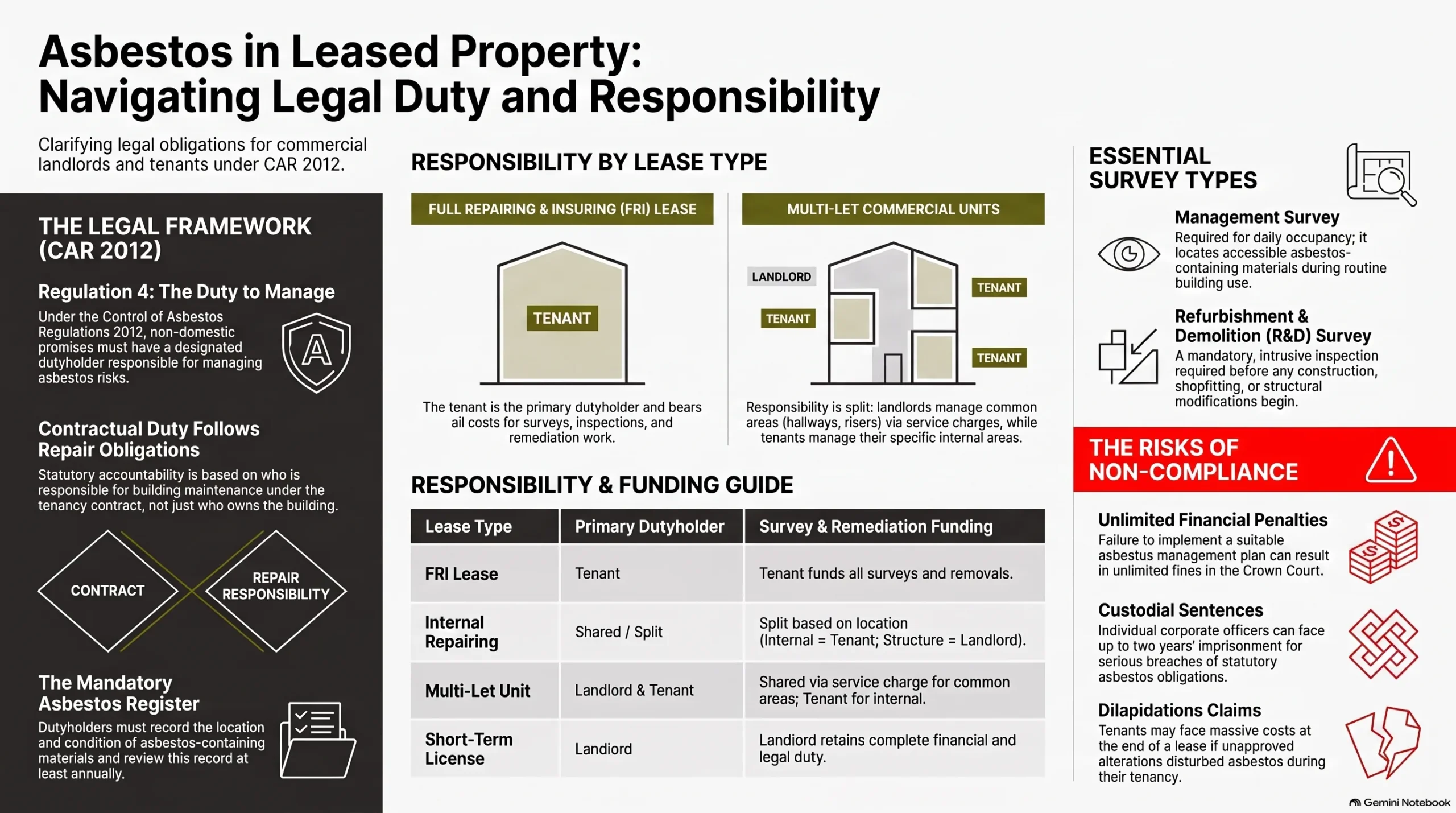
Legal Duty to Manage Asbestos under CAR 2012
Who Counts as the Dutyholder
Regulation 4 of the Control of Asbestos Regulations 2012 applies to every non-domestic building. It names a dutyholder for each set of premises. That dutyholder is the party with clear repair and maintenance obligations under the tenancy. Ownership of the freehold does not decide the question on its own.
Where no repairing obligation exists, the duty rests with the party in control of the premises. Multiple parties can hold the duty at once across one building. A landlord may be dutyholder for the risers whilst the tenant holds it for the demised floor. Written allocation avoids arguments later.
What the Duty Requires in Practice
The dutyholder must take reasonable steps to find asbestos-containing materials in the building. Materials that cannot be inspected are presumed to contain asbestos until proven otherwise. Location and condition go into an asbestos register. A written management plan then sets out how the risk is controlled.
The plan must name the people responsible. It must set review dates and record how contractors are told about the risk. Inspectors ask for the register and the plan first. A register with no plan behind it fails the test.
Lease Terms Decide Who Pays
Full Repairing and Insuring Leases
A full repairing and insuring lease hands the tenant responsibility for the whole demise. The tenant becomes dutyholder and funds every survey, reinspection and remedial work. Landlords sign these leases precisely to move that cost. Tenants who skip a pre-lease survey inherit a liability they never priced.
From experience across the sector, the trap is the yield-up clause. It can require the premises back in good repair, whatever their state on day one. A schedule of condition attached to the lease is the only reliable defence. Negotiate it before completion, not afterwards.
Internal Repairing and Short-Term Agreements
An internal repairing lease splits the duty along the line of the demise. The tenant covers the internal fabric. The landlord keeps the structure, roof and external elements. Asbestos in a ceiling void or a structural column usually stays with the landlord under this arrangement.
A short-term licence to occupy works differently again. The occupier has no repairing covenant, so the duty stays with the owner. Serviced offices and pop-up retail usually fall into this category. The owner must still give the occupier the relevant asbestos information before they move in.
Did You Know?
The UK banned the import, supply and use of all asbestos, including white chrysotile, in November 1999. Any building constructed or refurbished before 2000 must be presumed to contain asbestos-containing materials until a survey proves otherwise.
Tenant Duties in Day-to-Day Occupation
Asbestos Register Upkeep
A register is only useful if it reflects the building as it stands today. Tenants must reinspect known materials at least every twelve months. Condition ratings change as panels get knocked, doors slam and services are replaced. Each reinspection is dated, recorded and signed by a competent person.
Damage found at reinspection triggers action, not a note for later. Sealing, encapsulation or removal follows the material type and its condition. Keep the certificates with the register. An unbroken paper trail defends a business when an enforcing authority calls.
Contractor Control and Permits to Work
Every contractor entering the premises must see the register before work starts. That includes electricians, IT cabling teams, shopfitters and cleaners working above ceiling level. A permit-to-work system records who saw what and when. Verbal briefings leave no evidence and offer no protection in an investigation.
In practice, we find most fibre releases start with a small unplanned job. Someone fixes a bracket to a wall panel. Someone lifts a tile to run a cable. A permit system stops those jobs before they start.
Detailed ACM condition checks and regulatory compliance reports.
Landlord Duties in Multi-Let Buildings
Common Parts and Shared Services
Landlords keep the duty to manage across every part they retain. That covers entrance halls, stairwells, lift shafts, plant rooms and vertical service risers. A single building-wide management survey usually makes more sense than piecemeal inspections. The findings then feed one central register held by the managing agent.
Each tenant needs the section of the register that affects their unit. Issue it at the start of the lease and reissue it after any change. Managing agents should also brief the building’s own maintenance contractors. The duty does not stop at the door of the demise.
Service Charge Recovery of Asbestos Costs
Most modern leases let a landlord recover asbestos management costs through the service charge. Recovery depends on the wording of the service charge schedule. Survey and reinspection costs usually qualify as routine compliance expenditure. Large removal projects are often challenged as improvement rather than repair.
Tenants should read the schedule before signing, not when the demand arrives. Ask whether asbestos removal sits inside the cap. Ask whether the landlord can raise a sinking fund for it. Those two questions change the numbers materially over a ten-year term.
Management, refurbishment, and demolition surveys for all property types.
Survey Types and When Each One Applies
Management Surveys
A management survey supports normal occupation and routine maintenance. The surveyor inspects accessible areas, takes bulk samples and rates the condition of each material. The work causes minimal damage to the fabric. HSG264 sets the standard, and a UKAS-accredited organisation should carry out the sampling.
This survey answers the day-to-day question. It tells occupiers what is present, where it sits and what condition it is in. It does not clear a building for construction work. Treating it as fit-out clearance is a common and expensive error.
Refurbishment and Demolition Surveys
A refurbishment and demolition survey is intrusive by design. Surveyors open wall cavities, lift floor voids and access ceiling spaces to find concealed materials. The area surveyed must cover the full scope of the planned works. Anything outside that scope stays unverified and must be presumed to contain asbestos.
Commission this survey early. The premises normally need to be empty of people during the intrusive work. Programme time for laboratory analysis and for any licensed removal that follows. Late instruction is the main cause of fit-out delay on older commercial stock.
Asbestos Removal
Safe, certified removal of asbestos materials in line with HSE guidelines.
Fit-Out Works and Discoveries on Site
Fit-Out Planning around Known Materials
Fit-out design should start from the survey, not the other way round. Move a partition line away from a known asbestos insulating board panel and the cost disappears. Share the register with the designer at concept stage. Late design changes around asbestos are the most expensive kind.
Landlord consent matters as much as the survey. Most leases require written approval for alterations. Submit the refurbishment survey with the licence for alterations. That single step removes a large part of the dilapidations risk at the end of the term.
Unexpected Discovery During Works
Suspected asbestos found mid-project stops work in that area immediately. Isolate the zone and stop anyone entering. Notify the landlord and the principal contractor the same day. A competent analyst then samples the material and confirms whether it contains asbestos before anything else happens.
Higher-risk materials need a licensed contractor and fourteen days’ notice to the enforcing authority. Sprayed coatings, lagging and most asbestos insulating board fall into that category. Work restarts only after a four-stage clearance under HSG248. Budget for the delay honestly at the outset.
Dilapidations and End-of-Lease Disputes
Yield-Up Clauses and Asbestos Damage
Dilapidations claims often turn on asbestos disturbed during the tenancy. A yield-up clause requires the premises back in the condition the lease specifies. Damaged or exposed materials left behind become a repair item. Landlords price the remediation into the schedule of dilapidations and pursue the outgoing tenant.
Removal of tenant fit-out can create its own exposure. Stripping out partitions built against an asbestos panel disturbs the panel. Agree the strip-out method with the landlord in writing first. Clearance certificates then evidence that the premises were handed back safely.
Baseline Records That Defend a Claim
A photographic schedule of condition at lease commencement settles most arguments. Attach it to the lease and reference it in the repairing covenant. Add the asbestos register that applied on day one. Together they fix the starting position that any dilapidations claim must be measured against.
Keep every reinspection report, air test and clearance certificate for the full term. Store them where a successor can find them. Surveyors acting on a dilapidations claim ask for this file early. A complete file usually reduces the settlement figure.
Final Thoughts
Responsibility for asbestos in leased property follows the repairing covenant, not the title deeds. Regulation 4 sets the statutory duty. The lease decides who funds the surveys, the register and any remedial work. Read both documents together before signing anything.
Commission a survey before the lease, not after the first contractor arrives. Record the condition of the premises on day one. Those two steps remove most of the risk on both sides of the deal.
Submit Enquiry
Frequently Asked Questions
The tenant pays. An FRI lease transfers repair and maintenance of the whole demise to the occupier, which makes the tenant the dutyholder under Regulation 4. That covers the initial management survey, twelve-monthly reinspections, and any refurbishment and demolition survey needed before alterations. The landlord has no obligation to fund this work unless the lease says otherwise. Tenants should price the survey and any likely remediation into the deal before completion, because the cost does not disappear.
Usually yes, for the parts of the building the landlord retains. Recovery depends entirely on the service charge schedule in the lease. Routine management costs such as surveys, register upkeep and reinspections are normally recoverable as statutory compliance expenditure. Large removal projects are more contentious, because tenants often argue the work is an improvement rather than a repair. Check whether asbestos work sits inside any service charge cap before you sign the lease.
Stop work in that area straight away and prevent anyone from entering. Notify the landlord and the principal contractor the same day. Engage a competent analyst to sample and identify the material. If it proves to be a licensed product such as sprayed coating, lagging or insulating board, a licensed contractor must remove it, with fourteen days' notice to the enforcing authority. Work restarts only after a four-stage clearance certificate under HSG248.
A landlord holding the duty to manage must provide asbestos information to anyone who could disturb the materials. In practice that includes an incoming tenant planning a fit-out. Pre-lease enquiries should ask for the register, the management plan and the most recent reinspection report. If the landlord cannot produce them, treat that as a warning sign. Commission your own management survey before completion and reflect the findings in the rent and the schedule of condition.
Regulation 4 applies to non-domestic premises, so an individual let house or flat falls outside it. The common parts of a block do not. Shared hallways, stairwells, boiler rooms and plant areas count as non-domestic, and the landlord or management company holds the duty there. Separate obligations under the Health and Safety at Work etc. Act 1974 and housing legislation still require residential landlords to keep homes free from serious hazards.

Ora Asbestos Management Ltd
Unit A9, Seedbed Centre,
Shoeburyness, Southend-on-Sea SS3 9QY..
About the Author
Gordon Ringland is the founder, Director and principal asbestos surveyor at Ora. He holds the BOHS P402 qualification — the recognised industry standard for surveying and sampling strategies for asbestos in buildings — awarded by the British Occupational Hygiene Society (BOHS) Faculty of Occupational Hygiene (Certificate No. 20140911-32845-4254).
Gordon has over 12 years of hands-on experience in the asbestos industry, built on more than 20 years working in roofing. He carries out all three main survey types — management surveys, R&D surveys and re-inspections — and designs the sampling strategies used to find asbestos-containing materials (ACMs). He also leads non-licensed asbestos removal projects.
His work spans the full range of buildings, from residential garages and family homes to large commercial sites. Gordon has particular experience in heritage and museum environments, including listed buildings, where careful, fully compliant work matters most. He oversees Ora’s survey work and is the named author of our asbestos guides.