Dilapidations Survey Asbestos: Who Pays at Lease End?
Commercial landlords and outgoing tenants argue over reinstatement costs at almost every lease expiry. Yielding up clauses require premises to be returned to their original layout. Strip-out works in pre-2000 buildings routinely disturb asbestos-containing materials. A dilapidations survey asbestos assessment establishes what is present, who installed it, and who must pay to remove it. That evidence decides the claim.
Get this wrong and the consequences are not limited to money. The Health and Safety Executive can halt works, prosecute dutyholders and pursue unlimited fines. Both parties need to settle liability before contractors lift a single ceiling tile. So who actually pays for asbestos removal when a commercial lease ends?
Key Takeaways
- Statutory duties under the Control of Asbestos Regulations 2012 remain live throughout lease termination and cannot be contracted out of by lease covenant.
- Tenants carrying out intrusive strip-out works need a refurbishment and demolition survey, not the standard non-intrusive management survey held on file.
- Liability usually follows installation, so licences to alter are the decisive evidence in most asbestos dilapidations disputes between landlords and tenants.
- Licensed removal requires a written plan of work, a controlled enclosure and four-stage clearance under HSG248 before anyone re-occupies the space.
- Section 18 of the Landlord and Tenant Act 1927 caps damages at the diminution in the reversion, which limits many asbestos claims.
Lease Scenarios and Required Asbestos Action
Lease expiry brings two separate rulebooks into contact. One is the lease, which allocates repair and reinstatement obligations between the parties. The other is health and safety law, which allocates statutory duties regardless of what the lease says. The table below sets out the common scenarios, the duty that governs each, and the action required before works begin.
Establishing the position early prevents costly disputes and programme delay. Read the yielding up and alterations clauses alongside the current asbestos register and any licences to alter. In practice, we find that most arguments at lease end are evidential rather than legal. The matrix identifies the decision points that matter when pricing reinstatement or negotiating a cash settlement.
| Lease Scenario | Governing Duty | Required Asbestos Action |
|---|---|---|
| Tenant reinstatement and strip-out | Regulation 5, CAR 2012 | Refurbishment and demolition survey before intrusive work |
| Cash settlement in place of works | Section 18, Landlord and Tenant Act 1927 | Diminution valuation supported by a specialist removal estimate |
| Removal of unauthorised tenant works | Lease alterations and yielding up covenants | Tenant funds removal, air monitoring and clearance certification |
| Pre-existing material in original fabric | Regulation 4, CAR 2012 | Landlord manages in situ and keeps the register current |
| Building to be demolished after expiry | Section 18, Landlord and Tenant Act 1927 | No recoverable removal cost where no loss in value arises |
Who Bears Asbestos Liability at Lease Termination
Dutyholder Duties Under the Control of Asbestos Regulations 2012
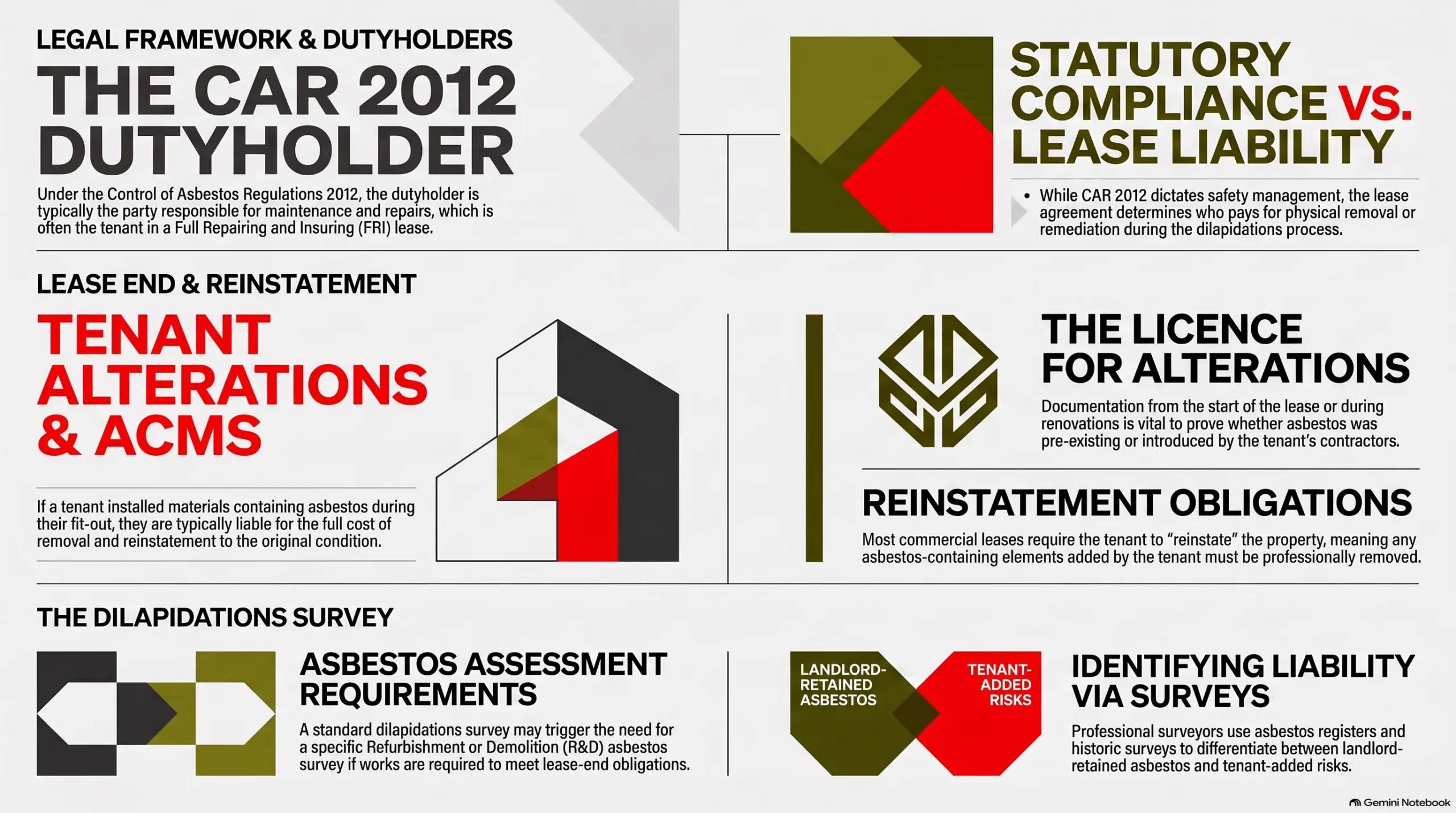
Regulation 4 of the Control of Asbestos Regulations 2012 places the duty to manage on whoever holds repair and maintenance obligations for non-domestic premises. In commercial leases that duty often splits between the parties. Statutory duties sit above the lease. Neither side can contract out of them, whatever the agreement says.
A full repairing and insuring lease usually makes the tenant dutyholder for the demise. The landlord normally retains the duty for common parts, structure and plant rooms. In practice, we find both parties hold partial duties. Each must keep a current register. Each must share it with anyone whose work could disturb the fabric.
Reinstatement Clauses and Yielding Up Covenants
Yielding up covenants set the condition in which premises must be returned. Where a tenant installed asbestos-containing materials during fit-out, the covenant normally requires their removal. A landlord cannot demand removal of original building fabric unless an express term says so. The wording of the clause decides the outcome.
Disputes cluster around partition walls, ceiling tiles and floor coverings. The question is always the same. Did the tenant put it there? Licences to alter answer that question. Without them, both sides argue from photographs and recollection. That is an expensive way to resolve a dilapidations claim.
Survey Types Required Before Reinstatement Works
Management Surveys Versus Refurbishment and Demolition Surveys
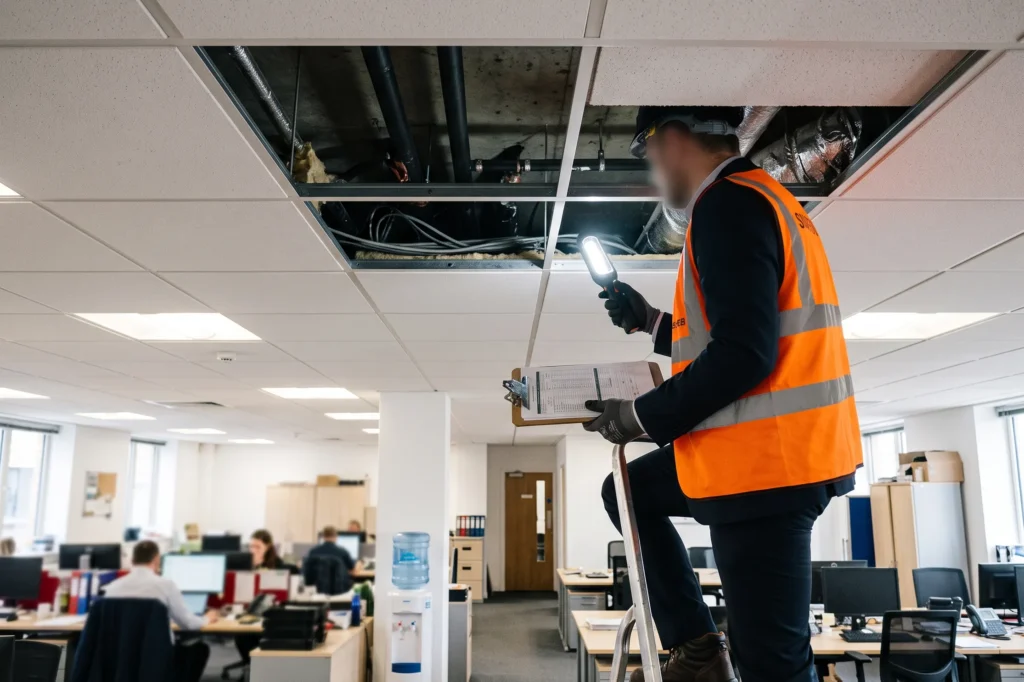
A management survey locates accessible asbestos during normal occupation. It involves no destructive inspection. It is not adequate cover for strip-out works. Regulation 5 of CAR 2012 requires a refurbishment and demolition survey before any intrusive activity. That survey opens voids, wall cavities and sub-floor areas.
Contractors who rely on a management register during dilapidations works take a serious risk. Hidden materials get cut, drilled or pulled down. Fibre release follows. The site stops. The HSE investigates. From experience across the sector, the survey cost is a fraction of the cost of one contaminated floor plate.
Hidden ACMs in Voids, Risers and Structural Cavities
Intrusive surveys require surveyors to breach decorative surfaces and open sealed risers and enclosures. Finding asbestos insulating board behind a stud wall before demolition prevents contamination. It also lets both parties cost the removal properly. An accurate scope at this stage removes most of the argument later.
Sampling follows HSG264. Representative bulk samples go to a laboratory accredited to ISO/IEC 17025. The result is defensible evidence rather than opinion. That matters when a schedule of dilapidations puts a six-figure sum against asbestos removal and the tenant disputes it.
Did You Know?
Breaches of the Control of Asbestos Regulations 2012 are prosecuted under the Health and Safety at Work etc. Act 1974. On conviction in the Crown Court, dutyholders face an unlimited fine and up to two years’ imprisonment.
Tenant Alterations and Licence to Alter Risks
Liability for Asbestos Installed by Tenant Fit-Out
Tenants alter commercial space throughout long terms. They insert partitions, mezzanine floors and suspended ceilings. Where those tenant alterations asbestos additions contain hazardous material, removal liability at lease end normally falls on the tenant who installed them. Standard alterations covenants make that clear. Proving who installed what is the difficulty.
A formal licence to alter records the works, the date and the responsible party. It is the single most useful document in an asbestos dilapidations dispute. Landlords who granted consent informally lose that protection. Tenants then argue the insulating board was original fabric, and the claim stalls.
Unauthorised Fixtures and Reinstatement Obligations
Undocumented fit-outs complicate dilapidations claims. A landlord can require the tenant to strip out unauthorised structures at the tenant’s cost. Alternatively, the landlord may carry out the works and recover the sum as a debt. Either route needs evidence that the tenant carried out the alteration.
Removal needs care where the surrounding fabric is friable. Contractors who damage landlord-owned sprayed coating or insulating board during a strip-out create a fresh liability. The tenant then pays twice. Method statements should identify landlord assets and place them out of scope before work starts.
Detailed ACM condition checks and regulatory compliance reports.
Dilapidations Claims That Involve Hazardous Materials
Cost of Works Versus Section 18 Damages
A landlord who genuinely intends to carry out remediation can claim the cost of those works. Damages are capped by Section 18 of the Landlord and Tenant Act 1927. The cap is the diminution in the value of the reversion caused by the breach. Intention and valuation both matter.
Where the building is scheduled for demolition, the tenant’s failure to remove asbestos causes no loss. The claim falls away. Landlords who overstate remediation in a schedule invite a Section 18 challenge. Tenants should obtain a valuation and a specialist removal estimate before conceding any figure.
Supervision of Removal and Four-Stage Clearance
Licensed work covers sprayed coatings, lagging and most insulating board. A licensed contractor must notify the HSE, prepare a plan of work and remove the material inside a controlled enclosure. Independent analysts then verify the area. None of this happens quickly, and the programme must allow for it.
HSG248 sets the four-stage clearance procedure. It covers a site condition check, a visual inspection, air monitoring and a final assessment after the enclosure comes down. The certificate of reoccupation closes the file. Settlement agreements should require it before any retention is released.
Management, refurbishment, and demolition surveys for all property types.
Industrial Estates and Ageing Building Fabric
Cement Cladding and Fragile Roof Sheeting
Industrial units built between the 1950s and 1990 commonly carry corrugated asbestos cement roof sheets and wall cladding. These materials weather, crack and admit water as they age. Roof condition drives a large share of industrial dilapidations claims, so the survey should record it in detail.
Work on fragile roofs needs specialist access and controlled handling. Cement products are usually non-licensed work, but the fragility risk remains. Tenants under full repairing covenants face substantial claims where blocked gutters or foot traffic damaged the sheets. A photographic schedule of condition taken at grant is the tenant’s best defence.
Asbestos Insulating Board in Partitions and Heating Cupboards
Mid-century offices often contain asbestos insulating board in column casings, fire linings and warm-air heating cupboards. These are friable materials. Cutting, drilling or forcing them during a strip-out releases fibres quickly. Removal is licensed work and must be planned into the reinstatement programme from the outset.
Service duct fire-breaks and boiler cupboard linings are disturbed most often during decommissioning. Mechanical and electrical engineers do not always consult the register. Property managers should make register sign-off a condition of any permit to work. That single control prevents most accidental disturbance at lease end.
Asbestos Removal
Safe, certified removal of asbestos materials in line with HSE guidelines.
Landlord Actions Before Grant and at Lease Expiry
Baseline Surveys Attached to the Lease
A baseline survey taken before grant records what asbestos exists, where it sits and what condition it is in. Attached to the lease, it becomes the benchmark against which later alterations are judged. It protects the landlord and removes an argument the tenant would otherwise run at expiry.
Incoming tenants then take the premises with full knowledge of the materials present. They cannot later claim that pre-existing asbestos prevented them from meeting their repair covenants. From experience across the sector, landlords who invest in a baseline recover far more at lease end than those who do not.
Asbestos Register Updates at Tenancy Handover
The register must be updated whenever material is removed, encapsulated, repaired or newly identified. Handover is the point at which records most often break down. Post-remediation condition assessments, revised risk ratings and clearance certificates all belong in the file before the next tenant takes occupation.
Digital asset systems make this manageable across a portfolio. The test is simple. Can a contractor arriving on site read the current position in minutes? If not, Regulation 4 is not being met. A register that sits in a filing cabinet at head office protects nobody.
Tenant Best Practice for End of Lease Repairs
Plans of Work and Hazardous Waste Routes
Outgoing tenants should build asbestos controls into the reinstatement programme rather than bolt them on late. Regulation 7 of CAR 2012 requires a written plan of work for licensed removal. It sets out enclosures, dust suppression, decontamination and waste routes. Contractors need that document before they mobilise.
Waste handling derails more programmes than removal itself. Asbestos waste must be double-bagged in UN-approved packaging, labelled correctly and moved by a registered carrier under a hazardous waste consignment note. Tenants who leave disposal to the final week of the term usually miss the yielding up date.
Pre-Exit Surveys That Test Landlord Claims
Tenants can commission their own survey before negotiating a settlement. It verifies whether the items in the landlord’s schedule are genuine tenant liabilities, pre-existing defects, or materials containing no asbestos at all. That evidence shifts the negotiating position more than any argument about lease wording.
Bulk sampling regularly clears textured coatings and floor tiles that a schedule had priced for licensed removal. In practice, we find a meaningful proportion of alleged asbestos items fail to test positive. Paying a removal allowance for a harmless material is a straightforward waste of money.
Final Thoughts
Asbestos liability at lease expiry turns on evidence rather than assertion. A dilapidations survey asbestos assessment establishes what is present, who installed it and what removal genuinely costs. Statutory duties under CAR 2012 sit above the lease and cannot be traded away. Settle the technical position first. The commercial negotiation is far shorter once both parties work from the same survey.
Landlords who record a baseline at grant and keep the register current hold a stronger position at every lease event. Tenants who survey before they negotiate rarely overpay. Both outcomes depend on work done well before the term expires.
Submit Enquiry
Frequently Asked Questions
Liability normally follows installation. A tenant who introduced asbestos-containing materials during fit-out is usually responsible for removing them under the alterations and yielding up covenants. Asbestos in the original building fabric normally remains the landlord's responsibility. A full repairing and insuring lease can shift that burden to the tenant. The lease wording, any licences to alter, and the survey evidence together decide the answer in each case.
A management survey is non-intrusive. It records only accessible material found during normal occupation. Dilapidations works are destructive by nature, involving the removal of partitions, ceiling grids and floor coverings. Regulation 5 of the Control of Asbestos Regulations 2012 requires a refurbishment and demolition survey before that type of work begins. It opens voids, risers and cavities so hidden materials are identified before a contractor disturbs them.
Usually not. Section 18 of the Landlord and Tenant Act 1927 caps dilapidations damages at the diminution in the value of the reversion caused by the tenant's breach. Where the landlord intends to demolish the premises shortly after expiry, leaving asbestos in place causes no loss in value. The claim is therefore capped at nil or close to it. Evidence of settled demolition intention is essential to that argument.
Work stops immediately and the area is isolated to contain fibre spread. Anyone potentially exposed is recorded. The dutyholder reports the incident to the Health and Safety Executive where a significant release has occurred. A licensed contractor then decontaminates the area and completes any removal under controlled conditions. Four-stage clearance under HSG248 and a certificate of reoccupation are required before the space is used again.
It creates a dated record of exactly what the tenant installed and what already existed. That record separates tenant additions from original landlord fabric. Without it, a landlord can price original asbestos-containing components into the dilapidations schedule and the tenant has little to argue with. With it, the tenant pays only to reinstate its own alterations. It is worth obtaining consent formally every time.

Ora Asbestos Management Ltd
Unit A9, Seedbed Centre,
Shoeburyness, Southend-on-Sea SS3 9QY..
About the Author
Gordon Ringland is the founder, Director and principal asbestos surveyor at Ora. He holds the BOHS P402 qualification — the recognised industry standard for surveying and sampling strategies for asbestos in buildings — awarded by the British Occupational Hygiene Society (BOHS) Faculty of Occupational Hygiene (Certificate No. 20140911-32845-4254).
Gordon has over 12 years of hands-on experience in the asbestos industry, built on more than 20 years working in roofing. He carries out all three main survey types — management surveys, R&D surveys and re-inspections — and designs the sampling strategies used to find asbestos-containing materials (ACMs). He also leads non-licensed asbestos removal projects.
His work spans the full range of buildings, from residential garages and family homes to large commercial sites. Gordon has particular experience in heritage and museum environments, including listed buildings, where careful, fully compliant work matters most. He oversees Ora’s survey work and is the named author of our asbestos guides.