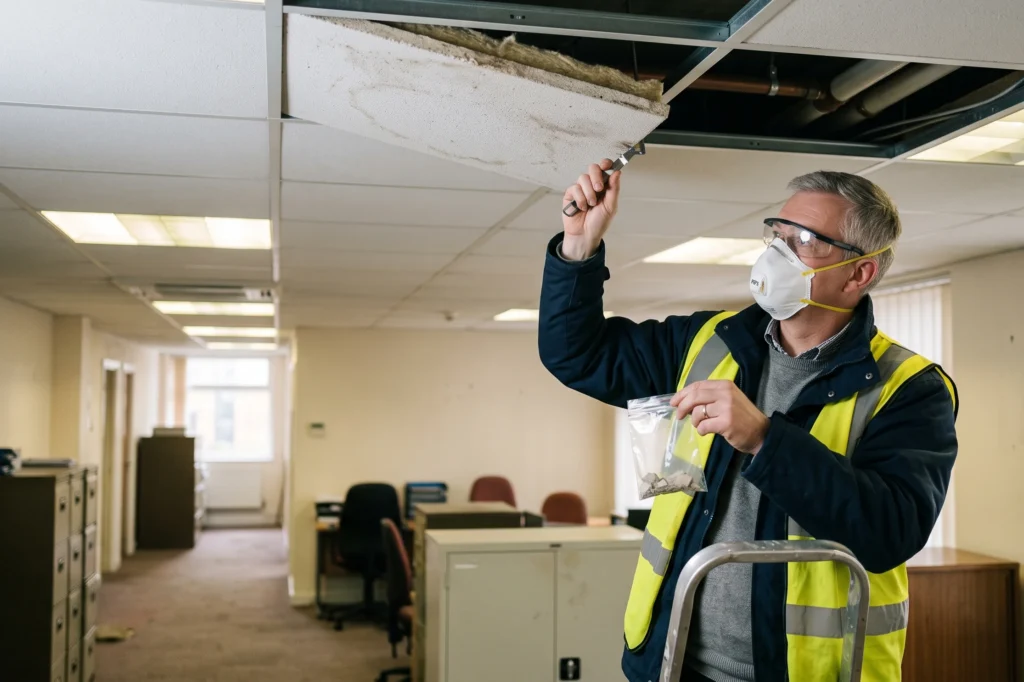
Commercial Property Asbestos: Dutyholder Duties
Commercial property asbestos compliance remains a statutory obligation for building owners, facilities managers, and commercial landlords across Great Britain. Under the Control of Asbestos Regulations 2012, designated dutyholders must locate, assess, and manage suspect mineral fibres. UK builders installed these materials extensively before the complete ban in 1999. Consequently, building occupants and maintenance contractors face severe health risks without proper controls. Creating an accurate register and an operational management plan prevents accidental exposure. This systematic oversight also safeguards ongoing business operations.
Failure to implement proper controls exposes building occupants to lethal dust. It also leaves commercial organisations vulnerable to severe enforcement action by the Health and Safety Executive. Lease agreements often divide legal liabilities between freeholders and commercial tenants in complex ways. Does your current operational strategy meet the mandatory legal standards required to protect workers across your property portfolio?
Key Takeaways
- Regulation 4 of the Control of Asbestos Regulations 2012 places a strict statutory duty to manage all hazardous materials on designated non-domestic property dutyholders.
- Commercial property dutyholders must locate all suspect materials, record their physical condition, and presume asbestos is present unless laboratory analysis proves otherwise.
- Appointing competent surveyors holding ISO/IEC 17020 accreditation guarantees reliable inspections that adhere strictly to Health and Safety Executive publication HSG264 standards.
- Dutyholders must update the written asbestos management plan at least annually and immediately after any refurbishment, material disturbance, or structural property changes.
- Clear communication protocols ensure outside contractors inspect the building asbestos register before undertaking any invasive maintenance or demolition work on site.
Core Statutory Responsibilities for Non-Domestic Buildings
Commercial property managers must maintain statutory compliance across five primary operational areas. Workplace safety legislation defines these core obligations clearly. The designated dutyholder must locate hazardous materials, record their physical condition, assess potential risks, and implement an active management plan. This systematic framework prevents dangerous fibre inhalation during routine maintenance.
Every non-domestic premises built before 2000 requires active oversight under these statutory standards across Great Britain. Legal responsibility falls directly upon the organisation holding contractual maintenance liabilities for the premises fabric. The following matrix outlines the fundamental compliance obligations and necessary operational outputs required to manage risks effectively.
| Compliance Stage | Statutory Requirement | Operational Deliverable |
|---|---|---|
| Identification | Regulation 4 CAR 2012 | HSG264 Management Survey report |
| Risk Evaluation | Regulation 4 & HSG264 | Material and priority risk assessment scores |
| Record Keeping | Regulation 4 CAR 2012 | Live, accessible Asbestos Register |
| Action Planning | Regulation 4 CAR 2012 | Written Asbestos Management Plan |
| Information Sharing | Regulations 4 & 5 CAR 2012 | Mandatory contractor sign-in register |
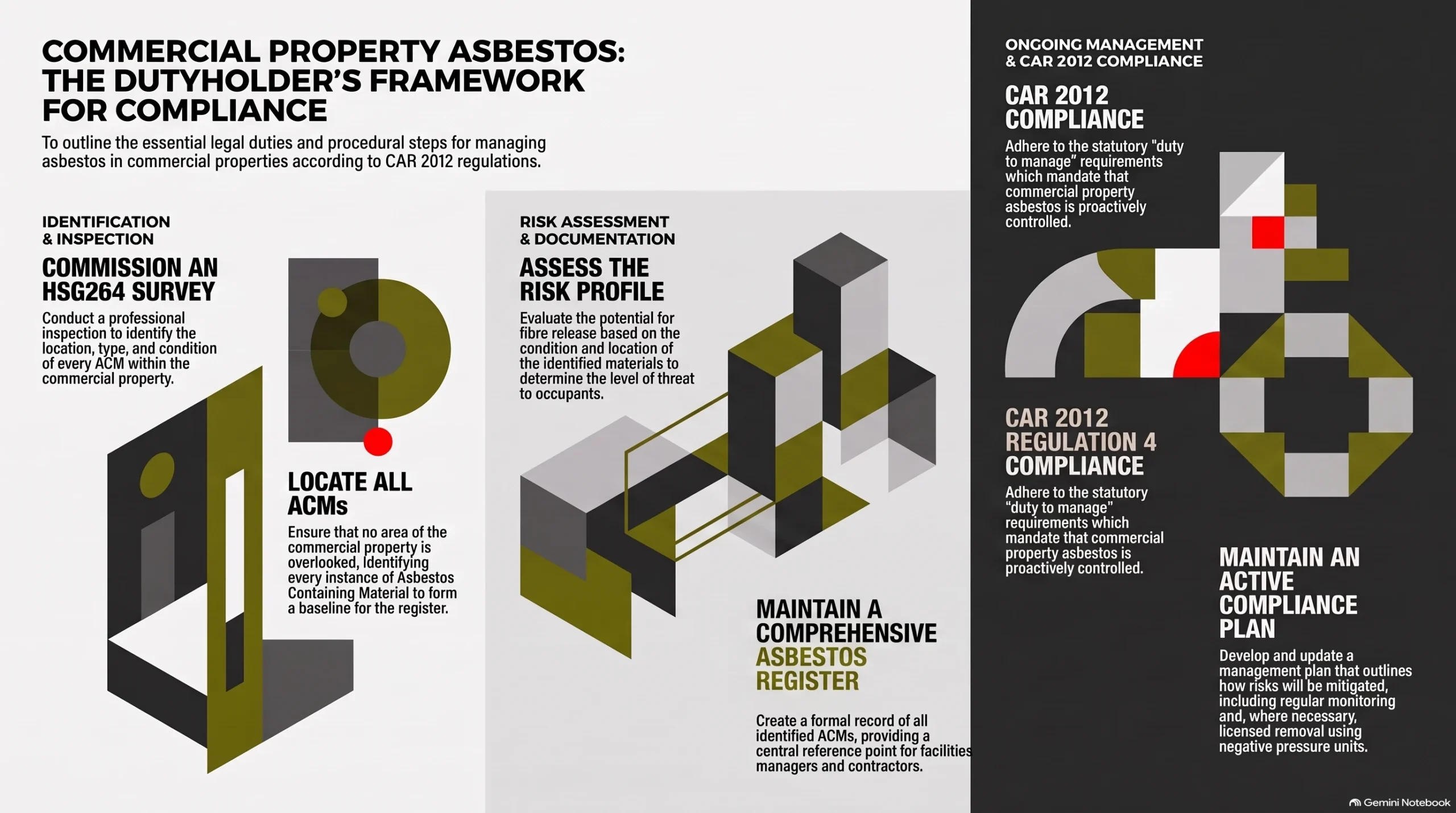
Statutory Requirements Under Regulation 4 of CAR 2012
Legal Definition of the Dutyholder
The dutyholder is the individual or corporate entity responsible for maintaining non-domestic premises under Regulation 4. In commercial properties, this responsibility usually rests with the owner, managing agent, or tenant. The terms outlined within the binding lease agreement determine who holds this legal burden. Clear lease clauses prevent costly statutory disputes.
Lease contracts dictate whether the landlord or the tenant exercises control over structural elements. Full repairing and insuring leases routinely transfer property maintenance burdens to the commercial tenant. The occupying business assumes primary liability as the designated dutyholder for internal work spaces. However, the freeholder usually retains duties for shared areas such as lift shafts, entrance lobbies, and exterior roofs.
Scope of Non-Domestic Premises
Regulation 4 applies to all commercial buildings, industrial facilities, public institutions, and shared common areas. The legislation encompasses factories, retail units, warehouses, transport hubs, and multi-occupancy communal corridors. Dutyholders must recognise that any commercial structure erected prior to 2000 falls within regulatory scope. Comprehensive property surveys protect all building occupants from hidden hazards.
The Health and Safety at Work etc. Act 1974 reinforces this duty. Employers must protect non-employees from workplace health hazards. In mixed-use buildings, commercial retail spaces often operate beneath residential apartments. Dutyholders must survey shared service risers and electrical cupboards. Disturbance in these communal zones can release dangerous fibres into tenanted domestic spaces.
The Asbestos Register and Initial Assessment
Locating and Presuming Materials
Dutyholders must locate suspect materials within commercial premises by reviewing historical building plans and conducting surveys. Where surveyors cannot safely access or sample a suspect component, the law requires them to presume the material contains asbestos. This presumption protocol prevents maintenance contractors from disturbing hazardous installations during routine structural repairs.
Dutyholders must document every identified or strongly presumed ACM commercial property features within a centralised Asbestos Register. The register must record the precise location, product type, surface extent, and condition. Maintaining this document electronically allows maintenance personnel to inspect asset data before work begins. This simple check prevents accidental damage to ceiling panels or wall linings.
Material and Priority Risk Scoring
Assessing risk requires combining the intrinsic material score with an operational priority assessment score under HSG264 guidance. The material score rates product type, friability, surface condition, and asbestos fibre species. The priority score evaluates occupant activity, maintenance likelihood, occupancy rates, and overall accessibility. These combined figures provide a clear risk profile.
The surveyor calculates the material assessment score by analysing bulk samples in an accredited laboratory. However, the dutyholder must determine the priority score for the site. External inspectors cannot predict internal maintenance schedules or tenant footfall accurately. Combining both independent assessments yields a total risk score. This mathematical total dictates whether dutyholders should monitor, encapsulate, or commission immediate removal.
Did You Know?
Although the UK banned all asbestos imports and uses in 1999, the Health and Safety Executive reports that asbestos-related illnesses still cause roughly 5,000 workplace deaths annually across Great Britain.
Survey Strategies Aligned with HSG264
Standard Management Surveys
A management survey serves as the foundational compliance document for standard day-to-day occupancy and routine upkeep. Its primary objective involves locating and recording accessible hazardous materials that occupants or contractors could inadvertently disturb. Surveyors visually inspect rooms, service ducts, and accessible ceiling voids without causing structural damage during their inspection.
During a standard management inspection, qualified surveyors take representative samples of suspect floor tiles and pipe insulation. Commercial dutyholders should appoint surveying organisations accredited to BS EN ISO/IEC 17020 by UKAS. Quality-assured inspection bodies adhere strictly to HSG264 standards. These detailed reports provide dutyholders with the baseline data required to formulate long-term asset management strategies.
Refurbishment and Demolition Inspections
A refurbishment and demolition survey is a legal prerequisite prior to carrying out invasive structural alterations or building demolition. Unlike non-intrusive management surveys, this inspection involves destructive access techniques to uncover hidden materials. Surveyors examine solid wall cavities, structural floor slabs, and enclosed risers to ensure complete site safety.
Under the Construction (Design and Management) Regulations 2015, clients must supply pre-construction safety information to principal designers. Surveyors target the exact spatial footprint of the proposed works, exposing concealed voids. Operatives vacate the target zones, and site managers isolate electrical services before destructive testing begins. The final report confirms whether concealed fibres exist within the project boundaries.
Detailed ACM condition checks and regulatory compliance reports.
Written Management Plans and Control Measures
Essential Elements of the Written Scheme
A compliant Asbestos Management Plan translates raw survey data into an operational roadmap for maintaining workplace safety. The written scheme details designated personnel roles, emergency response procedures, communication workflows, and scheduled re-inspection timetables. Dutyholders must actively review and update the complete management plan at least every twelve months without fail.
The management plan must never remain a dormant document. It establishes practical protocols for monitoring known materials that stay in sound physical condition. Fulfilling asbestos commercial property duties requires dutyholders to conduct physical re-inspections annually. The plan must also outline emergency decontamination protocols, specifying containment actions, evacuation pathways, and specialist contact lists.
Operational Action Triggers
The management plan must define precise action thresholds based on combined risk scores to dictate maintenance interventions. Low-risk installations in sound condition require routine monitoring, whereas damaged materials trigger immediate remedial action. Dutyholders must encapsulate, seal, or remove damaged products before occupants enter the area to prevent dangerous fibre inhalation.
Applying warning labels to known installations alerts internal staff and contractors to hazards. In sensitive retail areas where warning stickers could cause alarm, dutyholders can rely on strict permit systems. Whenever an action score indicates high potential for disturbance, dutyholders must restrict access immediately. Specialist contractors can then apply elastomeric sealants or erect full enclosures for removal.
Management, refurbishment, and demolition surveys for all property types.
Contractor Liaison and Information Sharing
Pre-Work Disclosure Protocols
Dutyholders must disclose the Asbestos Register to every contractor, maintenance engineer, and tradesperson before permitting any work on site. Regulation 4 strictly mandates that anyone liable to disturb building fabric understands the precise location of hazardous materials. Contractors must review the documentation thoroughly and sign formal confirmation acknowledgements before starting.
A major proportion of occupational asbestos exposure affects external tradespeople, including electricians, heating engineers, and telecoms installers. These specialists frequently drill through partition walls or run cables through ceiling voids where lagging remains hidden. Dutyholders must establish a robust induction process. Providing digital access to building plans on mobile tablets ensures engineers confirm clear pathways prior to work.
Permit Systems and Plan of Work Reviews
Commercial property managers must implement formal permit-to-work systems for all invasive tasks that could disturb building materials. Under Regulation 7 of CAR 2012, any contractor undertaking asbestos-disturbing work must submit a detailed Plan of Work. The dutyholder must verify this method statement before authorising any physical site operations on the premises.
The Plan of Work must detail the exact scope, engineering control measures, equipment specifications, and waste disposal routes. For non-licensable tasks, such as removing cement sheets, operatives must hold verified training in asbestos essentials methods. The facilities team must review the method statement against site conditions. Authorisation must only follow once managers confirm that containment measures and emergency procedures satisfy standards.
Asbestos Removal
Safe, certified removal of asbestos materials in line with HSE guidelines.
Licensing and Remediation Procedures
Licensed Versus Non-Licensed Works
The Control of Asbestos Regulations divides remedial operations into licensed, notifiable non-licensed, and non-licensed categories based on material friability. Higher-risk materials, including sprayed coatings, pipe insulation, and insulating board, demand execution by licensed contractors. These specialist contractors must hold a valid licence issued directly by the Health and Safety Executive.
Licensed work mandates strict administrative controls, including submitting a formal notification fourteen days before work begins. Licensed contractors construct airtight polythene enclosures maintained under negative air pressure. In contrast, lower-risk non-licensed tasks involving bonded cement or bitumen adhesives require trained operatives using dust suppression techniques. Dutyholders must verify licensing credentials to prevent illegal stripping of hazardous materials.
Four-Stage Clearance Verification
Before unmasking enclosures or allowing unprotected occupants to re-enter a remediated commercial space, contractors must complete four-stage clearance verification. The procedure follows HSG248 guidance and requires visual inspection, cleaning checks, air clearance monitoring, and final sign-off. An independent UKAS-accredited analytical testing organisation must conduct all stages of this formal process.
Stage one verifies the initial completeness of the enclosure and decontamination unit. Stage two involves a meticulous visual inspection of all bare surfaces using high-output lamps. Stage three requires air disturbance monitoring with calibrated pumps; fibre concentrations must register below 0.01 fibres per millilitre. Stage four completes the final assessment after enclosure dismantling, allowing the analyst to issue the Certificate of Reoccupation.
Enforcement Penalties and Asset Dilapidations
Statutory Notices and Prosecution Penalties
The Health and Safety Executive inspects commercial facilities and enforces compliance using improvement notices, prohibition orders, and criminal prosecutions. Failing to maintain an updated asbestos register or releasing dangerous fibres through unmanaged maintenance can lead to site shutdowns. Culpable executives and dutyholders also face unlimited financial penalties and potential custodial sentences.
Inspectors issue prohibition notices to halt work immediately whenever they uncover inadequate containment or unverified contractor competencies. Under the Health and Safety at Work etc. Act 1974, courts possess statutory power to impose unlimited fines. Directors and senior property managers face personal criminal liability where negligence contributes to statutory breaches. Beyond statutory fines, public enforcement notices cause severe reputational damage.
Commercial Lease Dilapidations and Liabilities
Asbestos compliance directly impacts commercial lease terminations, property transactions, and end-of-tenancy dilapidations negotiations between landlords and outgoing tenants. Unauthorised alterations that damage underlying hazardous building materials can leave tenants facing substantial claims. These claims often cover expensive remediation, specialised decontamination, and lost commercial rent during extended building repair works.
When commercial tenancies end, landlords inspect the property fabric against the initial schedule of condition. If a tenant fitted partitioning without consulting the register and punctured insulating board, the landlord can demand complete decontamination. Dilapidations disputes frequently escalate when parties debate who disturbed the material. Establishing clear survey records at lease commencement protects both parties against unexpected liabilities.
Final Thoughts
Managing commercial property asbestos requires persistent vigilance, technical precision, and complete commitment to statutory dutyholder compliance. The Control of Asbestos Regulations 2012 provides a clear framework designed to identify hazards, assess risk, and prevent fibre release. Establishing a dynamic register and maintaining an active management plan preserves asset values. This approach also protects maintenance engineers, office occupants, and industrial workers from life-threatening respiratory diseases.
As corporate real estate standards evolve, proactive asbestos management remains central to facilities governance. Modern digital platforms and accredited inspection methodologies streamline register updates and communication with visiting contractors. By integrating asbestos compliance into routine maintenance schedules, property operators protect operational continuity and secure long-term statutory compliance across their portfolios.
Submit Enquiry
Frequently Asked Questions
The dutyholder is defined under Regulation 4 of CAR 2012 as any entity with maintenance responsibilities. This includes anyone holding clear contractual obligations for repairing the commercial premises. In commercial property, this role falls to the freeholder, managing agent, or tenant. The commercial lease agreement determines the exact allocation of legal responsibility. Under full repairing leases, tenants usually assume dutyholder tasks for their internal areas. Meanwhile, landlords retain statutory obligations for shared communal zones and structural elements.
The Health and Safety Executive mandates that dutyholders review their written Asbestos Management Plan at regular intervals. This review must take place at least once every twelve months. The dutyholder must also update the plan if building usage changes, or if planned refurbishment work begins. Routine monitoring must verify the physical condition of recorded materials. Any physical change or remediation work requires immediate register updates. This ensures contractor records remain accurate and fully compliant with regulations.
A standard management survey is not sufficient for refurbishment work. Management surveys only assess accessible surfaces expected to undergo routine disturbance during normal operations. Before undertaking invasive refurbishment or structural alterations, dutyholders must commission a Refurbishment and Demolition survey under HSG264 guidelines. This intrusive survey uses destructive techniques to access structural cavities, sub-floor voids, and service risers. Failing to commission this specific survey before refurbishment breaches Regulation 5 of CAR 2012 and CDM 2015 regulations.
Commercial property managers should appoint surveying organisations that hold UKAS accreditation to BS EN ISO/IEC 17020. Individual surveyors should possess industry-recognised certifications, such as the BOHS P402 proficiency module in surveying and sampling strategies. Surveyors must also demonstrate practical supervised field experience. Appointing accredited inspection organisations ensures high technical competence, robust internal quality control, and impartial reporting. This compliance process adheres strictly to Health and Safety Executive guidance document HSG264, thereby minimising legal exposure.
Building owners can safely manage undamaged asbestos materials in place without immediate removal. If an installation remains in sound condition and faces no disturbance risk, leaving it in place represents safe practice. In these circumstances, the dutyholder must record the installation in the building register. Management teams must implement surface protection or warning labelling where appropriate. They must also conduct periodic re-inspections to ensure the condition does not degrade over time.

Ora Asbestos Management Ltd
Unit A9, Seedbed Centre,
Shoeburyness, Southend-on-Sea SS3 9QY..
About the Author
Gordon Ringland is the founder, Director and principal asbestos surveyor at Ora. He holds the BOHS P402 qualification — the recognised industry standard for surveying and sampling strategies for asbestos in buildings — awarded by the British Occupational Hygiene Society (BOHS) Faculty of Occupational Hygiene (Certificate No. 20140911-32845-4254).
Gordon has over 12 years of hands-on experience in the asbestos industry, built on more than 20 years working in roofing. He carries out all three main survey types — management surveys, R&D surveys and re-inspections — and designs the sampling strategies used to find asbestos-containing materials (ACMs). He also leads non-licensed asbestos removal projects.
His work spans the full range of buildings, from residential garages and family homes to large commercial sites. Gordon has particular experience in heritage and museum environments, including listed buildings, where careful, fully compliant work matters most. He oversees Ora’s survey work and is the named author of our asbestos guides.