
Industrial Site Survey for Factories & Depots
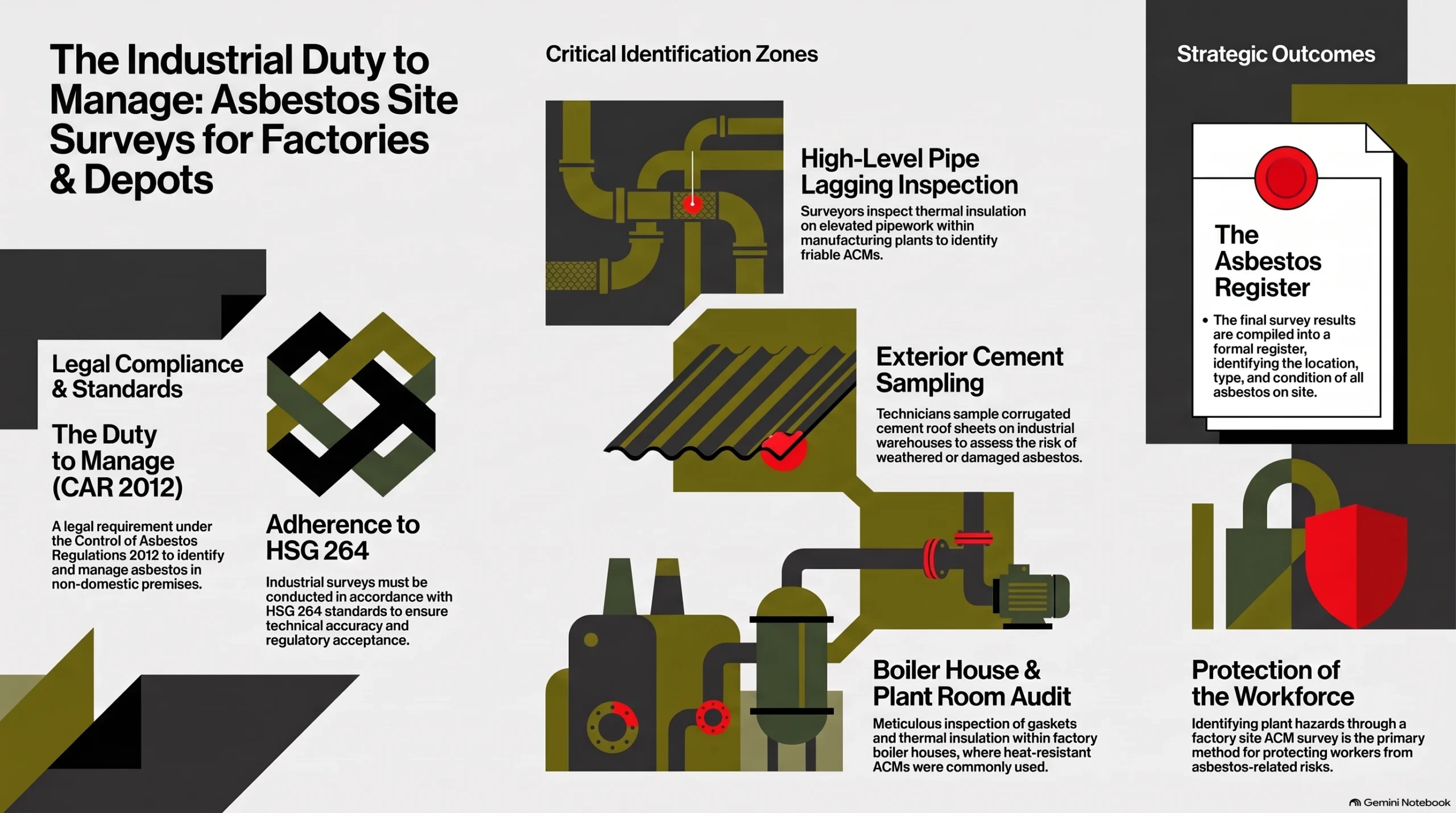
Operating a manufacturing plant, distribution depot, or heavy engineering facility requires rigorous control of legacy building materials. The Control of Asbestos Regulations 2012 place full statutory responsibility on commercial dutyholders. They must identify and manage hazardous materials across their estates. A comprehensive industrial site survey allows facility managers to locate, assess, and document asbestos. This covers production halls, boiler houses, and ancillary offices. Proactive inspection minimises accidental disturbance, protects the workforce, and maintains compliance with health and safety standards.
Industrial complexes often feature varied construction eras, aggressive operating environments, and hidden thermal insulation that create severe operational liabilities. Without an accurate inspection, routine maintenance or minor plant alterations can release lethal fibres. These airborne particles can spread rapidly into active production zones. How can dutyholders systematically evaluate their entire industrial property portfolio whilst avoiding costly shutdowns and safeguarding workforce health?
Key Takeaways
- Statutory regulations require dutyholders to commission an industrial site survey to identify and manage all legacy asbestos materials across manufacturing facilities and operational depots.
- Management surveys evaluate materials during everyday operations, whereas refurbishment surveys require intrusive inspection before undertaking plant modifications, demolition work, or structural alterations.
- A factory site ACM survey pinpoints high-risk materials, including thermal pipe lagging, sprayed limpet coatings, insulating boards, and deteriorating corrugated cement roof cladding.
- Accredited surveying organisations follow HSG 264 guidance and deploy dual material and priority risk assessments to establish defensible, actionable management plans.
- Dutyholders must maintain a live asbestos register, conduct scheduled reinspections, and communicate hazard locations directly to internal staff and visiting contractors.
Industrial Asbestos Risks by Facility Area
A robust asbestos survey provides the foundation for regulatory compliance across industrial facilities. It establishes the baseline data that dutyholders require to manage risks effectively under Regulation 4 of CAR 2012. Identifying material types, conditions, and locations helps industrial operators protect maintenance engineers and production workers. It also protects outside contractors from hazardous fibre exposure during daily operations.
Industrial sites combine complex infrastructure ranging from high-pressure steam distribution to fragile exterior cement cladding. Categorising these assets ensures appropriate surveying protocols apply to each operational zone. The table below outlines key inspection parameters, primary risk areas, and management obligations across standard factory and depot environments.
| Facility Area | Common Asbestos Applications | Survey Objective | Statutory Duty |
|---|---|---|---|
| Production Halls | Sprayed coatings, pipe insulation, roof sheets | Material condition monitoring | CAR 2012 Reg 4 |
| Boiler Houses | Thermal lagging, rope seals, gaskets | High-risk containment and assessment | CAR 2012 Reg 4 |
| Distribution Depots | Corrugated cement sheets, rainwater goods | Structural integrity and weathering checks | CAR 2012 Reg 4 |
| Plant Refurbishment Zones | Concealed AIB, floor tiles, penetration seals | Destructive pre-construction search | CAR 2012 Reg 5 |
| Administrative Offices | Textured coatings, thermoplastic vinyl tiles | Occupant protection during routine work | CAR 2012 Reg 4 |
Statutory Responsibilities for Industrial Dutyholders
Regulation 4 and the Duty to Manage
Regulation 4 of the Control of Asbestos Regulations 2012 places a strict legal duty on commercial facility owners and occupiers. Dutyholders must determine the location and condition of all suspected materials containing asbestos across their facilities. This mandate requires systematic inspection, record preservation, and the implementation of a comprehensive management plan.
This duty applies to all non-domestic properties built prior to 2000, including factories, warehouses, and transport hubs. Occupiers cannot discharge their liability by assuming a building is safe without documented proof. Where building records lack conclusive analytical evidence, dutyholders must presume materials contain asbestos until professional testing proves otherwise.
Penalties for Non-Compliance in Commercial Sites
Failure to maintain statutory asbestos compliance across factory premises invites immediate regulatory action from the Health and Safety Executive. Inspectors routinely issue prohibition notices that halt industrial operations immediately upon finding uncontrolled disturbance. Severe breaches trigger unlimited judicial fines and potential custodial sentences for responsible corporate directors and designated facility managers.
Under the Health and Safety at Work etc. Act 1974, directors face personal liability for systemic safety oversights. Financial penalties for corporate health and safety offences frequently exceed hundreds of thousands of pounds. Beyond immediate fines, operational stoppages disrupt manufacturing output and damage client supply agreements permanently.
Survey Methodologies for Industrial Projects
Management Surveys for Daily Operational Control
A standard management survey locates asbestos materials that maintenance staff or operational workers could disturb during normal occupancy. This survey covers all accessible manufacturing areas, administrative rooms, and high-level pipe routes without causing structural damage. Carrying out a factory site ACM survey provides the verified baseline data required for ongoing regulatory compliance.
Surveyors record the surface treatment, material condition, and potential for fibre release across all identified items. They sample accessible components, such as fire breaks, ceiling tiles, and boiler room gaskets, whilst presuming asbestos in unaccessed voids. A thorough industrial site survey establishes an accurate register that supports day-to-day facilities management.
Refurbishment and Demolition Surveys for Capital Works
Major plant upgrades, machinery replacement, or structural modifications require a targeted refurbishment and demolition survey prior to starting work. This survey protocol demands fully intrusive, destructive inspection techniques to access hidden wall cavities, structural voids, and internal ductwork. Surveyors inspect these areas thoroughly before external contractors begin intrusive engineering activities.
Refurbishment surveys involve destructive inspection methods. Facility managers often schedule them during planned plant shutdowns or within segregated work areas. Surveyors break into structural partitions, unseal service risers, and inspect behind plant machinery. These findings form the pre-construction information required under the Construction (Design and Management) Regulations 2015.
Did You Know?
The United Kingdom banned blue and brown asbestos in 1985 and completed the ban in 1999. Asbestos-related diseases still cause approximately 5,000 deaths annually across Great Britain due to historical industrial exposures.
High-Risk Asbestos Materials in Industrial Facilities
Thermal Insulation and Plant Lagging
Heavy industrial sites frequently house historic pipe lagging and thermal insulation around boilers, calorifiers, and steam pipes. These materials often contain high proportions of amosite or chrysotile fibres and exhibit extreme friability when aged. Disturbance during plant maintenance presents a grave exposure risk that demands immediate containment or specialist removal.
Historic industrial facilities often retain lagging residues behind retrofitted insulation or inside brick service chases. Plant engineers frequently disturb these residues during valve overhauls or pipe replacements if comprehensive registers do not exist. Any maintenance work involving friable thermal insulation requires a licensed asbestos contractor operating inside fully negative-pressure enclosures.
Asbestos Cement Cladding and Structural Roofing
Corrugated cement profile sheeting remains exceptionally widespread across British industrial depots and post-war manufacturing buildings. Decades of atmospheric weathering, moss growth, and ultraviolet radiation degrade the binding matrix, leaving sheets structurally fragile. Performing an industrial asbestos site survey identifies vulnerable exterior panels, damaged downpipes, and cracked rainwater gutters requiring proactive management.
Industrial roofing sheets typically incorporate 10 to 15 percent chrysotile bound tightly within a Portland cement matrix. Whilst intact cement presents lower risks than friable insulation, mechanical damage or power washing releases significant fibre concentrations. Dutyholders must monitor roof sheets regularly, as failing panels create dangerous fall hazards and contaminate internal factory floors.
Detailed ACM condition checks and regulatory compliance reports.
Survey Planning and Desktop Investigations
Pre-Survey Information Gathering and Asset Scoping
Competent survey delivery begins with a rigorous desktop evaluation of building plans, previous registers, and construction dates. Reviewing operation manuals and plant modifications helps surveyors anticipate high-risk installations before entering the production floor. This preparatory phase identifies safe access routes, operational hazards, and necessary permits to work across active industrial environments.
Surveyors coordinate closely with industrial operations teams to manage plant-specific risks. These include live overhead cranes, high-voltage equipment, and confined spaces. Planning access equipment, including cherry pickers or scaffolding, ensures surveyors reach high-level roof trusses and structural beams safely. Rigorous pre-planning prevents project delays and guarantees surveyor safety throughout complex production environments.
Representative Bulk Sampling Protocols
Systematic sampling requires trained surveyors to collect representative physical specimens from suspect materials using controlled, dustless techniques. Surveyors wet the material, extract a small core sample, seal it within two airtight polythene bags, and label it sequentially. This disciplined approach prevents cross-contamination across production zones whilst documenting verified sample locations.
Surveyors apply adhesive tape or wet wipes over sample points to prevent accidental fibre dispersion during core extraction. They immediately encapsulate sampling points using specialist sealants to leave the material stable. Surveyors maintain complete chain-of-custody documentation for every sample before submitting batches to accredited analytical laboratories.
Management, refurbishment, and demolition surveys for all property types.
Material and Priority Risk Evaluations
Material Assessment Scoring Under HSG 264
The material assessment algorithm defined within HSG 264 quantifies the intrinsic potential of an ACM to release airborne fibres. Surveyors evaluate four core parameters: product type, extent of damage, surface treatment, and asbestos fibre type. Summing these values generates a predictable hazard score ranging from low to high risk.
The material assessment score ranges from 2 to 12 points. Highly friable materials receive higher scores automatically. These include unsealed sprayed limpet coatings and damaged thermal insulation, due to their elevated fibre release potential. Conversely, hard composite materials or intact cement products receive lower scores, reflecting their stable matrix under normal conditions.
Operational Priority Scoring Factors
Whilst material assessments evaluate physical condition, the priority assessment examines the realistic likelihood of human disturbance during daily operations. Dutyholders assess worker occupancy levels, maintenance frequency, air movement patterns, and physical vulnerability to damage. Combining material and priority scores yields an actionable total risk rating that directs remedial capital expenditure.
Priority assessments reflect the operational reality of the specific factory or depot. A slightly damaged material inside a locked, infrequently visited plant room poses a lower human risk. An identical item in a busy dispatch area poses far greater risk. By evaluating accessibility, vibration from machinery, and occupant exposure, dutyholders target funds where risk reduction is greatest.
Asbestos Removal
Safe, certified removal of asbestos materials in line with HSE guidelines.
Surveyor Competence and Analytical Standards
ISO 17020 Inspection Body Accreditation
Industrial dutyholders should always commission surveying organisations accredited to ISO/IEC 17020 by the United Kingdom Accreditation Service. UKAS accreditation confirms technical competence, impartial inspection practices, and adherence to rigorous quality assurance systems like RG 8. This formal verification shields commercial clients from flawed survey data and subsequent legal liabilities.
Accreditation under ISO/IEC 17020 requires independent technical audits, documented standard operating procedures, and regular surveyor competency reassessments. Individual surveyors should hold industry qualifications such as the BOHS P402 certificate combined with extensive supervised field experience. Choosing an accredited organisation ensures survey reports withstand strict regulatory scrutiny from the HSE.
Accredited Laboratory Bulk Sample Analysis
Analysing bulk material samples requires independent testing by a laboratory holding UKAS accreditation to ISO/IEC 17025. Competent analysts examine fibres using polarised light microscopy coupled with dispersion staining techniques in accordance with HSG 248. This meticulous testing reliably differentiates between chrysotile, amosite, and crocidolite fibres within complex industrial matrices.
Where optical microscopy cannot definitively identify fine fibres or low concentrations, laboratories utilise scanning or transmission electron microscopy. Analysts participate in external quality schemes, such as the Asbestos in Materials Scheme (AIMS), to confirm testing accuracy. This independent scientific verification prevents false negatives that could put factory workers at risk.
Post-Survey Action Plans and Record Keeping
Live Asbestos Register Requirements
The asbestos register acts as an operational log documenting the location, condition, and risk score of every confirmed ACM. Dutyholders must update this electronic database immediately following periodic reinspections, accidental damage, or professional removal works. Dutyholders must retain these records for as long as the identified materials remain in the building. This ensures full transparency and audit readiness.
Modern industrial sites increasingly adopt cloud-based asset management software to host dynamic asbestos registers. Digital systems allow maintenance teams to access real-time material condition data and site drawings directly via handheld tablets. Dutyholders should review the register at least annually, as recommended by the HSE. They must update entries immediately if condition monitoring reveals material degradation.
Contractor Communication and Permit to Work Systems
Preventing accidental exposure relies on direct communication between facility management teams, internal maintenance staff, and visiting contractors. Dutyholders must mandate asbestos register reviews before issuing permits to work for any engineering or electrical installation. Clear site briefings and visible warning signage stop trade contractors from drilling or cutting into unidentified building fabric.
Third-party contractors represent the single highest risk group for accidental asbestos disturbance during commercial repairs. Integrating the asbestos register into the formal site induction process prevents unauthorised work on hazardous fabric. Dutyholders must secure written sign-offs from all contractor leads, confirming they have reviewed relevant ACM locations before touching building elements.
Final Thoughts
Commissioning a thorough industrial site survey is an essential statutory responsibility for any factory or depot operator managing pre-2000 property. Systematic surveying is far from a mere paper exercise. It provides the empirical data required to protect workers, contractors, and production continuity. A robust survey prevents accidental fibre disturbance, reduces legal liabilities, and establishes a clear foundation for effective estate management.
As industrial infrastructure continues to age, the proactive management of legacy materials becomes increasingly critical to operational safety. Facility managers who integrate digital asbestos registers with daily maintenance controls will maintain safer workplaces and seamless compliance. Long-term health and safety depends upon continuous vigilance and structured reinspections. It also requires unwavering adherence to established survey standards across every industrial facility.
Submit Enquiry
Frequently Asked Questions
A management survey assesses the condition of accessible asbestos materials. Occupants or maintenance staff could disturb these materials during everyday facility operations. It uses non-destructive techniques and presumptions to evaluate risks without damaging structural finishes. In contrast, a refurbishment and demolition survey is an intrusive, destructive inspection. It takes place before major building modifications or machinery installations begin. It accesses sealed voids, cavity walls, and subterranean ducts to locate every concealed material. This ensures the designated work zone is fully clear before structural work begins.
Regulation 4 of the Control of Asbestos Regulations 2012 requires dutyholders to review their asbestos management plan at regular intervals. The HSE recommends annual review as good practice, although the regulation itself does not fix a specific interval. Dutyholders must also update the register immediately after any scheduled condition reinspection or accidental material disturbance. The same applies following encapsulation treatment or specialist removal work. Reviewing records ensures the risk assessments accurately reflect current material conditions and operational changes.
A standard management survey usually proceeds safely whilst a factory remains fully operational. Surveyors inspect accessible areas without releasing harmful fibres into work areas. Surveyors use wet sampling methods and immediate point encapsulation to prevent airborne contamination during sample collection. However, intrusive refurbishment and demolition surveys often require targeted area shutdowns, service isolations, or out-of-hours scheduling. High-risk zones, such as live production lines or boiler houses, require careful coordination. This ensures complete surveyor safety and operational continuity.
Regulation 4 of CAR 2012 defines the dutyholder as the person or organisation with clear contractual responsibility. This means whoever holds the duty to maintain or repair the premises. In many commercial and industrial leases, full repairing and insuring terms place this responsibility squarely on the tenant. Lease agreements sometimes share maintenance duties, or leave terms undefined. In these cases, both the property owner and the commercial tenant share statutory dutyholder obligations. Every party must examine their lease contract to establish exact maintenance boundaries.
Individual surveyors should hold recognised professional certifications, such as the British Occupational Hygiene Society P402 qualification. This should be backed by at least six months of structured, mentored field experience in industrial environments. The Health and Safety Executive also advises dutyholders to engage surveying organisations accredited to ISO/IEC 17020. This accreditation comes from the United Kingdom Accreditation Service. UKAS accreditation demonstrates that the surveying body operates robust quality systems and maintains objective inspection procedures. It also undergoes regular independent technical audits.

Ora Asbestos Management Ltd
Unit A9, Seedbed Centre,
Shoeburyness, Southend-on-Sea SS3 9QY..
About the Author
Gordon Ringland is the founder, Director and principal asbestos surveyor at Ora. He holds the BOHS P402 qualification — the recognised industry standard for surveying and sampling strategies for asbestos in buildings — awarded by the British Occupational Hygiene Society (BOHS) Faculty of Occupational Hygiene (Certificate No. 20140911-32845-4254).
Gordon has over 12 years of hands-on experience in the asbestos industry, built on more than 20 years working in roofing. He carries out all three main survey types — management surveys, R&D surveys and re-inspections — and designs the sampling strategies used to find asbestos-containing materials (ACMs). He also leads non-licensed asbestos removal projects.
His work spans the full range of buildings, from residential garages and family homes to large commercial sites. Gordon has particular experience in heritage and museum environments, including listed buildings, where careful, fully compliant work matters most. He oversees Ora’s survey work and is the named author of our asbestos guides.