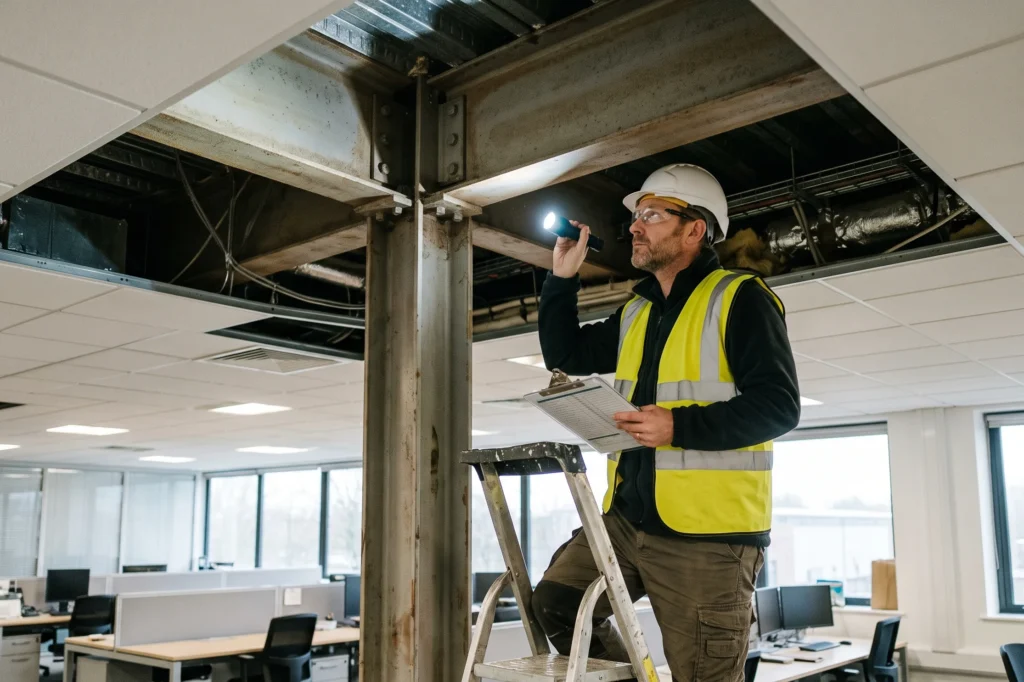
Sprayed Asbestos Coating on Structural Steelwork
Sprayed asbestos coating remains the most dangerous asbestos material found in commercial property. Contractors applied it across multi-storey offices, shopping centres, and industrial units during the post-war building boom. The material sits directly on structural steel, usually out of sight. Facilities managers, building surveyors, and fit-out contractors face serious legal and health risks when refurbishment work disturbs it.
These friable coatings were routinely concealed above suspended ceilings and behind service risers. They rarely appear in standard building records. When a strip-out disturbs them, fibre contamination spreads quickly through ventilation systems. How can commercial dutyholders identify, manage, and safely remove concealed sprayed asbestos on steelwork before invasive works begin?
Key Takeaways
- Sprayed asbestos coating was applied to structural steelwork between 1950 and 1980, leaving hidden contamination above suspended ceilings in commercial buildings.
- Extreme friability places sprayed coatings at the top of the asbestos risk hierarchy, requiring licensed removal contractors under CAR 2012.
- Management surveys cannot detect hidden steelwork coatings, so an intrusive refurbishment survey is mandatory before any Category A strip-out begins.
- Licensed containment demands sealed enclosures under negative pressure, three-stage airlocks, HEPA filtration, and full decontamination units for every operative.
- Reoccupation requires four-stage clearance testing, confirming airborne fibre levels sit below 0.01 fibres per cubic centimetre before certification.
Key Technical Metrics for Sprayed Asbestos Management
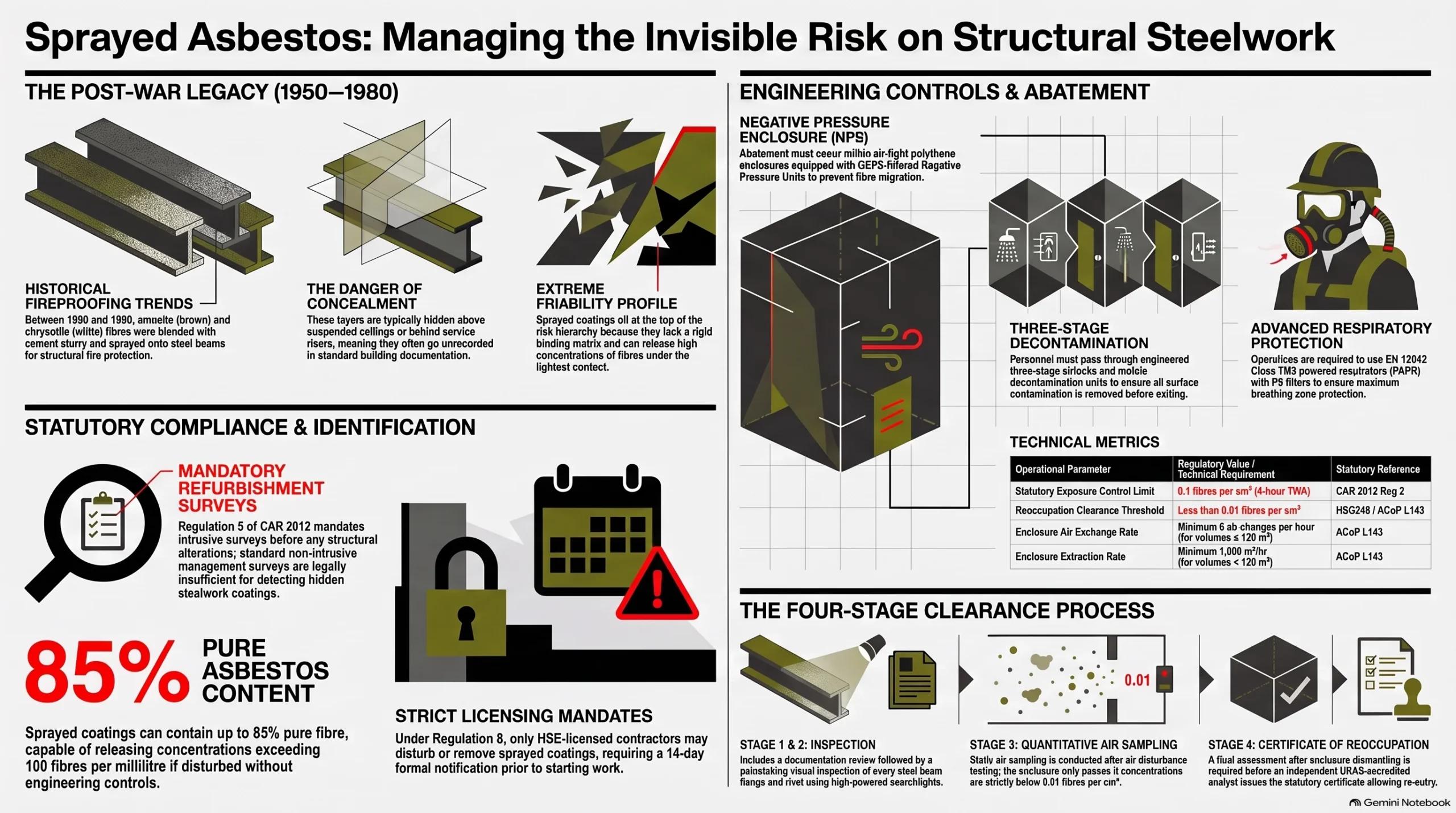
Managing sprayed asbestos coating on structural steelwork depends on fixed statutory limits. It also depends on precise containment specifications. Facilities managers, surveyors, and fit-out contractors need these figures before work starts. In practice, we find that disputes on site usually stem from confusion over enclosure ventilation rates and clearance thresholds.
The table below sets out the core regulatory metrics for licensed work. It covers exposure limits, air change mandates, and clearance standards. Each value derives from the Control of Asbestos Regulations 2012 and its supporting guidance. These parameters govern enclosure design, respiratory protection, and safe reoccupation of the building.
| Operational Parameter | Regulatory Value or Technical Requirement | Reference |
|---|---|---|
| Statutory exposure control limit | 0.1 fibres per cubic centimetre, averaged over four hours | CAR 2012 Regulation 2 |
| Reoccupation clearance indicator | Below 0.01 fibres per cubic centimetre | HSG248 and ACoP L143 |
| Enclosure extraction rate, under 120 cubic metres | Minimum 1,000 cubic metres per hour | ACoP L143 and HSG247 |
| Enclosure air exchange rate, 120 cubic metres or more | Minimum 8 air changes per hour | ACoP L143 and HSG247 |
| Enclosure negative pressure | At least 5 pascals below ambient | HSG247 |
| Respiratory protective equipment standard | EN 12942 Class TM3 powered respirator with P3 filter | HSG247 and ACoP L143 |
| Notification period for licensed work | 14 days before work commences | CAR 2012 Regulation 9 |
Historical Application in Commercial Building Stock
Post-War Steel Construction Trends
Commercial development between 1950 and 1980 relied heavily on structural steel frames. Those frames needed robust fire protection. Contractors sprayed asbestos coating directly onto beams, columns, and concrete soffits. The result was a durable fire barrier across multi-storey offices and retail developments throughout the United Kingdom.
Amosite and chrysotile fibres were blended with hydrated lime or cement slurry. Machines then sprayed the mixture onto unpainted steel. The technique delivered the fire ratings demanded by updated building bylaws. Over decades, the binder degraded. The coating turned extremely friable. Maintenance staff working in ageing office stock now face severe exposure risks.
Concealment Above Ceilings and Service Risers
Later refits and acoustic upgrades hid limpet asbestos on steelwork behind suspended ceiling tiles, drywall partitions, and vertical risers. These thermal insulation layers then sat untouched for decades. Substantial quantities of unrecorded hazardous material remain directly above occupied offices and high-street retail floors across the country.
Steel-framed office stock in London districts such as Holborn, Moorgate, and Victoria frequently harbours unrecorded asbestos fireproofing steel frame installations. Ceiling voids above flagship stores on Oxford Street and Bond Street conceal friable sprays behind period facades. From experience across the sector, these installations only surface when a project team opens a void. A central compliance register is the only reliable defence.
Risk Hierarchy and Friability Profile
High Friability and Fibre Release Potential
Sprayed asbestos insulation sits at the peak of the hazard hierarchy. Its friability is extreme and its mechanical bonding minimal. The soft fibrous matrix breaks down under the lightest contact. Any disturbance releases high concentrations of respirable fibres straight into the surrounding void.
Asbestos cement products and insulating boards hold their fibres in a rigid matrix. Sprayed coatings do not. Impact from ladders, vibration from plant, or turbulence in a ventilation shaft can slough off debris. Airborne fibre levels then climb past statutory limits within minutes. Contamination spreads into adjacent zones and puts unprotected occupants at acute risk.
Statutory Classification and Licensing Mandates
UK law treats all work on sprayed coatings as licensed asbestos work. That classification covers removal, encapsulation, and repair of any enclosure. Regulation 8 of the Control of Asbestos Regulations 2012 prohibits unlicensed contractors from disturbing the material. The prohibition applies regardless of the scale of the task.
Licensed work requires HSE notification fourteen days before the project starts. Regulation 7 demands a site-specific plan of work. Dutyholders must confirm that any specialist sub-contractor holds a valid HSE licence. Engaging unlicensed operatives invites prohibition notices, substantial fines, and criminal prosecution. Courts have imposed six-figure penalties on organisations that ignored these duties.
Did You Know?
HSE guidance records that sprayed asbestos coatings can contain up to 85 per cent asbestos by weight. That concentration makes them the most hazardous asbestos product in UK building stock. Disturbing them without engineered negative pressure controls can generate airborne fibre levels hundreds of times above the statutory control limit of 0.1 fibres per cubic centimetre.
Refurbishment Triggers and Unintentional Disturbance
Category A Commercial Fit-Out Operations
Category A office refurbishment is the most common trigger for accidental asbestos disturbance. Incoming tenants strip existing space back to a structural shell. Mechanical demolition then strikes unrecorded coatings above suspended ceilings and around columns. The damage often occurs before anyone recognises the material.
Demolition crews on fast-track strip-outs use heavy tools to clear ceiling hangers, redundant ductwork, and bulkheads. A single strike on encased steel showers the work zone with microscopic fibres. Without intrusive investigation beforehand, a routine fit-out becomes an environmental emergency. Sites close immediately. Decontamination then runs across multiple floors at considerable cost.
Routine Service Modifications and Cable Infrastructure
Minor works carry disproportionate exposure risk. Data cabling, lighting grid alterations, and sprinkler pipework changes all reach into ceiling voids. One contractor lifting a single tile can scrape friable spray. The released fibres travel directly into active mechanical ventilation systems serving the wider floor plate.
Fibres entering return-air plenums or ducting spread far beyond the immediate work area. Tradespeople without asbestos awareness training rarely recognise damaged spray. Many mistake it for mineral wool or acoustic foam. A permit-to-work system closes that gap. Mandatory pre-work inspection of every void keeps routine maintenance from compromising the whole building.
Detailed ACM condition checks and regulatory compliance reports.
Surveying Strategy and Pre-Work Inspections
Why Management Surveys Miss Sprayed Coatings
Management surveys under HSG264 are non-intrusive by design. They cover areas reachable during normal occupation. A surveyor cannot inspect steel beams sealed inside a ceiling void or behind riser boxing. High-risk sprayed coatings therefore stay absent from the building asbestos register.
Relying on a management register before intrusive construction work breaches Regulation 5 of CAR 2012. Management surveys use non-damaging techniques only. They assume material behind fixed panels is safe until proven otherwise. Fit-out teams read those records as confirmation that voids are clear. That assumption fails the moment structural steelwork is exposed.
Refurbishment Surveys and Void Access Protocols
A refurbishment and demolition survey must precede any structural alteration. HSG264 sets the methodology. The survey opens hidden voids, service risers, and structural encasements under controlled conditions. Every concealed asbestos application inside the planned work boundary is identified, sampled, and recorded before contractors mobilise.
Surveyors holding BOHS P402 carry out destructive sampling in unoccupied zones. They use localised air filtration and temporary protective enclosures. Bulk samples from steel sprays go to UKAS-accredited laboratories working to ISO/IEC 17025. The report maps every hazardous coating on the frame. Licensed contractors then design an abatement strategy around accurate data.
Management, refurbishment, and demolition surveys for all property types.
Engineering Controls and Negative Pressure Enclosures
Full Enclosure Construction and Negative Pressure Units
Removal of sprayed asbestos demands an airtight enclosure. Contractors build it from heavy-gauge polythene sheeting sealed with high-tack tape. Negative pressure units fitted with HEPA filtration hold the internal air below ambient pressure. That differential stops fibres escaping the containment zone during active mechanical stripping.
ACoP L143 and HSG247 set the ventilation benchmarks. Enclosures under 120 cubic metres need extraction of at least 1,000 cubic metres per hour. Larger enclosures require a minimum of eight air changes per hour. Differential pressure gauges monitor the enclosure throughout. Guidance expects at least 5 pascals of negative pressure against ambient conditions.
Decontamination Units and Transit Airlock Systems
Access to a licensed work zone runs through engineered airlocks. A three-stage baffle airlock controls personnel entry and exit. A mobile decontamination unit provides shower facilities and defined clean-to-dirty transition chambers. Operatives must strip and wash before they leave the containment boundary at any point.
Airlock design keeps air flowing inward, from clean space towards the dirty work zone. That direction prevents dust migration during entry and waste transfer. Operatives bag disposable overalls inside the dirty chamber. They then pass through a mandatory shower. Wash-water runs through micron filtration before discharge, satisfying environmental protection requirements.
Asbestos Removal
Safe, certified removal of asbestos materials in line with HSE guidelines.
Operational Removal Protocols and Operative Protection
Personal Protective Equipment and Power-Assisted Filtering
Operatives stripping friable coatings wear powered respiratory protective equipment to EN 12942 Class TM3. The unit combines a full-face mask with a high-efficiency P3 particulate filter. Constant positive airflow across the breathing zone delivers the highest practical protection factor during dense fibre release.
Regulation 22 of CAR 2012 requires medical examination at intervals of no more than two years for licensed work. Health records are kept for forty years. Every operative also completes face-fit testing before wearing a respirator. Type 5 and Type 6 disposable overalls with taped wrists and ankles keep dust off skin and clothing. Personal air monitoring in the breathing zone confirms that exposure stays below statutory limits.
Controlled Suppression Techniques and Waste Management
Suppression combines controlled wetting with shadow vacuuming. Operatives inject a surfactant solution directly into the sprayed matrix. Operatives then peel the wetted coating from the steel using non-sparking scrapers. Working wet keeps fibre release low throughout the strip and protects everyone inside the enclosure.
Stripped waste goes straight into heavy-duty red asbestos bags sealed with vinyl tape. A second clear bag encloses the first inside the waste airlock. Labelling must comply with carriage of dangerous goods legislation. Registered carriers then move the double-bagged waste to a licensed disposal site. Consignment notes complete the audit trail.
Four-Stage Clearance and Site Reoccupation
Rigorous Four-Stage Inspection Methodology
Reoccupation after removal depends on a successful four-stage clearance. An independent UKAS-accredited analyst carries out the procedure. HSG248 and ACoP L143 govern each stage. The process confirms that surfaces are clean, that the enclosure held, and that airborne fibre levels meet the statutory criterion.
Stage 1 reviews site documentation and enclosure integrity. Stage 2 is a detailed visual inspection inside the enclosure. Analysts use high-powered lamps to check every beam flange, web, and rivet for residual debris. Stage 3 combines air disturbance with static air sampling. Stage 4 assesses the area after the enclosure comes down.
Quantitative Air Sampling and Reoccupation Certification
Stage 3 sampling draws a measured volume of air through a 25 mm membrane filter. The analyst then examines the filter on site by phase-contrast optical microscopy. HSG248 sets the counting protocol. An enclosure passes only when the calculated fibre concentration falls below 0.01 fibres per cubic centimetre.
A result at or above that threshold fails the enclosure. The team must repeat HEPA vacuuming and wet wiping, then re-test. Only a full pass across all four stages produces a Certificate of Reoccupation. That certificate allows contractors back into the space. Refurbishment and normal tenancy can then resume.
Final Thoughts
Sprayed asbestos coating on structural steelwork is among the hardest technical problems in commercial property management. Unrecorded limpet installations sit above suspended ceilings in thousands of buildings. Routine refits disturb them. Intrusive surveying and licensed abatement under CAR 2012 are the only defensible responses.
Rigorous pre-work inspection, full negative-pressure containment, and independent four-stage clearance protect contractors and occupants alike. Dutyholders who plan for the material early keep projects on programme. Those who meet it mid-strip rarely do.
Submit Enquiry
Frequently Asked Questions
Sprayed asbestos coating, often called limpet asbestos, is a fireproofing material applied directly to structural steel beams, columns, and soffits. Contractors used it widely in commercial buildings constructed between 1950 and 1980. The mix combined raw asbestos fibres with hydrated lime or cement slurry, giving excellent fire resistance. It can contain up to 85 per cent asbestos and degrades easily. That combination makes it one of the highest-risk asbestos materials in commercial property.
A management survey under HSG264 is non-intrusive. It locates material accessible during normal daily occupation. Sprayed coatings are almost always concealed behind suspended ceilings, partition walls, and mechanical risers. A management survey does not disturb building fabric to inspect hidden steel frame members. Regulation 5 of CAR 2012 requires a suitable and sufficient assessment before work begins. In practice that means commissioning an intrusive refurbishment and demolition survey with full access to concealed voids.
No. Regulation 8 of the Control of Asbestos Regulations 2012 classifies all work on sprayed coatings as licensed asbestos work. The same applies to asbestos insulating board and thermal lagging. Extreme friability and high fibre release potential drive that classification. Removal must be carried out by an HSE-licensed contractor. The work requires negative pressure enclosures, decontamination units, and power-assisted respiratory protection. Notification to the HSE fourteen days beforehand is also mandatory.
Licensed removal requires a full negative-pressure enclosure built from heavy polythene sheeting. Under ACoP L143 and HSG247, negative pressure units fitted with HEPA filters must deliver at least eight air changes per hour for enclosures of 120 cubic metres or more. Smaller enclosures need a minimum extract of 1,000 cubic metres per hour. Access runs through three-stage airlocks and a mobile decontamination unit. Together these controls stop fibre migration beyond the enclosure.
Stage 3 of the four-stage clearance must show airborne fibre levels below 0.01 fibres per cubic centimetre. That figure is the clearance indicator set out in HSG248 and ACoP L143. It is not a safe level, simply the limit of reliable measurement by phase-contrast microscopy. A result at or above that value fails the enclosure. The team must repeat HEPA vacuuming, wet wiping, and re-sampling before the analyst issues a Certificate of Reoccupation.

Ora Asbestos Management Ltd
Unit A9, Seedbed Centre,
Shoeburyness, Southend-on-Sea SS3 9QY..
About the Author
Gordon Ringland is the founder, Director and principal asbestos surveyor at Ora. He holds the BOHS P402 qualification — the recognised industry standard for surveying and sampling strategies for asbestos in buildings — awarded by the British Occupational Hygiene Society (BOHS) Faculty of Occupational Hygiene (Certificate No. 20140911-32845-4254).
Gordon has over 12 years of hands-on experience in the asbestos industry, built on more than 20 years working in roofing. He carries out all three main survey types — management surveys, R&D surveys and re-inspections — and designs the sampling strategies used to find asbestos-containing materials (ACMs). He also leads non-licensed asbestos removal projects.
His work spans the full range of buildings, from residential garages and family homes to large commercial sites. Gordon has particular experience in heritage and museum environments, including listed buildings, where careful, fully compliant work matters most. He oversees Ora’s survey work and is the named author of our asbestos guides.