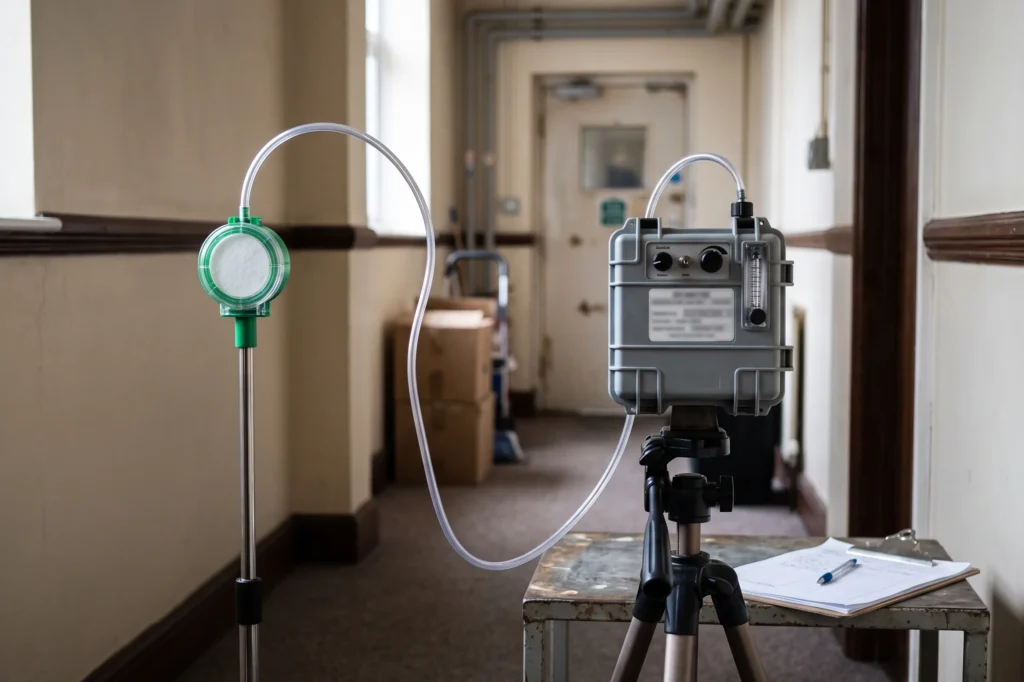
Asbestos Air Monitoring: The Four Types Explained
Airborne asbestos fibres cause fatal respiratory disease when disturbed during refurbishment or maintenance. Rigorous asbestos air monitoring proves that containment works and that the atmosphere remains safe to breathe. UK law regulates this sampling closely. Measurements are taken before, during and after site work. Reliable results depend on accredited methods, qualified analysts and strict adherence to Health and Safety Executive guidance.
Dutyholders and site managers often struggle to identify which air testing strategy applies to their work. The wrong protocol risks enforcement action and avoidable fibre exposure for operatives and occupants. So how do the four forms of air monitoring differ, and how do analysts verify atmospheric safety under statutory standards?
Key Takeaways
- Asbestos air monitoring measures airborne fibre concentrations using calibrated pumps and membrane filters analysed under phase contrast optical microscopy.
- Background sampling records baseline fibre levels before work starts, so later containment results reflect genuine site disturbance rather than pre-existing dust.
- Leak monitoring checks airlocks, bag locks and enclosure perimeters during licensed removal to prevent fibre migration into occupied areas.
- Personal exposure monitoring records breathing zone concentrations and confirms that respiratory protective equipment performs within the statutory control limit.
- Reassurance air testing confirms atmospheric safety after non-licensed work, accidental disturbance, or enclosure dismantling following a completed four-stage clearance.
The Four Air Monitoring Types Compared
Air monitoring protocols differ by project stage, legal purpose and site environment. The sampling strategy chosen must align with the Control of Asbestos Regulations 2012 and the methods set out in HSG248. In practice, we find most compliance failures start here, with the wrong test specified for the wrong stage of work.
The table below sets out the four principal monitoring types. It gives the objective of each test, where samples are drawn, and the concentration figure that triggers action. Thresholds are expressed in fibres per cubic centimetre. These figures apply across commercial, industrial and domestic asbestos projects in the United Kingdom.
| Monitoring Type | Primary Purpose | Sampling Location | Action Threshold |
|---|---|---|---|
| Background monitoring | Establishes pre-work baseline fibre levels | Ambient areas beyond the work zone | Below 0.01 f/cm3 |
| Leak monitoring | Verifies enclosure containment integrity | Airlocks, bag locks, NPU exhausts, perimeters | 0.01 f/cm3 warning level |
| Personal exposure monitoring | Measures individual worker exposure under Regulation 22 | Operative breathing zone | 0.1 f/cm3 control limit, four-hour TWA |
| Reassurance air testing | Confirms air safety after works or disturbance | Cleared or adjacent occupied areas | Below 0.01 f/cm3 clearance indicator |

Regulatory Duties and Independent Testing
Statutory Duties Under CAR 2012
The Control of Asbestos Regulations 2012 set the statutory requirements for monitoring airborne fibres. Regulations 19 to 21 require air sampling to prove that control measures work. Regulation 2 fixes the exposure limits. Employers must monitor exposure whenever work is liable to release fibres into the air.
Approved Code of Practice L143 explains how to discharge these duties in practice. A competent person must carry out the sampling. Licensed work on sprayed coatings, pipe insulation and asbestos insulating board demands a rigorous monitoring regime. Non-licensed tasks still require a risk assessment. That assessment decides whether monitoring is needed to demonstrate that airborne levels stay below the action limits. From experience across the sector, dutyholders understimate this second category most often.
Independence Between Analyst and Removal Contractor
HSG248 demands complete independence between the organisation performing air monitoring and the contractor carrying out the removal. This separation removes any conflict of interest. Air test results and visual clearance certificates then reflect an unbiased scientific judgement. Dutyholders should treat that independence as a contractual requirement, not a courtesy.
United Kingdom Accreditation Service accreditation to ISO/IEC 17025 verifies technical competence for sampling and testing. An independent analyst keeps air certificates, daily log sheets and chain-of-custody records legally defensible. Individual competence matters just as much. Analysts should hold BOHS P403 for air sampling and P404 for four-stage clearance. Dutyholders should check both the individual certificates and the organisational accreditation before appointing anyone.
Baseline and Operational Sampling Protocols
Background Monitoring Before Work Begins
Background air monitoring establishes the ambient fibre concentration in a property before anyone disturbs asbestos. The test identifies contamination that is already present. It gives a defined baseline for judging later operational and leak results. Without it, ordinary building dust can be misread as evidence of a containment failure.
Background sampling matters most in occupied commercial premises, industrial facilities and public buildings. Textile fibnes, plaster and organic debris all register under optical counting. Establishing baseline counts prevents removal operations being blamed for fibres that were there beforehand. Analysts run pumps in adjacent rooms or external areas to capture representative air volumes. Analysts record the results before any enclosure is built.
Leak Monitoring Around Live Enclosures
Leak monitoring samples the air outside a sealed containment enclosure whilst abatement work is under way. Analysts position pumps near airlocks, bag locks and structural seams. These checks confirm that engineering controls are holding. They give early warning of fibre migration into occupied space before anyone is harmed.
Negative pressure units keep airflow moving inward, holding dust inside the enclosure. Tears in polythene sheeting, tape failure or filter bypass can defeat that control. Leak testing acts as the immediate safety buffer for staff in neighbouring corridors. In practice, we find seam failures at high level cause most warning-level readings. Where concentrations reach the operational warning level, the analyst alerts the supervisor at once.
Did You Know?
Regulation 22 of the Control of Asbestos Regulations 2012 requires UK employers to retain personal exposure monitoring records and health surveillance files for at least 40 years from the date of the last entry.
Individual Exposure and Static Clearance
Personal Monitoring in the Breathing Zone
Personal exposure monitoring measures the fibne concentration an individual worker actually inhales during abatement tasks. Lightweight battery-powered pumps clip to the operative. The sampling head sits in the breathing zone. Regulation 22 of CAR 2012 requires these records, and they form the legal evidence of exposure.
The sampling head sits within 300 millimetres of the nose and mouth. Results show how well the selected respiratory protective equipment performs. Powered full-face respirators fitted with P3 filters are the common choice on licensed work. Personal sampling data populates the individual exposure record for each operative. Employers use that record to demonstrate that concentrations stay well below the control limit of 0.1 fibres per cubic centimetre.
Reassurance Testing After Non-Licensed Work
Reassurance air testing confirms that airborne fibre levels sit below the clearance threshold after non-licensed work or accidental damage. The result tells occupants that a space is safe to re-enter without respiratory protection. It is a static test, run in the affected area once cleaning has finished.
Licensed removal ends with a mandatory four-stage clearance under HSG248. Non-licensed projects on cement sheeting or textured coatings usually close with static reassurance air testing instead. Samplers run in the cleared area to confirm concentrations below 0.01 fibres per cubic centimetre. Building owners often request the same test after damage to ceiling tiles or thermal pipe insulation. In practice, the test answers the first question occupants ask about re-entry.
Detailed ACM condition checks and regulatory compliance reports.
Equipment Standards and Sampling Procedure
Pump Calibration and Filter Cassettes
Accurate air sampling depends on calibrated battery-operated pumps. These draw air through a membrane filter at a controlled flow rate, normally between one and three litres per minute. Analysts calibrate flow against a primary standard before and after every sampling run. The tolerance is five per cent.
Pumps pull air through 25 millimetre cellulose nitrate filters with a 0.8 micron pore size. The filters sit in open-faced conductive plastic cassettes. A cowled holder stops static electricity deflecting fibres away from the collection surface. Analysts log start time, finish time and flow rate to calculate the total volume drawn. Fibre concentration is total counted fibnes divided by total air volume, so volume accuracy governs the result.
Chain of Custody and Field Blanks
Field protocol requires analysts to handle cassettes under strict quality assurance controls. Contamination at any stage invalidates the result. Analysts prepare daily field blanks alongside the live samples. They complete chain-of-custody paperwork that tracks every filter from the sampling point through to microscope analysis in the laboratory.
The analyst opens a field blank cassette briefly on site, then seals it without drawing air through. Analysing the blank proves that the filter batch, transit box and laboratory handling carry no background contamination. Chain-of-custody paperwork records sample reference numbers, pump serial identifiers, sampling locations and site conditions. This level of logging keeps every figure on the final air certificate traceable. Without it, a result will not survive scrutiny from the Health and Safety Executive.
Management, refurbishment, and demolition surveys for all property types.
Laboratory Analysis and Microscopy
Phase Contrast Optical Microscopy
Phase contrast optical microscopy is the primary analytical method for counting airborne fibres. It follows MDHs 39/4 and HSG248. Analysts examine the cleared membrane filter at 500 times magnification. A Walton-Beckett graticule in the eyepiece defines the counting field and gives a repeatable measure of respirable fibnes.
MDHS 100 sets the counting rules. Analysts count fibres longer than five micrometres and narrower than three micrometres. The length to width ratio must be at least three to one. Triacetin vapour or acetone clears the filter on a glass slide. Analysts count 100 graticule fields, or stop at 100 fibres, to reach a statistically valid concentration. The method counts every respirable fibre of that shape, whether asbestos, mineral wool or organic material.
Electron Microscopy for Fibre Discrimination
Scanning and transmission electron microscopy separate asbestos from other fibres when optical counts approach a regulatory limit. Heavy non-asbestos dust loads make that separation necessary. Electron methods assess chemical composition and crystalline structure. The analyst can then state whether the counted fibres are truly asbestos or ordinary mineral dust.
Optical microscopy cannot tell chrysotile from plaster dust or synthetic mineral fibre. High dust loads therefore produce counts that read as failures. Energy dispersive X-ray spectroscopy paired with transmission electron microscopy gives elemental analysis. It confirms the ratios of silicon, magnesium, iron and sodium that identify each asbestos type. Where a background or reassurance sample reads high in a dusty industrial building, this analysis prevents an unnecessary shutdown.
Asbestos Removal
Safe, certified removal of asbestos materials in line with HSE guidelines.
Air Quality Thresholds and Response Plans
Control Limits and Operational Thresholds
UK regulations fix precise numerical thresholds for asbestos in air. The statutory control limit under CAR 2012 is 0.1 fibres per cubic centimetre, averaged over four hours. The operational warning level used outside enclosures is 0.01 fibres per cubic centimetre. The clearance indicator sits at the same figure.
The clearance figure of 0.01 fibres per cubic centimetre represents the limit of reliable detection by optical microscopy. It is not a proven safe level. Work inside an enclosure must stay far below the control limit, and respiratory protective equipment is compulsory throughout. Where leak monitoring outside an enclosure reaches the warning level, an immediate operational review follows. Honest practice treats that figure as a trigger, not a target.
Action Following an Exceedance
Work stops immediately when an air monitoring result exceeds an operational threshold or the statutory limit. Operatives withdraw to the decontamination unit. The supervisor isolates the area. The analyst then begins a root cause investigation covering enclosure integrity and equipment performance.
Corrective work involves re-inspecting polythene seals and smoke testing structural joints. Negative pressure units need a performance check. Supervisors verify face-fit test records for every operative and inspect pump calibration logs. Wet cleaning and HEPA vacuuming follow the sealing repairs. The analyst then re-monitors the air before work restarts. Every exceedance, root cause finding and corrective action belongs in the site log and the project safety file.
Record Retention and Health Surveillance
The Forty Year Retention Requirement
Regulation 22 of CAR 2012 requires employers to keep personal exposure monitoring records for at least 40 years. The period reflects the long latency of asbestos-related disease. Mesothelioma, lung cancer and asbestosis can appear decades after exposure. Records held for less than 40 years leave an employer exposed to later claims.
Air certificates, pump run logs and personal monitoring reports must link to the individual employment file. Electronic record systems keep that data available for audit by the Health and Safety Executive or by legal representatives. An unbroken archive across four decades lets an organisation prove compliance with the control limits in force at the time. In practice, we find that retention fails at handover, when a business changes ownership or a contractor closes.
Exposure Data Within Health Surveillance Records
Personal exposure data feeds directly into the health surveillance records held by an appointed doctor. Baseline lung function tests and clinical examinations draw on those figures. The combination shows how an individual worker exposure profile has developed over time. It also gives the employer an auditable record of protection.
Licensed removal operatives undergo a medical examination every two years. Workers carrying out extensive notified non-licensed work need regular health surveillance as well. Pairing respiratory health data with breathing zone fibne counts creates a defensible safety record. Employers who keep those logs integrated meet the expectations in ACoP L143. More importantly, they give their workforce real protection rather than paperwork.
Final Thoughts
Rigorous asbestos air monitoring is what turns a control measure into proven safety. Background, leak, personal and reassurance testing each answer a different question. Applied correctly under HSG248 and CAR 2012, they protect operatives and occupants alike. Applied to the wrong stage of work, they prove nothing.
An independent UKAS-accredited analyst keeps sampling data, laboratory results and clearance certificates defensible. Retention for 40 years completes the picture. As buildings from the asbestos era reach the end of their service life, refurbishment volumes will rise. Monitoring discipline will matter more, not less.
Submit Enquiry
Frequently Asked Questions
Leak monitoring runs during active removal. Analysts sample the air outside the containment enclosure and around airlocks to confirm that engineering controls are preventing fibre release into surrounding areas. Reassurance air testing happens after the work is finished. It applies to non-licensed tasks, minor repairs and accidental disturbances. The test confirms that fibre levels inside the space sit below the clearance figure of 0.01 fibres per cubic centimetre before people return to normal occupation.
Independence removes commercial pressure from the people judging whether a site is safe. HSG248 and ACoP L143 require structural separation between the analyst and the removal contractor. Without it, the organisation being paid to complete the removal would also certify its own work. Air certificates, fibre counts and re-occupation permits need to reflect impartial evidence. Accreditation to ISO/IEC 17025 through UKAS provides independent verification that the analytical work is technically sound.
Work stops straight away. Operatives withdraw through the decontamination unit and the supervisor isolates the affected area. The analyst then investigates the cause, checking enclosure seals, smoke testing joints and reviewing negative pressure unit performance. Supervisors check face-fit test records and pump calibration logs at the same time. After corrective sealing, wet cleaning and HEPA vacuuming, the analyst re-monitors the air. Work restarts only once fresh results confirm levels below the warning threshold.
Regulation 22 of the Control of Asbestos Regulations 2012 requires employers to keep personal exposure monitoring records for at least 40 years from the date of the last entry. Health surveillance files carry the same requirement. The period reflects the long latency of asbestos-related disease, which can appear decades after the exposure that caused it. Keeping the archive intact allows an employer to prove compliance with the limits in force at the time.
Analysts follow MDHS 39/4 and MDHS 100, using phase contrast optical microscopy at 500 times magnification. A fibne counts if it is longer than five micrometres, narrower than three micrometres, and has a length to width ratio of at least three to one. A calibrated Walton-Beckett eyepiece graticule defines the counting area. The method counts all respirable fibres of that shape, so it cannot separate asbestos from mineral wool without electron microscopy.

Ora Asbestos Management Ltd
Unit A9, Seedbed Centre,
Shoeburyness, Southend-on-Sea SS3 9QY..
About the Author
Gordon Ringland is the founder, Director and principal asbestos surveyor at Ora. He holds the BOHS P402 qualification — the recognised industry standard for surveying and sampling strategies for asbestos in buildings — awarded by the British Occupational Hygiene Society (BOHS) Faculty of Occupational Hygiene (Certificate No. 20140911-32845-4254).
Gordon has over 12 years of hands-on experience in the asbestos industry, built on more than 20 years working in roofing. He carries out all three main survey types — management surveys, R&D surveys and re-inspections — and designs the sampling strategies used to find asbestos-containing materials (ACMs). He also leads non-licensed asbestos removal projects.
His work spans the full range of buildings, from residential garages and family homes to large commercial sites. Gordon has particular experience in heritage and museum environments, including listed buildings, where careful, fully compliant work matters most. He oversees Ora’s survey work and is the named author of our asbestos guides.