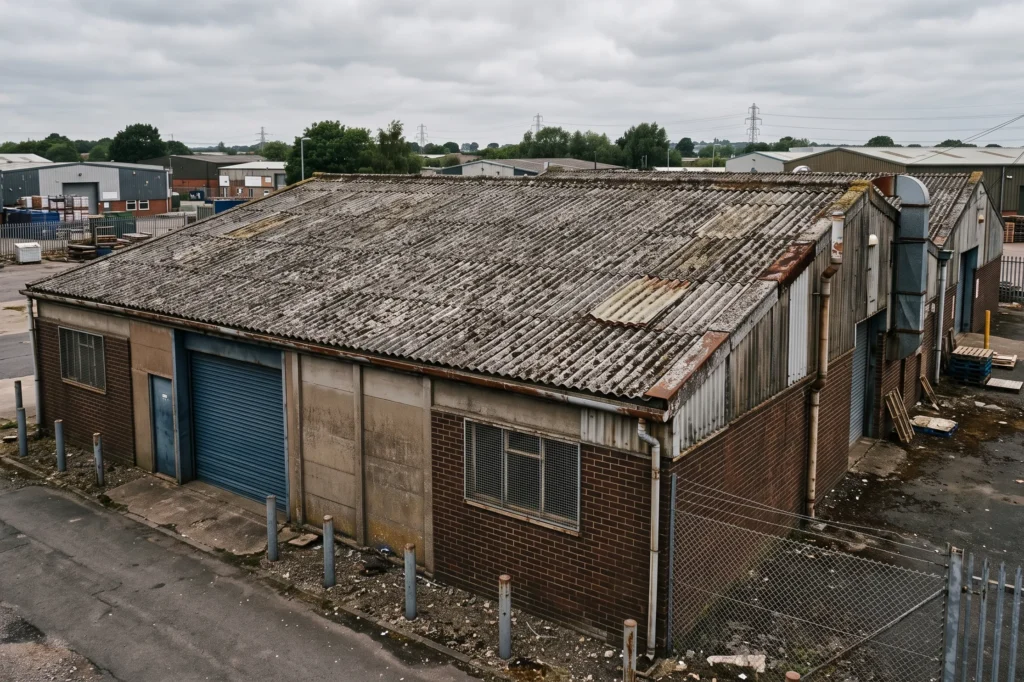
Industrial Asbestos Removal: Cement Roofs and Cladding
Steel-framed industrial units built between 1960 and 1990 rely heavily on corrugated asbestos cement roofs. Forty to sixty years of weather exposure has left much of that fabric brittle. Industrial asbestos removal now sits high on the agenda for owners of ageing commercial premises. The cost of delay is measured in falls, fibre release and enforcement action.
Corrugated cement panels degrade slowly and quietly. They become porous, moss-covered and dangerously fragile underfoot. A single misplaced step can end in a fatal fall through the roof. So how should industrial landlords and owner-occupiers assess roof decay, stay compliant with UK law, and replace failing materials without halting trade?
Key Takeaways
- Asbestos cement roofs installed between 1960 and 1990 turn brittle with age, making fall prevention and fibre containment the priority.
- The Control of Asbestos Regulations 2012 require an accurate register, a formal risk assessment and a written management plan for non-domestic premises.
- An industrial roof survey supplies the technical evidence needed to choose between patch repair, overcladding and full roof replacement.
- Unbroken removal lowers corrugated sheets whole on mechanical hoists, avoiding the fragmentation that drives airborne fibre release across trading premises.
- Phased programmes and out-of-hours working allow site operators to replace an asbestos roof without interrupting warehouse or production activity.
Roof Intervention Options Compared
Choosing a management route for an ageing corrugated asbestos roof depends on material condition, operational risk and whole-life cost. Dutyholders must weigh initial outlay against future liability and structural safety. A cheap repair that preserves a fragile roof rarely represents value once re-inspection and access controls are priced in over the following decade.
The comparison below sets out the three intervention strategies open to commercial property managers. Reading current roof condition against operational demand shows whether containment or full replacement is the sounder regulatory and economic choice. In practice, we find condition scoring settles this question faster than any discussion of headline price alone.
| Intervention Strategy | Operational Risk Level | Regulatory Requirement | Structural Lifespan Impact |
|---|---|---|---|
| Patch and local repair | High, fragility retained | Ongoing HSG264 re-inspection | Short term, one to three years |
| Overcladding system | Moderate, hazard concealed | Building Regulations sign-off | Medium term, ten to fifteen years |
| Full strip and replacement | Low, hazard eliminated | CAR 2012 plan of work and waste consignment | Long term, thirty years plus |

Legacy Roof Infrastructure Across Essex Commercial Parks
Big Six Corrugated Cement Sheets in Industrial Roofing
Corrugated asbestos cement sheet in the Big Six profile dominates industrial roofing from the mid to late twentieth century. Manufacturers bound chrysotile fibres into a Portland cement matrix. The result was cheap, non-combustible and weather-resistant. It covered warehouses, factories and distribution sheds across the country in enormous quantities.
Across Essex, steel-framed warehouses built between 1960 and 1990 still carry their original cement roofs. The A12 and A127 corridors are dense with this stock. Cranes Farm Road, Pipps Hill and Burnt Mills in Basildon carry it, as do Templefields and The Pinnacles in Harlow. The Springwood estate in Braintree follows the same pattern. Most of these roofs have passed their engineered lifespan by a decade or more.
Structural Degradation After Decades of Weather Exposure
After forty to sixty years of exposure, asbestos cement cladding shows severe physical decay. Freeze-thaw cycles, carbonation, acid rain and heavy moss growth break down the cement binder. Sheets turn porous. They delaminate into thin layers. Load-bearing strength falls sharply across the whole roof pitch, often without any obvious warning.
Decay extends well beyond the main slopes. External gutters, downpipes, soffit boards and side wall cladding degrade on the same timeline. Lichen and moss root into surface micro-cracks and hold moisture against the sheet. Trapped water then expands in winter and drives spalling. A durable shell becomes a soft, friable surface that releases fibres when disturbed.
Core Safety Risks and Fragile Roof Hazards
Roof Fall Hazards on Weathered Asbestos Cement Sheets
The dominant physical risk on an ageing cement roof is collapse underfoot. New sheets met their original load specification. Decades of micro-fracturing and matrix erosion have removed that margin entirely. Walking directly on weathered cement causes sudden panel failure. The fall that follows is frequently fatal rather than merely serious.
The Health and Safety Executive treats every asbestos cement roof as fragile, whatever its appearance. Sheets that look sound crack without warning under a point load from a boot or a tool bag. Roof access therefore demands crawling boards, safety netting, edge protection or a fall-arrest system. Nobody should step onto the covering itself. From experience across the sector, most near-misses trace back to a short, unplanned access task.
Airborne Fibre Release from Delaminating Roof Cladding
Delaminating cement panels release fibres continuously rather than in a single dramatic event. The cement binder erodes and exposes chrysotile at the surface. Wind scour, driving rain and structural vibration then dislodge loose fibres. Those fibres travel into the working areas below and settle on stock, plant and floors.
Chrysotile bound in sound cement is tightly held and presents a low risk. Weathered sheeting is different. Mechanical degradation generates respirable dust on the surface and on the underside. Vibration from overhead cranes, fork-lift trucks and production plant shakes that dust loose inside occupied units. It settles on stored goods, floors and ventilation intakes. The exposure is low level and cumulative, which is exactly what makes it easy to ignore.
Did You Know?
The Control of Asbestos Regulations 2012 set a control limit of 0.1 asbestos fibres per cubic centimetre of air, averaged over four hours. A separate short-term limit of 0.6 fibres per cubic centimetre applies to any ten-minute sampling period. Neither figure represents a safe level of exposure.
Regulatory Compliance and Dutyholder Obligations
Statutory Requirements Under Control of Asbestos Regulations 2012
Regulation 4 of the Control of Asbestos Regulations 2012 places a Duty to Manage on every non-domestic property. Landlords, owner-occupiers and managing agents must take reasonable steps to locate asbestos-containing materials. They must assess condition. They must record findings in an accurate asbestos register and then keep it current.
Approved Code of Practice L143 requires a written Asbestos Management Plan. The plan sets out how identified materials are monitored, maintained or removed, and who holds each responsibility. A stale register or an unassessed roof leaves the dutyholder exposed to improvement notices and prosecution. The information must also reach every tradesperson before work starts. Handing over the register is not a courtesy. It is a legal obligation.
Licensed Versus Non-Licensed Removal Boundaries
UK law splits asbestos work into licensed, notifiable non-licensed and non-licensed categories. The split turns on friability and likely exposure. Removal of intact asbestos cement sheeting usually sits within the non-licensed band. That classification holds only where the method prevents breakage, grinding and significant fibre release on site.
Severely degraded cement changes the picture. Crushed sheeting, or cement combined with asbestos insulating board, can push work into licensed territory. Licensed work requires an HSE licence holder, advance notification and, in most cases, a sealed enclosure under negative pressure. In practice, we find the boundary is settled by the refurbishment survey rather than by the programme. Assuming non-licensed status before survey is a common and costly mistake.
Detailed ACM condition checks and regulatory compliance reports.
Strategic Options for Ageing Industrial Roofs
Condition Assessment Frameworks Guided by HSG264 Standards
The right strategy starts with a survey structured around HSE guidance HSG264. A qualified surveyor inspects the roof structure, records material degradation and scores the risk numerically. Two scores emerge from that work. One covers the material itself. The other covers the likelihood of disturbance during normal daily use.
The material assessment weighs product type, surface damage, extent of erosion and fibre matrix integrity. The priority assessment weighs occupant numbers, activity levels, disturbance potential and air movement. Combined, the two scores give an objective ranking across a portfolio. Owners can then sequence works by risk rather than by the lowest quotation. That distinction matters when budgets are tight and several roofs are failing at once.
Patch Repair, Overcladding and Full Replacement Compared
Three routes are open to a commercial owner. Localised patch repair, an overclad system, or a full strip and replacement. Sealing treatments fix minor leaks and buy a season or two. Where erosion is widespread across an ageing unit, full replacement is usually the only durable answer available.
Patch repair leaves brittle sheeting in place. The fragile roof risk persists and re-inspection continues indefinitely. Overcladding fixes light metal profiles over the existing sheets with insulation between the layers. It adds dead load to an ageing steel frame and conceals the hazard rather than removing it. Trapped moisture is a further concern. Full asbestos cement roof replacement removes the liability, lifts thermal performance and improves asset value.
Management, refurbishment, and demolition surveys for all property types.
Technical Workstreams for Controlled Asbestos Sheet Removal
Survey Execution and Safe Lowering Protocols
A refurbishment and demolition survey precedes any unfastening of panels. It confirms the exact extent of asbestos across the pitch, the gutters and the fixings. Operatives then apply wetting agents to suppress surface dust. Fixings are unbolted individually. Sheets come down whole on a scissor lift or crane hoist.
Breaking sheets, or dropping them down a chute, is prohibited under a CAR 2012 plan of work. Operatives wear respiratory protective equipment fitted with P3 filters. Safety netting is slung directly beneath the work bay inside the frame. Lowering panels intact is the single most effective control on the job. It keeps fibre release close to zero and keeps the waste stream clean.
Complex Double-Skin Insulated Roof Assemblies
Double-skin cement roofs complicate the dismantling sequence considerably. The assembly runs outer corrugated cement sheet, a glass-mineral insulation layer, then an inner cement ceiling liner. Each layer behaves differently when disturbed. The inner liner is the real problem, because it sheds directly into the occupied space below.
Removal teams establish internal drop-sheets or sealed polythene enclosures beneath each active bay. Layers come off from the exterior pitch inwards. Loose insulation is vacuumed with industrial HEPA units as the work proceeds. Nothing is allowed to fall free. This sequence prevents cross-contamination of the floors below and keeps the final clearance test straightforward.
Asbestos Removal
Safe, certified removal of asbestos materials in line with HSE guidelines.
Business Continuity During Roof Works
Phased Works and Out-of-Hours Execution Schedules
Trading through a roof replacement is achievable with disciplined planning. Contractors establish isolated overhead working zones so that ground-level logistics continue safely. High-risk stripping is pushed into weekends or night shifts. Internal staff are then absent from the building while the most hazardous tasks are under way.
Phased strip-and-cover divides a large roof into manageable daily bays. A team strips, cleans and re-sheets one bay inside a single working window. The envelope is sealed again before weather arrives. On continuously operating sites, out-of-hours scheduling protects both output and personnel. It costs more per shift. It costs far less than an unplanned shutdown.
Dilapidations Risk Management for Industrial Tenants
Commercial leases push heavy dilapidations liability onto tenants of older industrial units. Failure to maintain cement cladding can trigger a substantial claim at lease expiry. So can unauthorised roof penetrations. An early condition inspection records what was there at the start and clarifies who repairs what later.
Tenants routinely drill cement soffits and wall sheets when installing lighting, heating or extract ventilation. Each penetration risks contaminating the building fabric, and each one is traceable at lease end. Landlords assessing terminal schedules rely on asbestos register records to show how condition has changed. Prompt professional evaluation settles the financial position between leaseholder and freeholder before it becomes a dispute.
Waste Consignment and Re-occupation Clearance
Double-Wrapping Protocols and Hazardous Waste Consignments
Removed cement sheeting and contaminated debris are hazardous waste under UK environmental law. Panels are double-wrapped in 1000-gauge polythene, red inner and clear outer. Every package carries the correct hazard labelling. Wrapped material then goes into a locked skip or an enclosed vehicle for removal from site.
Each movement requires a Hazardous Waste Consignment Note tracking the load from origin to a permitted landfill site. Dutyholders must retain those records for at least three years. The paperwork is not administrative padding. It is the only evidence that material left the site lawfully. Without it, the building owner carries the liability for whatever happened to the waste afterwards.
Four-Stage Clearance Procedures Under HSG248 Guidelines
Re-occupation after enclosed removal work depends on formal clearance under HSE guidance HSG248. An independent analyst carries out that assessment, not the removal contractor. The process runs in four distinct stages. It ends with air sampling and a written certificate confirming the area is fit for normal use.
Stage one reviews the site and the job records. Stage two is a thorough visual inspection, and it is where most failures occur. Stage three is air testing by phase-contrast optical microscopy against a clearance indicator of 0.01 fibres per cubic centimetre. Stage four confirms reinstatement of the area. Only then is a Certificate of Reoccupation issued.
Final Thoughts
Ageing cement roofing demands structured assessment, honest compliance and controlled execution. Timely industrial asbestos removal eliminates the fragile roof hazard, stops progressive fibre release and protects asset value across a commercial portfolio. The work is predictable when it is planned. It becomes expensive and disruptive when it is left to fail.
Dutyholders who inspect on a schedule keep control of both cost and programme. Those who wait for a leak or a fall inherit an emergency instead. Roof stock built in the 1960s and 1970s is now well past its design life, and the decision window is closing.
Submit Enquiry
Frequently Asked Questions
Asbestos cement sheeting installed between 1960 and 1990 was designed for roughly 25 to 40 years of service. Most sheets still in place are now 40 to 60 years old. Carbonation, freeze-thaw cycling and moss growth erode the cement matrix over that period. The sheet becomes porous and brittle. Expect cracking, water ingress and surface fibre release rather than a sudden single failure. Condition, not age alone, should drive the replacement decision.
Yes. Regulation 5 of the Control of Asbestos Regulations 2012 requires the presence of asbestos to be established before work liable to disturb it begins. A refurbishment and demolition survey, structured around HSG264, identifies the type, location and extent of asbestos across roof sheets, gutters, soffits and fixings. Contractors need that information to write a valid plan of work. Starting without it is a straightforward regulatory breach.
Usually, yes. Phased strip-and-cover schedules and out-of-hours working allow ground-floor operations to continue while the roof is replaced above. Internal safety netting, catch decks and drop-sheets isolate each active bay from the space below. High-risk stripping is normally scheduled for weekends or night shifts when staff are off site. The programme takes longer overall, but avoids the cost of closing the unit entirely.
Overcladding fixes new metal sheeting over the existing asbestos cement roof, with insulation sandwiched between the two layers. The asbestos stays in place, concealed. That adds dead load to an ageing steel frame and leaves a fragile material hidden above the workforce. Full replacement strips the cement sheeting out and disposes of it as hazardous waste. It removes the liability permanently, improves roof strength and lifts building value.
Enclosed removal work requires a four-stage clearance carried out by an independent analyst under HSE guidance HSG248. The analyst reviews the job, inspects the area visually, and takes air samples analysed by phase-contrast optical microscopy. Fibre concentrations must fall below the clearance indicator of 0.01 fibres per cubic centimetre. A Certificate of Reoccupation is then issued. Without that certificate the area should stay sealed.

Ora Asbestos Management Ltd
Unit A9, Seedbed Centre,
Shoeburyness, Southend-on-Sea SS3 9QY..
About the Author
Gordon Ringland is the founder, Director and principal asbestos surveyor at Ora. He holds the BOHS P402 qualification — the recognised industry standard for surveying and sampling strategies for asbestos in buildings — awarded by the British Occupational Hygiene Society (BOHS) Faculty of Occupational Hygiene (Certificate No. 20140911-32845-4254).
Gordon has over 12 years of hands-on experience in the asbestos industry, built on more than 20 years working in roofing. He carries out all three main survey types — management surveys, R&D surveys and re-inspections — and designs the sampling strategies used to find asbestos-containing materials (ACMs). He also leads non-licensed asbestos removal projects.
His work spans the full range of buildings, from residential garages and family homes to large commercial sites. Gordon has particular experience in heritage and museum environments, including listed buildings, where careful, fully compliant work matters most. He oversees Ora’s survey work and is the named author of our asbestos guides.