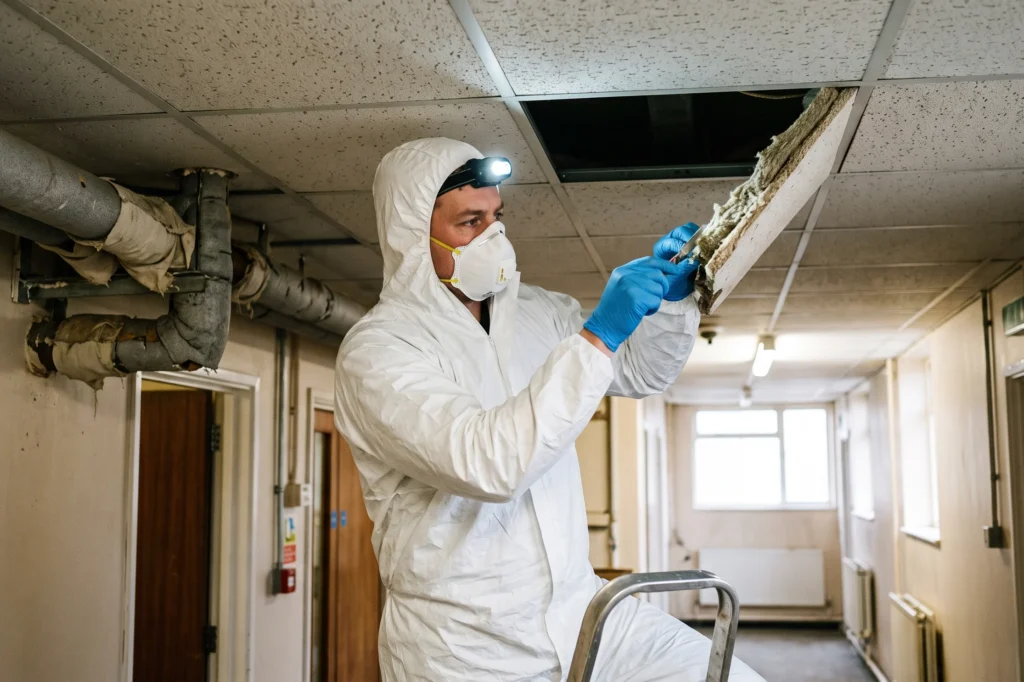
Pre-Acquisition Asbestos Survey: Commercial Buys
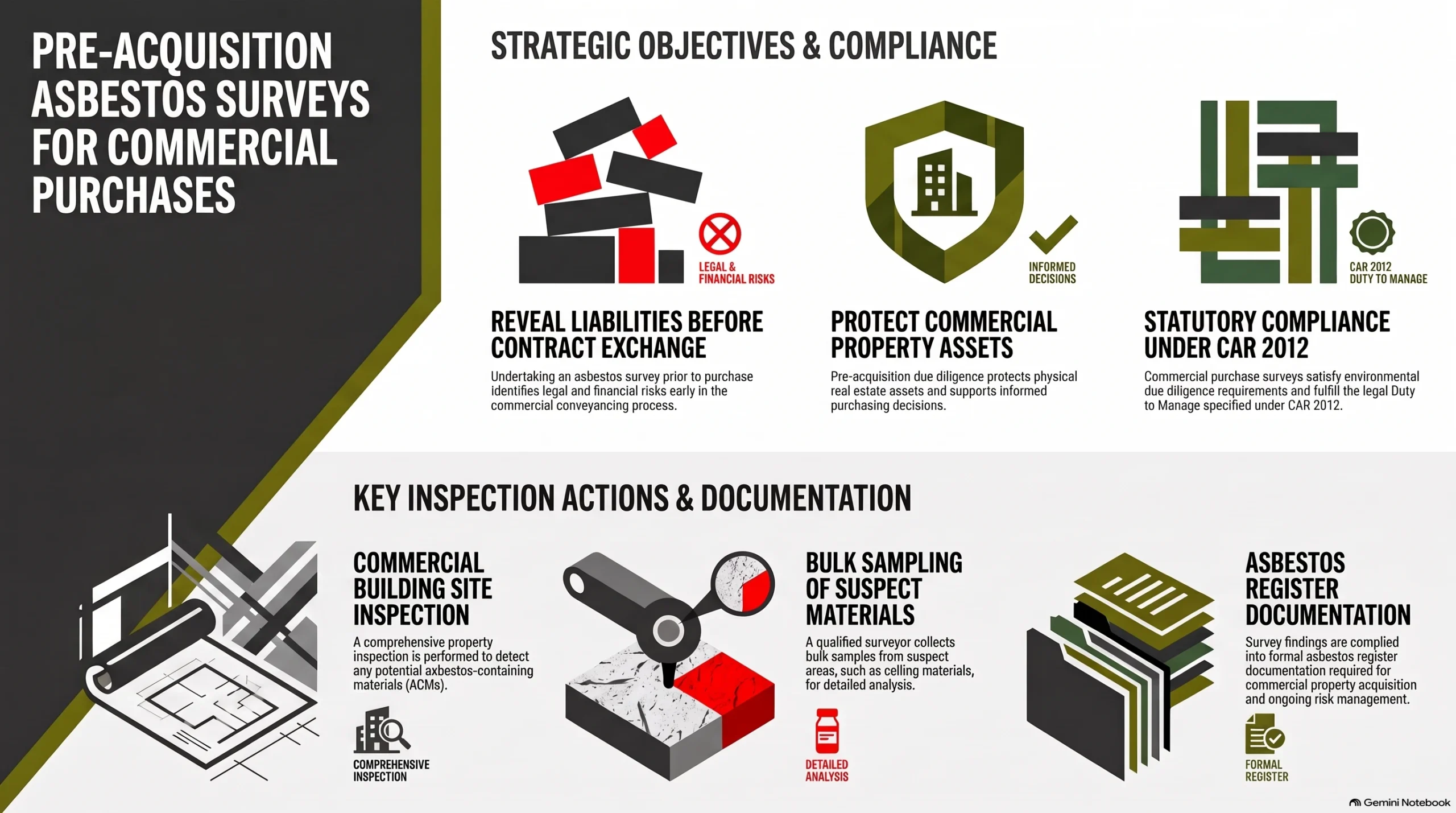
Purchasing commercial property in the United Kingdom requires rigorous technical due diligence to uncover hidden operational and structural liabilities. A comprehensive pre-acquisition asbestos survey shows prospective buyers exactly which hazardous materials exist before contracts complete. Under UK health and safety regulations, legacy construction materials can create substantial unexpected costs if left unidentified. Conducting this targeted inspection early protects capital investment, informs commercial purchase negotiations, and ensures seamless compliance with statutory building standards.
Failing to verify environmental hazards before legal completion risks inheriting substantial removal expenses, immediate regulatory enforcement, and significant business disruption. Commercial buyers often assume existing property records provide complete protection, yet historical records frequently omit alterations or unrecorded materials. How can commercial property investors accurately quantify asbestos liabilities and secure their legal position before final contracts are signed?
Key Takeaways
- A dedicated pre-acquisition survey identifies hazardous materials prior to contractual exchange, protecting commercial purchasers from inherited legal liabilities and unexpected remediation costs.
- Regulation 4 of the Control of Asbestos Regulations 2012 places statutory responsibility on dutyholders to manage all asbestos risks within commercial premises.
- Commercial buyers leverage thorough survey findings during legal negotiations to adjust asset valuations, establish retention funds, or require vendor remediation works.
- Standard building condition reports lack the technical depth required to identify hidden hazardous materials, necessitating an independent inspection aligned with HSG264 guidance.
- Engaging qualified surveyors holding UKAS accreditation ensures defensible asbestos registers, supporting seamless regulatory compliance and protecting ongoing operational asset values.
Commercial Acquisition Survey Comparison
Commercial purchasers must evaluate different inspection scopes to determine statutory liabilities before contract exchange. Whereas general condition reports address macro structural integrity, specialised inspections evaluate specific material risks. The table below compares survey methodologies by inspection depth, legal compliance and commercial purpose.
Selecting an appropriate survey level prevents significant future financial liabilities and project delays. For standard property transfers without immediate structural remodelling, baseline inspections identify manageable hazards. Conversely, properties slated for conversion or extensive refurbishment require intrusive methodologies. These uncover materials embedded within the building fabric prior to completion.
| Survey Type | Inspection Scope | Strategic Purpose |
|---|---|---|
| Management Survey | Readily accessible surfaces and standard maintenance zones | Baseline compliance and ongoing operational management |
| Refurbishment Survey | Destructive access into voids, risers, and structural components | Pre-construction planning and capital expenditure scoping |
| Pre-Acquisition Audit | Targeted sampling and historical documentation review | Transactional risk appraisal and legal price negotiation |
| Re-Inspection Audit | Visual assessment of known materials in the current register | Verification of material condition and vendor compliance |
Dutyholder Responsibilities Under UK Regulations
Statutory Obligations Under Regulation 4
The Control of Asbestos Regulations 2012 defines the duty to manage asbestos in non-domestic premises under Regulation 4. This legal duty requires dutyholders to identify, assess, and manage all asbestos-containing materials. Property purchasers inherit these statutory responsibilities immediately upon completion, exposing new owners to regulatory scrutiny.
The Health and Safety Executive enforces these duties rigorously across Great Britain. A missing asbestos register or inadequate management plan can trigger improvement notices or immediate prohibition notices. Commercial purchasers must review existing documentation during due diligence to ensure the vendor fulfilled their legal duties throughout their tenure.
Transfer of Statutory Liability
Legal ownership transfers all ongoing compliance liabilities directly to the commercial buyer upon completion of the transaction. Without an accurate asbestos survey before purchase, new owners risk inheriting non-compliant buildings with unresolved enforcement actions. Dutyholders must actively maintain up-to-date registers to protect maintenance contractors and building occupants.
Lease agreements frequently distribute maintenance duties between commercial landlords and corporate tenants. Even where institutional leases assign internal repair obligations to tenants, freeholders often retain overarching common-part liabilities. Buyers must scrutinise lease terms alongside technical survey reports to pinpoint precisely where legal liabilities fall across multi-let commercial properties.
Differences Between Survey Methodologies
Standard Management Surveys for Due Diligence
A management survey represents the standard inspection format detailed within Health and Safety Executive guidance HSG264. Surveyors locate, assess, and record accessible asbestos-containing materials that occupants or maintenance staff could disturb during everyday use. This process relies on visual inspection, representative bulk sampling, and reasoned presumption.
Surveyors inspect accessible spaces including service ducts, ceiling spaces, plant rooms, and standard circulation corridors. Where surveyors cannot safely access specific locations without causing structural damage, the report applies a reasoned presumption of asbestos presence. Prospective purchasers use this baseline assessment to understand day-to-day management obligations and future routine monitoring costs.
Targeted Refurbishment and Demolition Inspections
Refurbishment and demolition surveys involve fully intrusive, destructive inspection techniques across all targeted work areas. Surveyors break into structural cavities, sub-floor voids, and solid partitions to uncover deeply embedded hazardous materials. Commercial investors planning post-acquisition redevelopment require this intrusive methodology before starting any physical construction work.
Undertaking intrusive investigations within an occupied building during commercial conveyancing presents significant logistical challenges. Vendors rarely permit destructive sampling prior to exchange whilst current tenants occupy the premises. In such cases, purchasers often negotiate conditional access agreements. Others commission phased management surveys with allowances for later structural investigations.
Did You Know?
The UK banned the last remaining form of asbestos, chrysotile, in November 1999. The Health and Safety Executive advises that any building built or refurbished before 2000 may still contain asbestos. Asbestos-related disease still causes around 5,000 deaths each year in Great Britain.
Financial Exposure and Capital Expenditure Scoping
Hidden Remediation Costs in Commercial Transactions
Undetected asbestos materials introduce substantial financial risks into commercial property transactions through direct abatement costs. Licensed contractors must remove high-risk materials such as sprayed limpet coatings or thermal lagging under strict statutory enclosures. Discovering these hazardous materials post-completion causes significant capital expenditure overruns and unexpected project delays.
Abatement expenses encompass far more than physical removal charges alone. Projects require independent air monitoring, four-stage clearance testing, hazardous waste disposal tariffs, and structural reinstatement. Quantifying these costs before exchange lets investors model real asset yields and set adequate financial reserves.
Commercial Lease Dilapidations and Liabilities
Commercial landlords frequently face complicated dilapidations claims when outgoing corporate tenants leave altered premises in poor repair. Incoming purchasers must establish whether existing tenants disturbed asbestos-containing materials without statutory clearance or approved plans of work. A commercial purchase survey establishes an indisputable baseline for terminal dilapidations and repair claims.
Institutional leases often stipulate that tenants must yield up properties in full statutory compliance. An outgoing tenant may have damaged asbestos insulation board when installing partitions. Others lay flooring over degraded bitumen adhesives, making remediation a priority. Purchasers armed with precise survey data can compel vendors to enforce repair covenants prior to completion.
Detailed ACM condition checks and regulatory compliance reports.
Technical Survey Execution and Methodologies
Systematic Zone Inspection Protocols
HSG264 guidance requires surveyors to execute systematic, zone-by-zone inspections across every individual level, wing, and room. Surveyors cross-reference architectural drawings with on-site observations, logging construction types, surface finishes, and historical modifications. This methodical protocol ensures complete spatial coverage and eliminates omissions across complex commercial floorplates.
Survey teams systematically log suspect materials on electronic capture devices, noting product composition, surface degradation, and maintenance accessibility. High-risk zones such as lift motor rooms, boiler houses, and basement service tunnels receive meticulous scrutiny. Each suspect item receives a photographic record and unique identifier linked directly to the draft asbestos register.
Bulk Sampling Protocols and Laboratory Verification
Accurate identification of suspect materials requires representative bulk sampling executed under controlled hygiene procedures. Competent surveyors minimise airborne fibre release by applying water suppressants and using personal protective equipment. They seal extracted samples in double-labelled polythene bags and dispatch them directly to accredited testing facilities.
Testing laboratories must hold accreditation to ISO/IEC 17025 from the United Kingdom Accreditation Service. Analysts utilise polarised light microscopy and dispersion staining techniques to confirm specific fibre types, including chrysotile, amosite, or crocidolite. Independent laboratory verification ensures that material risk ratings rest on defensible scientific analysis rather than unverified visual presumptions.
Management, refurbishment, and demolition surveys for all property types.
Transactional Strategy and Price Negotiation
Survey Data as Negotiation Leverage
Concrete survey findings provide commercial purchasers with substantial commercial leverage during contract negotiations. Documented evidence of deteriorated asbestos materials allows prospective buyers to justify price reductions reflecting true remediation costs. Alternatively, purchasers may request formal price retentions to fund necessary abatement works following legal completion.
Vendors seeking smooth transactions generally prefer price adjustments over executing complex remediation contracts themselves prior to sale. Armed with a formal pre-acquisition asbestos survey, commercial buyers can present detailed, costed quotes from licensed abatement contractors. This factual transparency transforms speculative arguments into objective valuation adjustments grounded in regulatory reality.
Contractual Warranties and Indemnities
Commercial property solicitors utilise technical survey data to draft targeted environmental indemnities and contractual warranties. Standard commercial property pre-contract enquiries frequently yield vague responses regarding historical building alterations. Precise survey findings enable legal teams to draft specific covenants protecting purchasers from historic contamination claims.
When a survey identifies restricted access zones that could harbour concealed materials, legal advisers insert specific disclosure qualifications. Contracts can include deferred consideration clauses or vendor indemnity agreements that trigger if subsequent intrusive works expose unrecorded licensed materials. This contractual integration ensures that technical surveying findings directly inform corporate risk transfer mechanisms.
Asbestos Removal
Safe, certified removal of asbestos materials in line with HSE guidelines.
Integration into Post-Completion Asset Management
The Statutory Asbestos Management Plan After Completion
Following property acquisition, the new dutyholder must transform raw survey findings into an active Asbestos Management Plan. Regulation 4 mandates that this written document outline specific control measures, assign organisational responsibilities, and set strict monitoring schedules. The plan ensures that building occupants and visiting maintenance trades remain protected.
The management plan must incorporate a dynamic register detailing the location, condition, and risk score of all retained materials. Dutyholders must establish operational protocols ensuring that external contractors review the register before executing minor works. Clear warning labels and access permit systems prevent accidental disturbance during routine repairs and service installations.
Annual Re-Inspection and Register Updates
Statutory compliance requires dutyholders to review and update their commercial asbestos registers at regular intervals. Best practice dictates inspecting all known materials at least once every twelve months to assess physical degradation. Any changes in surface condition, tenant usage, or occupancy patterns demand an immediate register revision.
Re-inspections confirm whether encapsulated materials remain intact or whether surface sealants require reapplication. If maintenance personnel notice damage or progressive deterioration, the dutyholder must commission immediate remedial intervention or licensed removal. Maintaining this audit trail protects property owners against statutory enforcement and preserves overall asset value.
Surveyor Competence and Procurement Assurance
UKAS Accreditation and ISO Standards
Procuring competent surveying services demands rigorous verification of corporate and individual credentials. The Health and Safety Executive strongly recommends commissioning inspection bodies accredited to ISO/IEC 17020 by the United Kingdom Accreditation Service. UKAS accreditation demonstrates technical competence, operational impartiality, and adherence to rigid quality assurance frameworks.
Technical standard RG 8 outlines specific quality criteria that accredited inspection bodies must maintain during site inspections. These requirements include peer reviews of final reports, desktop audits of sample densities, and regular field audits of active surveyors. Selecting an accredited firm guarantees that the resulting documentation withstands legal and institutional scrutiny.
Individual Qualifications and Technical Proficiency
Qualified surveyors should hold recognised professional certifications such as the British Occupational Hygiene Society P402 credential. In addition to theoretical knowledge, competent professionals possess extensive practical experience evaluating various commercial construction types. This practical acumen ensures accurate identification of unusual or obscure asbestos-containing materials across diverse commercial premises.
Surveyors must understand the structural characteristics of system-built structures, 1960s office blocks, and post-war industrial facilities. Familiarity with typical building practices helps specialists identify high-risk installations. Composite floor tiles and concealed fire-stopping boards are common examples that inexperienced inspectors overlook. Thorough surveyor vetting safeguards the overall integrity of the acquisition process.
Final Thoughts
Commissioning a thorough pre-acquisition asbestos survey provides essential clarity when purchasing UK commercial property. By identifying hazardous materials and quantifying removal costs, commercial buyers safeguard their balance sheets. The survey also establishes baseline compliance with Regulation 4. Thorough upfront investigations replace transactional uncertainty with verified technical data, facilitating informed asset valuations and successful contract negotiations.
Regulators continue to enforce dutyholder responsibilities strictly. Proactive environmental due diligence therefore remains a non-negotiable part of commercial property investment. Early technical engagement ensures that future capital works, maintenance operations, and tenancy arrangements proceed safely and without unexpected regulatory intervention.
Submit Enquiry
Frequently Asked Questions
Conveyancing law does not strictly mandate a survey before purchase. However, the Control of Asbestos Regulations 2012 impose a statutory duty to manage on whoever controls maintenance after completion. Under Regulation 4, new owners become legally responsible for managing known or presumed materials. Relying on outdated vendor information exposes buyers to enforcement action. A dedicated survey represents essential due diligence to quantify statutory liabilities before completing the transaction.
A management survey locates materials that occupants or maintenance staff could disturb during normal occupancy and routine repair works, utilising non-destructive inspection techniques. In contrast, a refurbishment and demolition survey is fully intrusive. It accesses hidden voids, structural risers and cavity walls before building works begin. Commercial buyers intending to carry out significant redevelopments post-purchase require an intrusive survey to establish capital costs and comply with construction safety regulations.
Yes, documented survey findings provide legitimate commercial justification to renegotiate purchase terms before contractual exchange. The survey may uncover materials requiring licensed removal, repair or ongoing encapsulation. The purchaser can then present fully costed estimates to the vendor. Buyers frequently negotiate price reductions or formal cash retentions. Some require the seller to complete approved remediation works under regulated conditions before completion.
Appoint surveying organisations holding UKAS accreditation to ISO/IEC 17020, as recommended by HSE guidance HSG264. This accreditation proves organisational independence, rigorous quality management, and technical competence. Individual surveyors should also hold recognised certifications, such as the British Occupational Hygiene Society P402 award. Practical experience inspecting commercial and industrial building types matters equally. Ask to see sample reports and confirm the laboratory holds UKAS accreditation to ISO/IEC 17025.
If unrecorded asbestos comes to light after completion, the new dutyholder assumes full legal and financial responsibility under Regulation 4. The owner must immediately assess the risk, update the asbestos register, and implement appropriate control measures or arrange licensed removal. If the discovery halts planned works, the owner faces project delays and unbudgeted remediation costs. Recourse against the seller is usually limited unless the contract includes specific warranties or indemnities.

Ora Asbestos Management Ltd
Unit A9, Seedbed Centre,
Shoeburyness, Southend-on-Sea SS3 9QY..
About the Author
Gordon Ringland is the founder, Director and principal asbestos surveyor at Ora. He holds the BOHS P402 qualification — the recognised industry standard for surveying and sampling strategies for asbestos in buildings — awarded by the British Occupational Hygiene Society (BOHS) Faculty of Occupational Hygiene (Certificate No. 20140911-32845-4254).
Gordon has over 12 years of hands-on experience in the asbestos industry, built on more than 20 years working in roofing. He carries out all three main survey types — management surveys, R&D surveys and re-inspections — and designs the sampling strategies used to find asbestos-containing materials (ACMs). He also leads non-licensed asbestos removal projects.
His work spans the full range of buildings, from residential garages and family homes to large commercial sites. Gordon has particular experience in heritage and museum environments, including listed buildings, where careful, fully compliant work matters most. He oversees Ora’s survey work and is the named author of our asbestos guides.