Asbestos Abatement and Removal: The UK Process
Property managers and building owners often search for asbestos abatement when hazardous materials surface during refurbishment. The term belongs to North American practice. UK health and safety law uses a different vocabulary, set by the Control of Asbestos Regulations 2012. Knowing how the two align protects occupants, workers and your legal position.
The decision itself is rarely obvious. Must the material be stripped out, sealed in place, or simply monitored under a written plan? Which route keeps a dutyholder compliant with CAR 2012?
Key Takeaways
- UK law controls asbestos through removal, encapsulation and ongoing management, rather than the North American term abatement.
- Leaving sound, undamaged asbestos containing materials in place under a written management plan is a lawful and often safer option.
- Pipe lagging, loose insulation and asbestos insulating board require an HSE-licensed contractor working inside a fully sealed enclosure.
- Regulation 7 requires a written Plan of Work covering equipment, control measures, decontamination and respiratory protective equipment before mobilisation.
- Re-occupation after licensed work needs a four-stage clearance, with air tests confirming fibre levels below 0.01 fibres per cubic centimetre.
UK Asbestos Work Categories and Contractor Requirements
UK law sorts asbestos work into statutory tiers. The tier depends on material friability, condition and the likely release of fibres. Each tier carries its own contractor requirements, notification duties and clearance expectations. Dutyholders who identify the right tier early appoint the right contractor and avoid enforcement action under CAR 2012.
The correct route also depends on the physical condition of the material and the scope of planned building works. A sound ceiling tile in an occupied office needs different handling from the same tile facing demolition. The table below sets out the four control categories, typical materials, and the licensing position for each.
| Control Category | Typical Materials | Contractor and Regulatory Position |
|---|---|---|
| Licensed Removal | Sprayed coatings, thermal pipe lagging, loose fill insulation, asbestos insulating board | HSE-licensed contractor, sealed enclosure, negative pressure units, four-stage clearance |
| Notifiable Non-Licensed Work | Large asbestos cement projects, sanded textured coatings, minor work on damaged board | Trained operatives, notification to the enforcing authority, exposure records, health surveillance |
| Non-Licensed Work | Asbestos cement sheets, thermoplastic floor tiles, undamaged textured coatings | Asbestos Essentials training, basic engineering controls, local dust suppression |
| Management in Place | Undamaged asbestos insulating board, sound cement, intact floor tiles | Regulation 4 duty to manage, written management plan, register and re-inspection |

UK Regulatory Terminology and the Control Hierarchy
Transatlantic Terminology Differences
Asbestos abatement is a North American term. UK legislation does not use it. The Control of Asbestos Regulations 2012 speaks instead of removal, encapsulation and management. Approved Code of Practice L143 sets the control hierarchy. Dutyholders must eliminate the material where reasonably practicable, then fall back on containment or engineering controls.
In practice, we find overseas terminology causes real confusion on UK sites. A client asking for abatement may need three different responses. Some materials must come out under license. Others are sealed and recorded. Many are left undisturbed and inspected. Translation the request into the correct statutory category is the first job on any survey.
Sound Materials Left in Place
Leaving undamaged asbestos containing materials in place is often the correct legal decision. Regulation 4 of CAR 2012 places a duty to manage on the dutyholder. That duty means continuous monitoring of condition, not automatic removal. Sound, undisturbed material presents no active hazard to occupants or maintenance staff.
Removing sound material releases fibres for no benefit. Where the material is in good condition and unlikely to be disturbed, retention is lawful and safer. Regulation 4 also requires an accurate asbestos register. That register records the location, type, condition and risk score of every identified material. Re-inspection intervals follow the risk score, and annually as a minimum in most buildings.
The Statutory Boundaries of Asbestos Work
High-Risk Licensed Removal Work
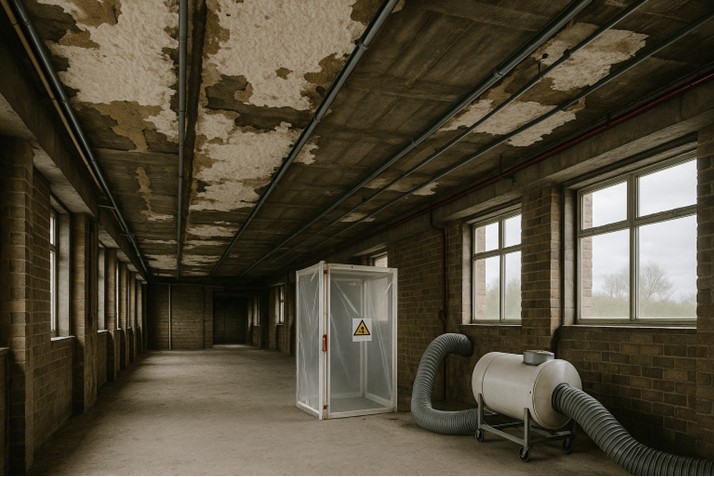
Sprayed coatings, loose fill insulation, thermal pipe lagging and asbestos insulating board sit at the top of the risk scale. Work on these friable materials demands an HSE-licensed contractor. The site needs a sealed polythene enclosure, negative pressure units, decontamination facilities and continuous air testing throughout the works.
Regulations 6 and 8 of CAR 2012 restrict this work to license holders. The Health and Safety Executive issues those licences and inspects the holders. Enclosures are kept under negative pressure so air flows inward. Decontamination units attach directly to the enclosure. Air monitoring runs throughout to confirm containment, not merely at the end.
Non-Licensed and Notifiable Categories
Non-licensed work covers short-duration tasks on lower-risk materials. Asbestos cement sheets, undamaged textured coatings and vinyl floor tiles fall here. Notifiable non-licensed work sits between the two extremes. It requires site notification to the enforcing authority, exposure records for each operative, and health surveillance under CAR 2012.
HSG210, Asbestos Essentials, sets out the engineering controls for lower-risk tasks. Degraded material changes the picture. Minor maintenance on asbestos insulating board usually falls into notifiable non-licensed work. Employers must notify the enforcing authority before work starts. Personal exposure records must be kept for 40 years from last exposure, and operatives receive medical examinations.
Did You Know?
Under Regulation 22 of the Control of Asbestos Regulations 2012, employers must keep personal exposure records and health surveillance files for operatives carrying out licensed or notifiable non-licensed asbestos work. Those records must be retained for at least 40 years from the date of last exposure.
Legal Requirements for Plans of Work
Mandatory Contents under Regulation 7
Regulation 7 of CAR 2012 bars any asbestos work without a written Plan of Work. The plan must state the scope of operations and the equipment in use. It must set out control measures, personal protective equipment and emergency spill protocols. Site layout diagrams complete the document before mobilisation.
A compliant Plan of Work is a binding method statement, not a formality. It names the exact location, the nature of the task and the expected duration. It lists engineering controls, negative pressure calculations, waste routes and respiratory protective equipment. Procedures for unexpected fibre release and power failure must appear in full. Enforcement officers read this document first.
Site Integration and Dutyholder Sign-Off
The Plan of Work must stay accessible on site for the whole project. Every operative receives a documented briefing on its contents before work begins. Dutyholders review and approve the method statement in advance. Under the Construction Design and Management Regulations 2015, the plan feeds into the wider pre-construction information.
From experience across the sector, sign-off is where projects slip. A principal designer must confirm that the proposed controls match site safety rules. Access routes, isolation of services and occupied areas all need agreement in writing. CDM 2015 makes this coordination a legal duty rather than good practice. Clients who skip the review inherit the risk.
Detailed ACM condition checks and regulatory compliance reports.
Enclosure Construction and Air Management Systems
Enclosure Build and Differential Pressure
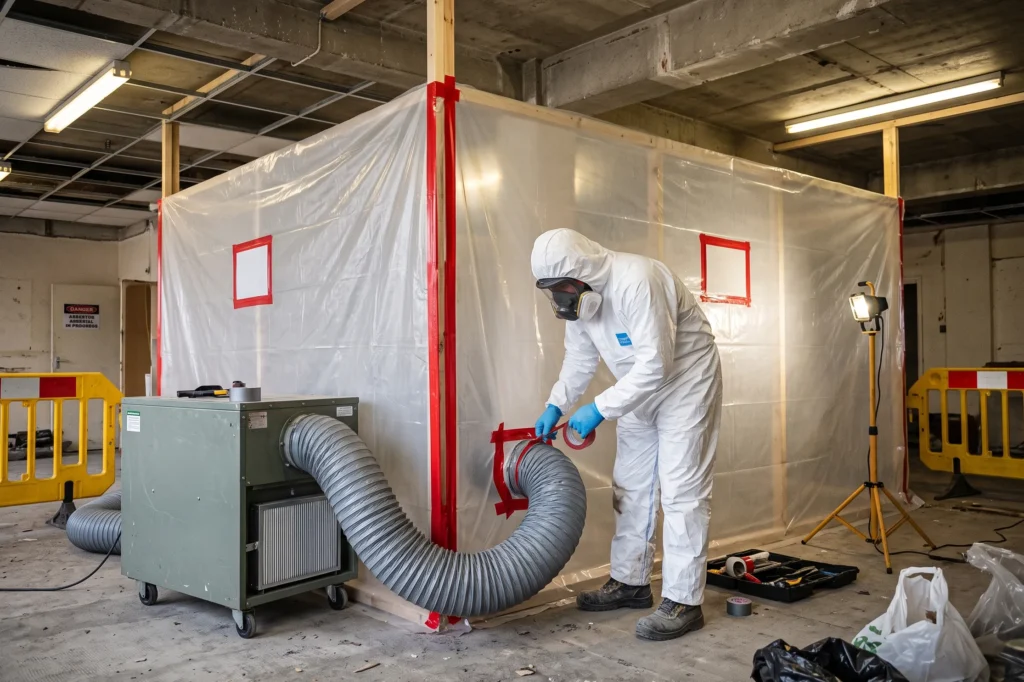
Licensed removal enclosures use heavy-duty 1000 g/m² polythene sheeting on sealed timber or modular frames. Negative pressure units hold a differential pressure of 0.05 to 0.15 mbar. Extraction must deliver at least eight air changes per hour. All extracted air vents through HEPA filtration to protect the surrounding environment.
Containment depends on the quality of the seal. Operatives tape joints with specialist low-permeability tape and smoke-test the enclosure before stripping starts. Negative pressure units fitted with H13 HEPA filters run continuously. Differential pressure gauges record enclosure stability across the shift. Designated inlets draw clean air inward, so any leak pulls air in rather than pushing fibres out.
Decontamination and Respiratory Protection
Operatives inside a full enclosure pass through a three-stage decontamination unit. The unit comprises a clean end, a shower and a dirty end. Respiratory protective equipment follows the risk assessment for the task. Powered full-face respirators to EN 12942 Class TM3, fitted with P3 filters, are standard for friable removal.
Face-fit testing is not optional. Operatives must be clean-shaven and pass a quantitative fit test for the mask they wear. Entry and exit run exclusively through the decontamination unit. Operatives shower between work periods to remove surface fibres. Transit routes between the unit and the enclosure are sealed, because contaminated coveralls must never cross open ground.
Management, refurbishment, and demolition surveys for all property types.
The Four-Stage Clearance Process
Stage One and Stage Two Inspections
Four-stage clearance is carried out by an independent, UKAS-accredited analyst. Stage 1 is a preliminary check on the site condition and job completeness. The analyst confirms the enclosure is intact and negative pressure is working. Stage 2 is a thorough visual inspection of every internal surface within the work area.
Stage 2 is where most failures ocuur. The analyst searches for residual dust, debris and unstripped material under high-powered task lighting. Ledges, cable trays and floor junctions receive particular attention. Surfaces are cleaned with H-class HEPA vacuums and wet wiping until the analyst is satisfied. No air test proceeds until the visual inspection passes.
Stage Three Air Monitoring and Final Sign-Off
Stage 3 measures airborne fibre concentration inside the cleaned enclosure. Air pumps draw a measured volume through membrane filters at set positions. The analyst counts fibres by phase-contrast optical microscopy under HSG248. Counts must fall below 0.01 fibres per cubic centimetre before the enclosure can be dismantled.
Stage 4 follows dismantling. The analyst re-inspects the area and the surrounding space for debris left by the strip-out. Only then is a Certificate of Reoccupation issued. That certificate is the document a dutyholder keeps as evidence of safe handover. In practice, we find clients should never accept a verbal clearance.
Asbestos Removal
Safe, certified removal of asbestos materials in line with HSE guidelines.
Asbestos Waste Handling and Legal Transport
Packaging and On-Site Segregation
Asbestos waste is segregated at the point of origin, inside the work area. Small items are double-bagged in heavy-duty polythene. Red inner bags carry the statutory asbestos warning text, and clear outer bags seal the package. Larger items are wrapped in 1000 g/m² sheeting and taped closed.
Poor waste discipline undoes an otherwise clean job. Bags leave the enclosure through the bag lock, never through the personnel route. Sharp edges from cement sheet or pipe sections tear polythene, so wrapping must be doubled where needed. Waste is stored in a locked, labelled skip or vehicle until collection. Loose fragments in a site yard are a common enforcement finding.
Consignment Notes and Permitted Landfill Disposal
Hazardous asbestos waste may only be moved by a registered waste carrier. The carrier must hold a valid Environment Agency registration. Every movement travels with a hazardous waste consignment note recording the waste code, volume, producer and carrier. The load must reach a landfill permitted to receive asbestos.
The Hazardous Waste Regulations impose a documented chain of custody. Dutyholders retain consignment notes for a minimum of three years. Those notes are the only proof that waste reached a permitted site. Where a contractor cannot produce them, the liability returns to the waste producer. Ask for the notes at handover, not months later.
Surveys and Modern Asset Management
Survey Methodologies under HSG264
HSG264 sets the survey frameworks used across commercial and domestic property. A management survey locates accessible materials that routine occupation might disturb. A refurbishment and demolition survey is intrusive and destructive by design. It opens wall cavities, floor voids and risers to find hidden asbestos before works begin.
Commissioning the wrong survey is a costly error. A management survey handed to a demolition contractor gives false comfort. Hidden lagging behind a riser panel will stop a programme dead. Order a refurbishment and demolition survey whenever the fabric will be opened up. The cost is trivial against a project shutdown and an HSE investigation.
Digital Registers and Regional Compliance
An asbestos register must reflect the current location and condition of every identified material. Digital registers make that easier to keep accurate. Entries change whenever material is removed, encapsulated, damaged or re-inspected. Based in Great Wakering near Southend-on-Sea, we work across Essex, London and the wider South East.
Building stock differs sharply by area and age. Post-war system-built estates carry widespread asbestos insulating board in ceilings, panels and soffits. Victorian commercial conversions hide legacy thermal lagging in basements and ducts. A register that reflects the actual building, rather than a generic template, protects maintenance staff and demonstrates compliance to an inspector.
Final Thoughts
Asbestos abatement is a useful search term, but it is not a UK legal category. The law asks a narrower question. Should the material be removed, encapsulated, or managed in place under a written plan? Answering that correctly controls the health risk and satisfies CAR 2012.
Keep the register current, commission the right survey before opening up the fabric, and hold contractors to the Plan of Work. Retain clearance certificates and consignment notes. Those records are what an inspector asks for first.
Submit Enquiry
Frequently Asked Questions
Abatement is a North American umbrella term. It covers removal, encapsulation and repair together. UK law does not use it. The Control of Asbestos Regulations 2012 refers to removal, encapsulation and management as separate routes. UK practice also follows a control hierarchy. Sound, undamaged asbestos containing materials are usually left in place under a monitored management plan. Removal becomes the required route when refurbishment or demolition will disturb the material, or when its condition has clearly deteriorated.
A licence is required for work on high-risk, friable materials. These include sprayed asbestos coatings, loose fill insulation, thermal pipe lagging and asbestos insulating board where exposure risk is significant. Licensed work needs trained operatives, a sealed polythene enclosure under negative pressure, continuous air monitoring and a three-stage decontamination unit. Before anyone re-enters, an independent UKAS-accredited analyst must complete the four-stage clearance and issue a Certificate of Reoccupation. Carrying out licensable work without a licence is a criminal offence.
Yes. Regulation 4 of CAR 2012 makes management in place a lawful option. Where material is in good condition and unlikely to be disturbed during normal occupation or maintenance, removal creates unnecessary exposure. The dutyholder must record the material in an asbestos register with its location, type, condition and risk score. A written management plan then sets out how the material is monitored, who is told about it, and how often it is re-inspected.
Regulation 7 requires a written plan before any asbestos work starts. It must set out the scope, the removal or remediation method, and the engineering controls in use. Negative pressure calculations, personal protective equipment and respiratory protective equipment specifications all belong in the document. So do site layout diagrams, waste routes, decontamination arrangements and operative training records. Emergency procedures for unexpected fibre release or equipment failure must be written out. The plan stays on site for the duration.
Waste is segregated at source and double-bagged, or wrapped in 1000 g/m² polythene sheeting for larger items. Red inner bags carry the statutory asbestos warning label and clear outer bags seal the package. Only a carrier registered with the Environment Agency may transport the load, and it must go to a landfill permitted to receive asbestos. Every movement travels with a hazardous waste consignment note. Dutyholders retain those notes for at least three years as proof of compliant disposal.

Ora Asbestos Management Ltd
Unit A9, Seedbed Centre,
Shoeburyness, Southend-on-Sea SS3 9QY..
About the Author
Gordon Ringland is the founder, Director and principal asbestos surveyor at Ora. He holds the BOHS P402 qualification — the recognised industry standard for surveying and sampling strategies for asbestos in buildings — awarded by the British Occupational Hygiene Society (BOHS) Faculty of Occupational Hygiene (Certificate No. 20140911-32845-4254).
Gordon has over 12 years of hands-on experience in the asbestos industry, built on more than 20 years working in roofing. He carries out all three main survey types — management surveys, R&D surveys and re-inspections — and designs the sampling strategies used to find asbestos-containing materials (ACMs). He also leads non-licensed asbestos removal projects.
His work spans the full range of buildings, from residential garages and family homes to large commercial sites. Gordon has particular experience in heritage and museum environments, including listed buildings, where careful, fully compliant work matters most. He oversees Ora’s survey work and is the named author of our asbestos guides.